
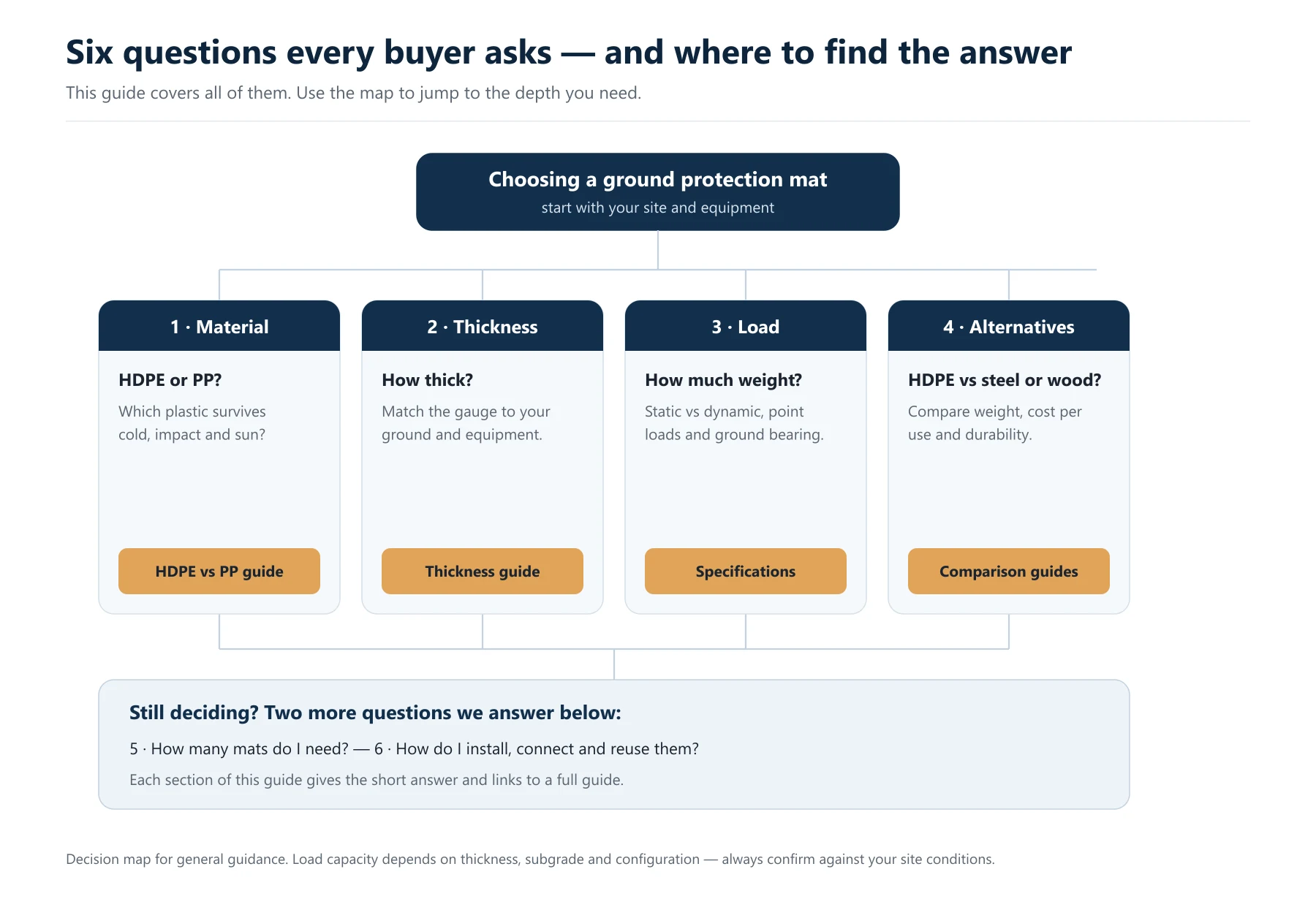
If you are new to ground protection mats, this is the page to start on. A mat is a simple-looking product, but choosing the right one means balancing material, thickness, load, ground conditions, quantity and how you will install and reuse it. Get one variable wrong and a mat can fail early or cost more than it should. This guide walks through every decision, gives you the short answer up front, and links to a dedicated in-depth guide wherever you need more detail. It is written from the perspective of a source factory that moulds these mats every day.
1. What a ground protection mat is — and how it actually works
The short answer: a ground protection mat is a large, flat panel laid over soft or sensitive ground to spread a load and let vehicles, equipment or people pass without sinking, rutting or damaging the surface.
The physics is simple. A wheel, track or outrigger concentrates weight onto a small area. On wet clay, turf or sand that pressure exceeds what the soil can carry, so the ground deforms. A mat sits between the load and the soil and spreads that force across a much larger footprint. Two things follow from this, and they explain almost every specification decision later in this guide:
- Area matters as much as strength. A bigger bearing footprint protects weak ground better than a merely thicker panel. This is why layout and overlap matter.
- The ground sets the limit, not just the mat. The same mat performs very differently on firm gravel than on saturated clay. Any honest capacity statement has to name the ground condition it assumes.
Mats are used as temporary access roads, work platforms, crane and outrigger pads, event flooring, and turf or lawn protection. If you want to see the range of settings, the HDPE ground protection mats product page and the application pages cover construction, utilities, oil and gas, mining, events, landscaping and wind farms.
2. Why HDPE is the standard material
The short answer: for a heavy-duty outdoor mat, high-density polyethylene (HDPE) is the default choice because it combines impact toughness, cold-weather flexibility, near-zero water absorption and weatherability at a reasonable weight.
HDPE is a grade of the polyethylene (PE) family — the densest and toughest of the common grades. It is not the same thing as “PE” in general: an order that only says “PE” leaves the most important variable undefined. Compared with polypropylene (PP), HDPE stays tough near freezing where PP turns brittle, and it absorbs impact better. PP is stiffer and more heat-resistant, which suits welded tanks and ducts but matters far less for a mat that must flex slightly over uneven ground.
Three practical consequences for a buyer:
- It will not rot, swell or delaminate when wet, and pressure-washes clean between jobs.
- It keeps its toughness in cold weather — a real advantage for year-round sites.
- It does not corrode or leave rust stains the way steel does, and it is non-magnetic.
Two more properties are worth knowing because they come up in real projects. HDPE has very low water absorption — effectively negligible for practical purposes — which is why a wet mat does not swell, soften or lose shape the way an untreated wood product does. It is also resistant to a wide range of chemicals, so spills on an industrial or agricultural site do not break the panel down. And because it is non-conductive and non-magnetic, it is widely used on utility and electrical work where a steel plate would be unacceptable.
One limitation deserves an honest mention: HDPE is stiffer in cold than in warm conditions and does expand and contract with temperature, though far less than many materials. This is a design consideration for permanently laid surfaces, not usually a problem for temporary mats. As with any polymer, exact behaviour depends on the resin grade and additive package — a UV-stabilised grade is the right choice for long-term outdoor exposure.
For the full material reasoning, typical property values and where PP or LDPE still make sense, read the HDPE vs PP material guide. Exact dimensions, formats and weights are on the specifications page.
3. The four main types of mat
The short answer: mats group into heavy-duty, light-duty, interlocking and custom-format types. Pick by load and ground first, then by how you will join them.
- Heavy-duty mats are the thick panels used under plant, trucks and cranes on weak ground. See heavy-duty ground protection mats.
- Light-duty and pedestrian mats protect turf, grass and finished surfaces from foot traffic and light vehicles. See light-duty and pedestrian mats.
- Interlocking mats use shaped edges or connectors to build a continuous surface that resists separation under movement. See interlocking ground protection mats and mat connectors.
- Custom-size mats are made to non-standard dimensions when a site layout or handling limit calls for it. See custom size mats.
Most buyers end up with a mix: a heavy core route, lighter mats for walkways, and connectors to tie the system together. Rental companies in particular often stock several types so they can match a mat to very different jobs from the same fleet. If your needs change between projects, it is worth thinking about which panels will see repeat use and which are better hired for a single job — a decision covered in the renting-versus-buying section below.
One detail worth checking before you commit: whether the mats you are comparing use the same connector system. A mat is rarely used alone, and a system with reliable, readily available connectors is worth more than a slightly cheaper panel with a proprietary or fragile fixing. The type decision and the thickness decision are closely linked, which leads to the next section.
4. How to choose the right thickness
The short answer: thickness follows the worst combination of equipment weight and ground softness you expect — when in doubt, go thicker on soft ground rather than thinner on the assumption the mat is “strong enough”.
Six standard thicknesses cover almost all jobs: 12.7, 20, 30, 40, 50 and 60 mm. As a broad guide, 12.7–20 mm suits pedestrians and light vehicles on firm ground; 30–40 mm handles excavators and heavier plant on softer ground; and 50–60 mm is for very heavy equipment, outriggers and weak subgrades. The table below gives the standard sizes and weights at a glance.
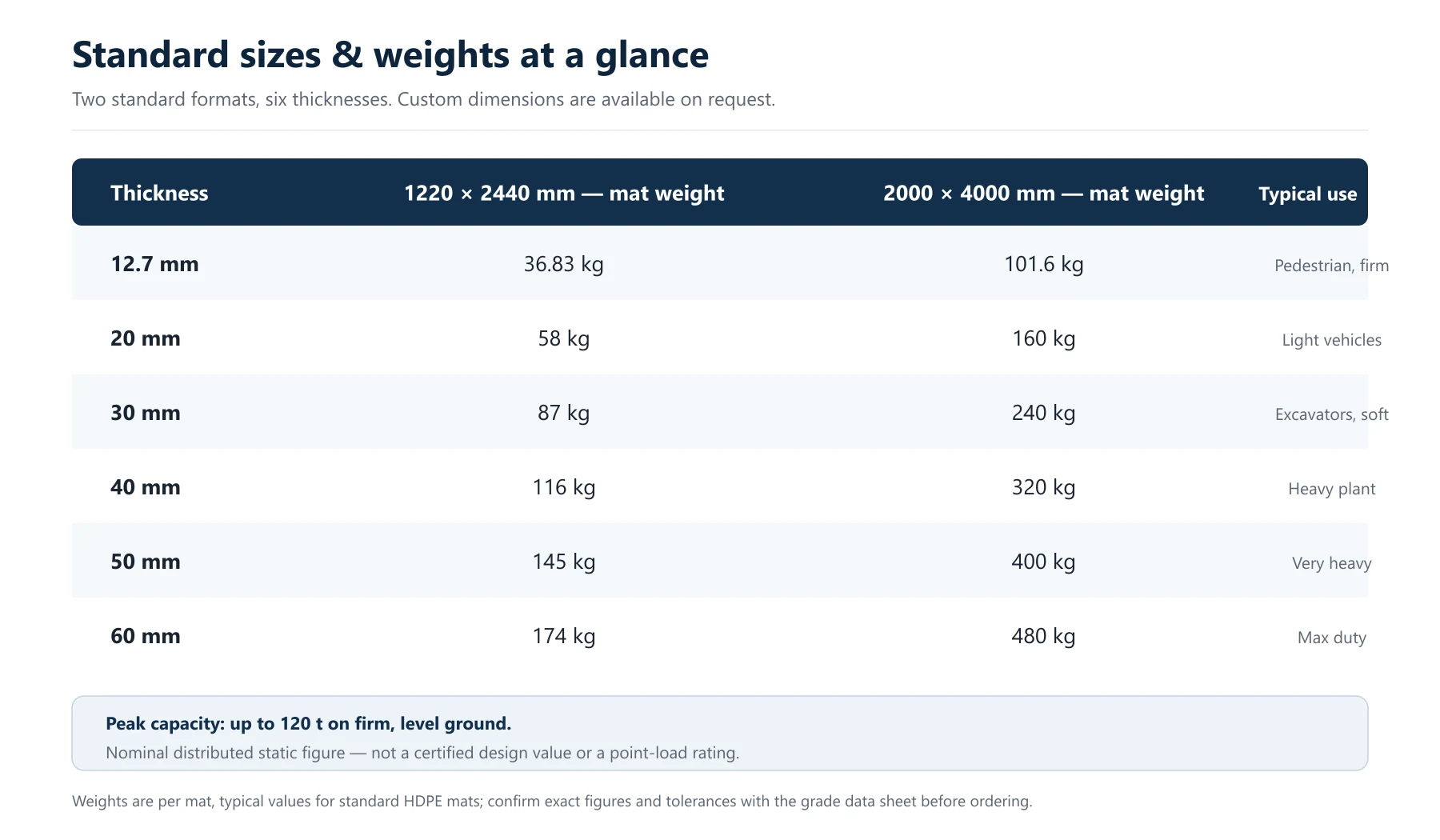
Two standard panel formats cover most orders: 1220 × 2440 mm and 2000 × 4000 mm. In the 1220 × 2440 mm format, weights run from 36.83 kg at 12.7 mm up to 174 kg at 60 mm; the larger 2000 × 4000 mm panel runs from 101.6 kg to 480 kg across the same six gauges. The smaller panel is a genuine two-person lift at moderate thickness, which matters where there is no lifting equipment on site. For a decision table that maps thickness to ground condition and equipment type, see the thickness selection guide. For the full data set, see mat specifications.
5. Understanding load capacity
The short answer: load capacity is not one number — it depends on the mat, the ground beneath it and how the load is applied. Always ask which ground condition a rating assumes.
Four terms cause most of the confusion:
- Static vs dynamic load. A stationary crane applies a steady load; a moving vehicle adds impact. Moving loads are more demanding.
- Point vs distributed load. An outrigger foot concentrates force on a tiny area; a tracked excavator spreads it. Point loads are the hard case.
- Ground bearing capacity. Soft clay or saturated ground fails long before a firm subgrade. The mat can only spread load; the soil still has to carry it.
- Safety margin. Sensible specifiers add margin above the calculated minimum for uneven loading and ground variation.
Our own careful reference is that the top specification reaches up to 120 t on firm, level ground. That is a nominal distributed static figure, not a certified design value and not a point-load rating — real capacity must be checked against the site’s ground assessment. Any supplier who quotes a single load number without naming the ground condition is telling you less than you need to know.
A practical way to think about a difficult site is to work backwards from the soil. Find the allowable bearing pressure of the ground from a site assessment, work out how much area the equipment’s load must be spread over to stay under that pressure, then choose a mat thickness and layout that provides that footprint. On very soft ground the required area often exceeds what one layer of mats can provide, and the answer is a larger format, multiple layers, or dedicated cribbing under point loads — not simply a thicker panel. Turning movements concentrate load at the edges, so joints and overlap matter as much as the panel itself.
For crane and outrigger applications in particular, where point loads dominate, see the crane and outrigger pads page and the thickness guide.
6. HDPE versus steel, timber and plywood
The short answer: HDPE wins on weight, corrosion resistance, water behaviour and reuse; steel and thick timber still win in a few specific high-point-load or on-site-repair situations.
Compared with steel plates, an HDPE mat is a small fraction of the weight, will not rust, and is far easier to move and clean — but a thick steel plate tolerates extreme point loads and abrasion that destroy plastic. Compared with thick timber or bog mats, HDPE does not absorb water, rot or splinter, and cleans far more easily; timber can still be repaired on site and remains competitive for certain very heavy, long-duration placements. Plywood is a lighter, cheaper short-term option that wears out much faster.
Each comparison has its own full guide, with the honest cases where the alternative still wins:
7. How the mats are made — and why it matters
The short answer: quality heavy-duty mats are compression-moulded from HDPE resin in one dense piece, with the traction pattern and connection features formed during moulding rather than added later.
The manufacturing route explains most of the performance differences buyers notice. Compression moulding produces a uniform panel with no glued layers or weak planes to delaminate. The diamond traction texture is moulded into both faces, and edge features and connection holes are formed or machined as part of the process. A layered or poorly fused mat, by contrast, can split under repeated wet/dry cycling and heavy traffic.
Understanding the process helps you ask better supplier questions — what resin grade, what moulding pressure, what quality control on thickness and weight. The full eight-stage walkthrough, from raw resin to finished panel, is in the how HDPE ground mats are made guide, and more about us is on the about page.
8. Installing and connecting mats
The short answer: prepare and level the ground, orient the traction surface correctly, stagger the joints, and lock the mats together so they act as one continuous surface.
Good installation is what turns a stack of panels into a safe working surface. Inspect the ground for hidden voids and soft spots, level and compact where needed, then lay the mats in a staggered pattern so the joints do not line up into a continuous seam. Use connectors to stop panels separating under turning or braking forces, and always observe the rated load for the actual ground condition. On sloped or wet sites, pay extra attention to sideways movement.
Step-by-step layout, orientation and safety practice are covered in how to install ground protection mats; the hardware options are explained on the ground mat connectors page.
9. How many mats do you need?
The short answer: work from the area to be covered, divide by the area of one mat, then add allowance for overlaps, bends, passing places and a few spares.
A rough starting point: measure the length and width of the route or work area, note the panel format you plan to use, and calculate the base count from the total area. Then adjust for reality — a 100 m access road is rarely a straight, flat strip. Allow extra for turns, wider passing points, overlap at the joints and the inevitable damaged panel. It is better to plan a small contingency than to run short mid-project.
Because the right count depends on your exact layout, the fastest route is to send us your dimensions and equipment: contact us with your site plan and we will help you size the order. The buying guide also covers quantity planning.
10. Renting versus buying
The short answer: rent for a one-off job with uncertain future use; buy when you expect to reuse the same mats regularly and can store and maintain them.
Hiring suits a single project, changing specifications, or limited storage. Buying suits repeat work, gives you control over condition and availability, and builds an asset with resale value. A fair comparison uses the same jobs and the same period on both sides: rental charges plus delivery, collection and handling, versus purchase price plus transport, storage, inspection and maintenance, less any realistic resale. Do not compare a weekly hire rate directly with a purchase price — they answer different questions.
The rental fleets page looks at ownership from a fleet perspective, and the cost and ROI guide sets out the ownership cost framework in more detail.
11. Cleaning, care and reuse
The short answer: shake or wash off mud, inspect for damage, stack flat out of direct sun, and keep connectors together — good care is what makes cost per use fall with every redeployment.
One of HDPE’s main advantages is that it comes back for another job. A mat that survives repeated lifting, stacking and redeployment spreads its purchase cost over many uses. Pressure-wash with cold water, avoid dragging panels over sharp edges, inspect around connection holes and edges, and store mats flat on a pallet or stillage. Keeping the mats clean also keeps the working surface safe — mud and ice reduce traction.
Reuse is the key to the economics: see the cost and ROI guide for how reuse drives cost per use, and the installation guide for inspection and handling practice.
12. How to write your RFQ
The short answer: a usable enquiries states ground condition, equipment and loads, desired panel size and thickness, quantity, and delivery location — not just “send me a price”.
The more precise your enquiry, the faster you get a usable quotation. At minimum, tell a supplier:
- Ground condition — firm, soft, clay, sand, turf, wet or frozen, and any slope.
- Equipment and loads — vehicle or machine type, weights, and whether loads are static or moving, distributed or point loads.
- Panel format — standard size or custom dimensions, and preferred thickness.
- Quantity and layout — area to cover, route shape, and whether you need connectors.
- Logistics — delivery location and any handling constraints on site.
Specifying the material properly matters too: name HDPE and the grade, not just “plastic” or “PE”. The buying guide and specifications page give checklists you can copy, and you can send your RFQ directly to our team.
13. Frequently asked questions
What is a ground protection mat used for?
It spreads load over soft or sensitive ground to create temporary access roads, work platforms, crane pads, event flooring and turf protection. The product page shows the main applications.
How thick should my mat be?
It depends on equipment weight and ground softness. Light duty on firm ground can use 12.7–20 mm; heavier plant on soft ground needs 30–60 mm. See the thickness selection guide.
How much weight can an HDPE mat hold?
It depends on thickness, ground condition and how the load is applied. Our top specification reaches up to 120 t on firm, level ground — a nominal distributed static figure, not a point-load rating. See the specifications and outrigger pads pages.
Are HDPE mats better than steel plates?
They are much lighter, will not rust and are easier to handle and clean. Steel still wins for extreme point loads and heavy abrasion. The full trade-off is in HDPE vs steel plates.
Are HDPE mats better than wooden or bog mats?
HDPE does not absorb water, rot or splinter, and is easier to clean and reuse. Thick timber can be repaired on site and still suits some very heavy placements. See HDPE vs timber mats.
How do I connect mats together?
Use the moulded connection points with the appropriate metal clips or interlocking edges so the panels act as one surface. See ground mat connectors.
How many mats will my project need?
Divide the area to cover by the area of one mat, then add allowance for overlap, turns, passing places and spares. Send us your layout for an exact count.
Is HDPE safe to use around utilities?
HDPE is non-conductive and non-magnetic, which is why it is common on utility and electrical work. Confirm any site-specific requirements with the utility operator.
Ready to specify your mats?
Tell us your ground condition, equipment and area — we will recommend a thickness, format and quantity and send a quotation. As the source factory, we can also discuss custom sizes and your branding.
Request a quote · See full specifications · Read the buying guide