
Temporary Access Roads: How to Design, Size and Build a Reusable HDPE Haul Road
For a continuously trafficked temporary access road, start with 20 mm HDPE panels on a prepared subgrade, specify a single lane at least 2,440 mm (8 ft) wide, stagger joints by half a panel, and connect every panel. Thickness is the second lever, not the first: on weak ground, geotextile separation, drainage and load spreading will do more for reliability than moving to a thicker panel. A permanent road, a void or ditch crossing, sustained steel-track traffic and a crane outrigger position are outside the scope of a standard mat road — see the limits below.
This page is about the road as a system — panels, connectors, subgrade, width, turns and reinstatement — rather than the panel as a product. If you are comparing the boards themselves, see our 4×8 ft ground protection mats and standard specifications.
What a temporary access road made from HDPE mats actually is
A mat road is a removable load-spreading layer, not a pavement. Each 1,220 × 2,440 mm HDPE panel covers 2.98 m² (32 sq ft) and transfers wheel loads into the soil over a larger footprint than the tyre contact patch. Connected edge to edge, the panels form a continuous running surface that distributes braking and turning forces across joints instead of concentrating them at a single board.
Four components decide whether the road works:
- The subgrade. Its bearing capacity, moisture content and uniformity set the ceiling for everything above it.
- The separation layer. A geotextile between soil and panel prevents fine soil pumping up into the joints and stops aggregate or mud from contaminating the running surface.
- The panel field. Thickness, tread orientation and joint pattern determine stiffness and how much the board deflects between supported areas.
- The connections. Eight connector holes and four hand holes per panel allow the field to act as a linked mat rather than 250 loose boards. Connector types and when to use each are covered separately.
Typical traffic on this kind of road includes 30–40 t rigid tippers and concrete trucks, rubber-tracked excavators up to roughly 25 t, telehandlers, and service vehicles. The design case should always be the heaviest axle load at the worst ground condition, not the average vehicle on a dry day.
A useful distinction for specification documents: temporary access mats describes the product; a temporary access road describes the engineered arrangement. Tenders often conflate the two and then omit the subgrade, the turns and the staging area from the bill of quantities — which is where cost overruns start.
When to use a mat road — and when not to
| Condition | Suitable | Notes |
|---|---|---|
| Project duration | 2 weeks to ~18 months | Beyond this, a permanent or semi-permanent road is usually cheaper per use |
| Traffic | Repeated daily passes by rubber-tyred plant; rubber-tracked machines | Count passes, not just vehicles |
| Ground | Firm granular soil to soft clay, provided it can be drained and separated | Saturated soil needs derating and a geotextile — separate guidance planned at /ground-mats-on-soft-ground/ |
| Gradient | Gentle, substantially level running surface | Steep grades increase braking shear at the joints |
| Reinstatement | Site must be returned to original condition | Panels leave no aggregate to remove |
| Access constraint | Narrow easements, farmland, turf, remote sites | Panels can be placed and recovered with a telehandler |
Do not use a standard HDPE mat road when:
- The road must bridge a void, trench, culvert or ditch. Panels are load spreaders, not beams; they are not temporary bridges.
- Sustained steel-track traffic is expected — sharp grousers cut and abrade HDPE. Composite, timber or steel solutions should be evaluated instead.
- The position is a crane outrigger or critical lift pad. A point load is a different engineering problem; separate guidance planned at
/crane-and-outrigger-pads/. - The subgrade is deep, unbounded soft silt or peat with no bearing layer. Mats will migrate; ground improvement or timber bog mats come first.
- The road is permanent, carries public traffic, or must meet a highway or ADA-compliant public-access specification without further assessment.
Stating these limits costs a sale occasionally. It also prevents the failure that costs a project a week of downtime — and it is the first thing an experienced site engineer checks for when judging whether a supplier understands the job.
How to design and build it: width, panel count and a 7-step sequence
Road width and layout
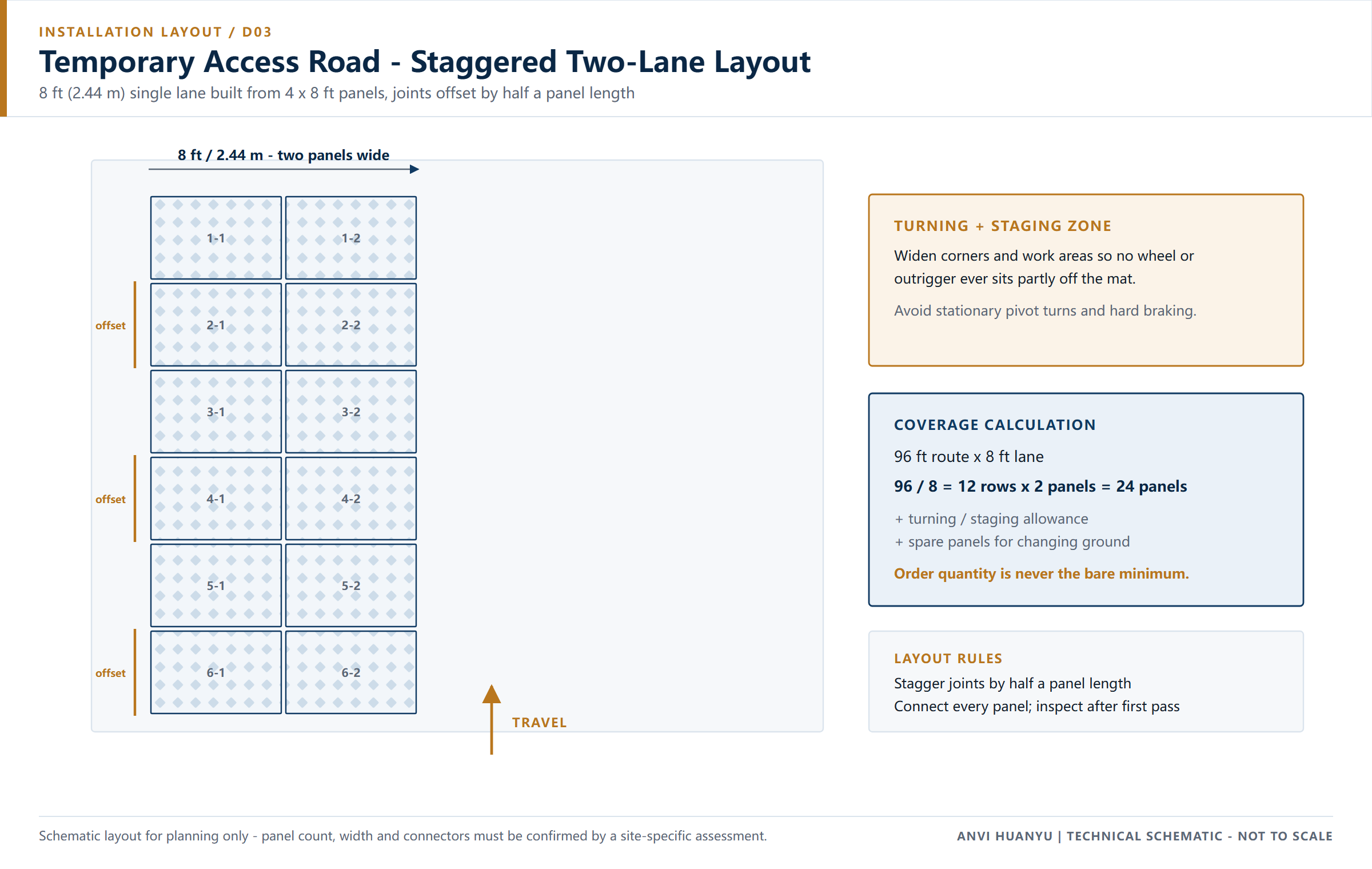
A 1,220 × 2,440 mm panel laid with its 2,440 mm edge across the direction of travel gives an 8 ft single lane. That is the practical minimum for one-way plant movement. Two-way traffic needs 16–20 ft, and bends need an extra panel width on the outside of the turn because the rear wheels of a rigid vehicle track inside the front wheels. Add a 12–15 m passing or staging bay wherever deliveries queue.
Worked example: 300 m single-lane road
This is an illustrative quantity take-off, not a design value. Substitute your own route length and layout.
| Step | Calculation | Result |
|---|---|---|
| Single-lane width | One panel across, 2,440 mm edge | 2.44 m |
| Coverage per panel along the route | 1,220 mm = 1.22 m | 1.22 m/panel |
| Straight run | 300 m ÷ 1.22 m | 246 panels |
| Staggered joints | Half-panel offset on alternating rows; no change to total count | 246 |
| Row ends | Use 610 × 2,440 mm panels (a listed size) rather than cutting on site | ~12 half-width panels |
| Turning head, passing bay, staging | +15–20% allowance | +37–49 |
| Order quantity | 246 + ~45 | ≈ 291 panels |
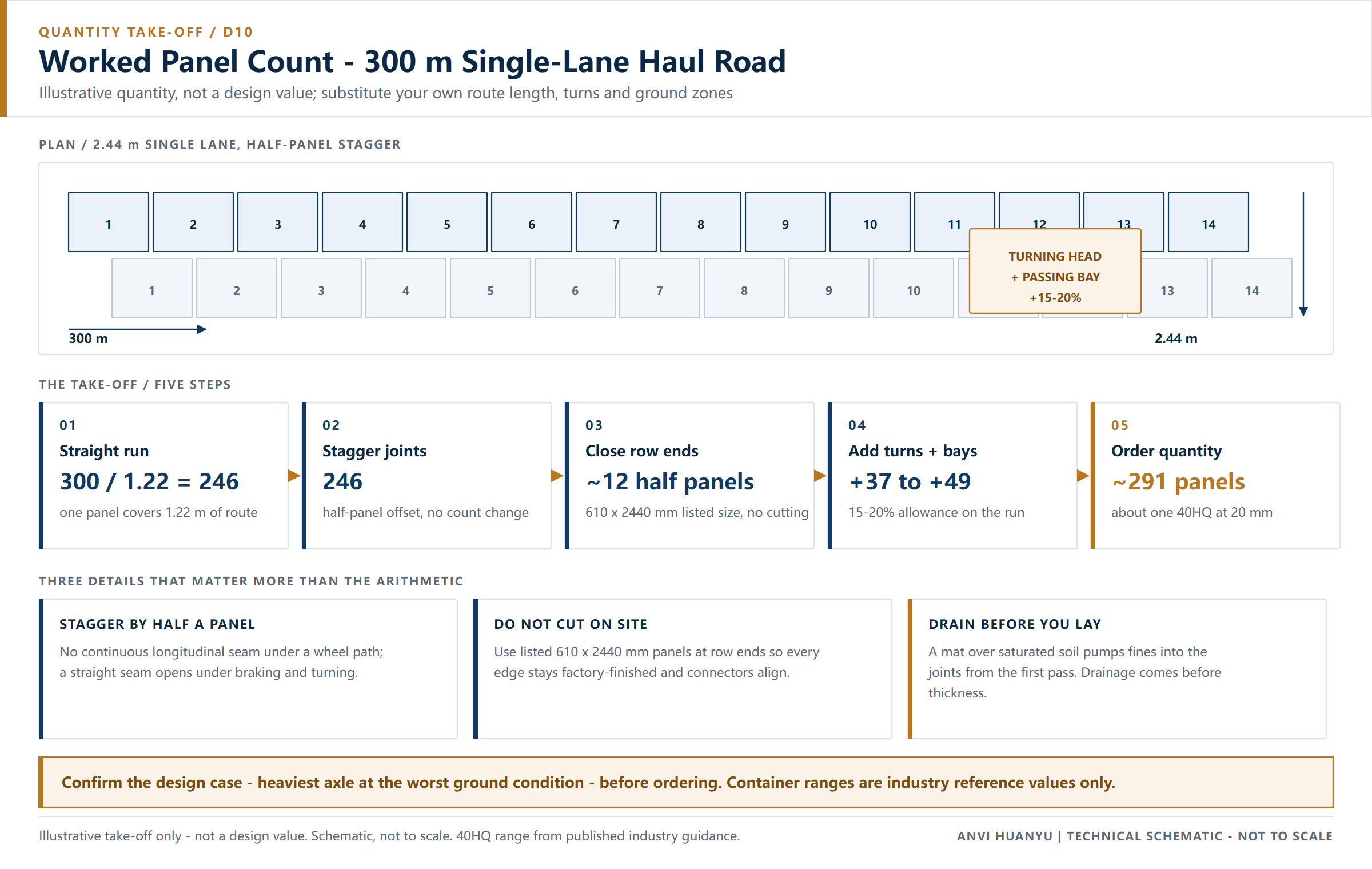
Two details in that table matter more than the arithmetic. First, stagger the joints by half a panel so that no continuous longitudinal seam lines up with a wheel path; a straight seam opens under braking and turning. Second, avoid field cutting: our custom and listed sizes include 610 × 2,440 mm panels, which close alternating rows cleanly and keep every edge factory-finished.
As a logistics cross-check, published industry guidance puts a 40 ft high-cube container at roughly 300–350 panels at 20 mm and only 200–250 at 30 mm (industry reference range, to be confirmed against actual stack height and packing method). A 300 m single lane is therefore approximately one container at 20 mm.
The 7-step sequence
- Walk the route and divide it into ground zones. Mark soft spots, standing water, crossing services and the transition onto firm ground.
- Drain before you lay. Cut intercept drains or pump standing water. A mat over saturated soil without drainage pumps fines into the joints from the first pass.
- Roll out geotextile with adequate overlap. Select the grade for the soil, not from a standard shopping list; overlap seams generously and anchor against wind.
- Start on firm ground and work outward. Build from the competent edge so the first panels always have support; never place a panel so it spans a hollow.
- Stagger, orient the tread, and connect every panel. Vehicle tread face up on haul lanes; use the connection system appropriate to the expected movement.
- Run one laden vehicle at walking pace, then re-inspect. Check for edge settlement, joint opening and panel migration before opening the road to full traffic.
- Recover, wash, and store flat. Lift from firm ground backwards, clean off soil and vegetation, and stack flat and supported to avoid long-term creep.
A more detailed lifting, handling and recovery procedure is in how to install ground protection mats.
What it saves: a cost comparison you can audit
The honest comparison is not “mats versus nothing”; it is mats versus a crushed-stone haul road over the whole project life.
For the same 300 m × 2.44 m route, a 300 mm compacted aggregate layer requires roughly 220 m³ of stone (300 × 2.44 × 0.30), about 350 t at a typical loose density of 1.6 t/m³, or 14–18 lorry deliveries at 20–25 t each. That is before grading, compaction, dust or mud control, track-out cleaning on public roads, and — the item most often forgotten — excavating, removing and disposing of the stone and restoring the ground at the end of the project. A mat road requires no aggregate, no disposal, and leaves the subgrade intact.
Use this framework with your own rates rather than a supplier’s headline price:
Cost per use = (delivered cost + handling + deployment labour + cleaning + storage
+ losses + reinstatement) ÷ number of deployments| Factor | Crushed-stone road | Reusable HDPE mat road |
|---|---|---|
| Material movements | 14–18 lorry loads (worked example) | ~1 container, then site handling |
| Reinstatement | Excavate, remove, dispose, restore | Lift, wash, store |
| Reuse on next site | None | Panels redeploy; strongest where a fleet moves between sites |
| Weather sensitivity | Degrades after rain; rutting and mud | Surface stays intact; subgrade still governs |
| Failure cost | Regrade and re-deliver stone | Re-lay affected panels after inspection |
The break-even point depends almost entirely on how many times the same panels are redeployed. Our cost and ROI guide sets out the calculation; for a single short project, hiring may beat buying.
Why this mat — not a lighter panel or another material
| Option | Where it fits on a haul road | Why we would not choose it here |
|---|---|---|
| 12.7 mm HDPE | Pedestrian routes, turf protection, finished-surface protection | Under repeated heavy axles the board deflects, joints work loose and edges can lift; the saving is spent on re-laying |
| 15 mm HDPE | Mixed light plant on firm subgrade, short-duration works | Acceptable for a site entrance, marginal for continuous laden traffic on variable ground |
| 20 mm HDPE (recommended) | Continuous haul road, repeated dynamic loading, braking and turning | The practical ceiling for standard panels — see the derating note below |
| 25–30 mm+ HDPE / composite | Engineered heavy-lift or extreme soft-ground cases | Heavier to handle, fewer panels per container (industry range 200–250 at 30 mm), higher freight per panel; does not fix a bad subgrade |
| Plywood / timber bog mats | Very soft ground, one-off heavy access | Absorbs water, adds weight, can break and can transfer seed or contaminants between sites |
| Steel plates | Short, very high point loads | Needs lifting plant, corrodes, conductive, high recovery cost; see HDPE vs steel mats |
Two questions buyers actually ask, answered plainly:
- Why not the cheaper, thinner board? Because on a haul road the cost is not the panel, it is the interruption. A working joint under a braking 40 t truck is a far more expensive event than the price difference between 12.7 and 20 mm.
- Why not simply the thickest board? Beyond 20 mm, panel weight, manual handling and container utilisation deteriorate, and the extra stiffness still will not compensate for an unprepared subgrade. Spend the first unit of budget on drainage and geotextile.
The four hand holes and eight connector holes are not decorative on a road: linked panels resist the horizontal forces that push individual boards apart on bends. Panel-to-panel compatibility across batches also matters — a mixed-thickness field does not sit flat.
Why 20 mm is our starting specification for continuous traffic
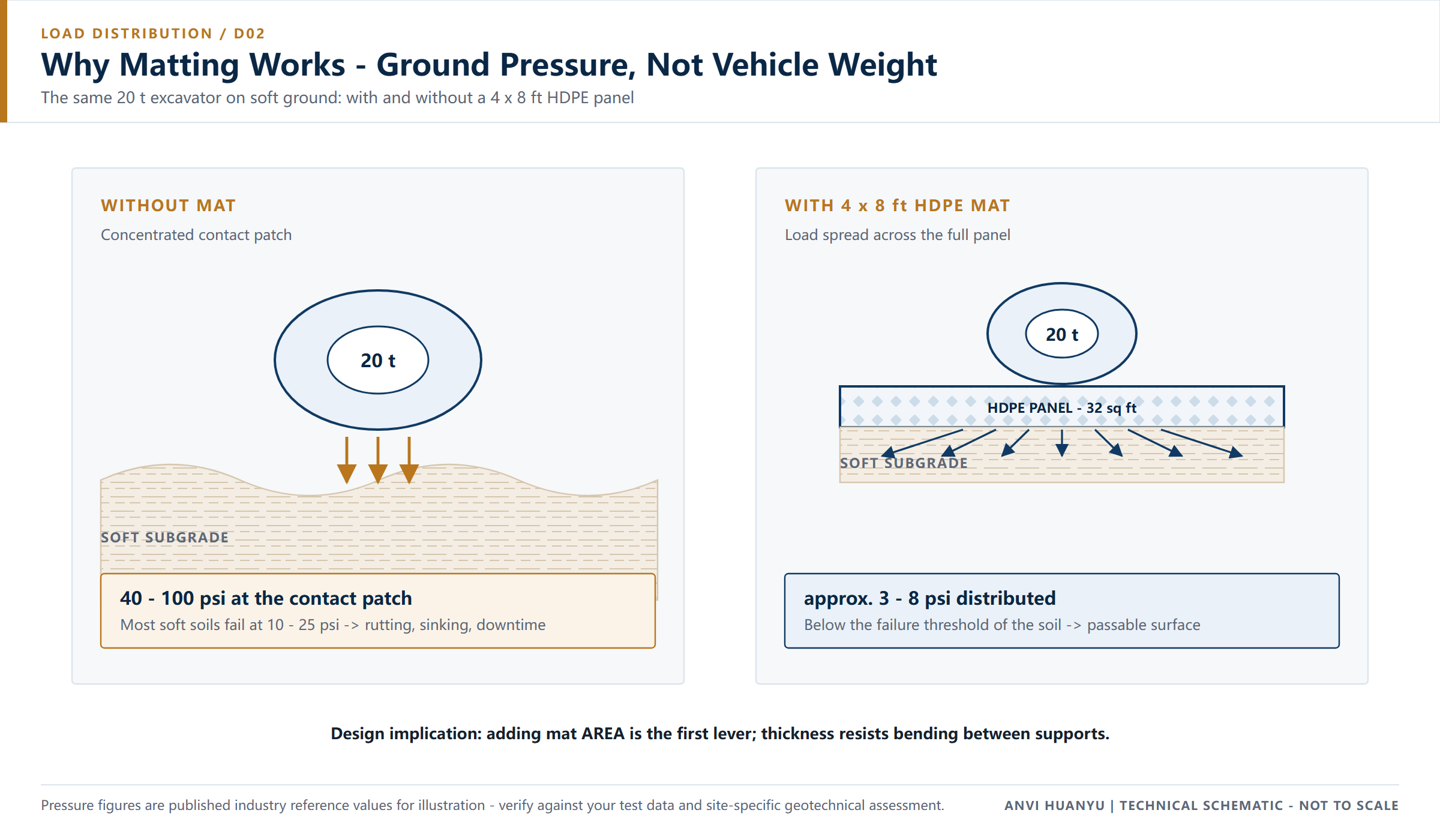
Work the selection chain in order. The figures below are an illustrative engineering check, not a certified design value.
| Step | What to establish | Illustrative check |
|---|---|---|
| 1 | Heaviest vehicle and its axle group | 40 t rigid tipper, rear axle group ≈ 26 t (assumed for this example) |
| 2 | Tyre contact pressure | High at the patch; the panel’s job is to spread it |
| 3 | Ideal spread over one panel | 26,000 kg × 9.81 ÷ 2.98 m² ≈ 86 kPa if the whole board acted as a rigid plate |
| 4 | Real effective area | HDPE deflects between supports, so use a reduced effective area — at 60%, ≈ 143 kPa |
| 5 | Subgrade allowance | Dry compacted granular soil tolerates this; saturated clay often does not (industry guidance: saturated soil loses 30–50% of dry bearing capacity) |
| 6 | Safety margin | Add 15–20% above the calculated case; specify against the heaviest machine, never the fleet average |
| 7 | Conclusion | 20 mm on prepared ground; geotextile and, on wet clay, a double layer in the wheel paths |
Three qualifications belong in any specification written from this table:
- We have not used our published nominal ratings in this calculation. The 80 / 100 / 120 t figures listed for 12.7 / 15 / 20 mm are published reference ratings for evenly distributed static loading on a firm, level subgrade; they are not certified design values and must not be used as point-load capacity. We publish no test method, sample thickness, support span or test report for these figures; they are labels, not design inputs.
- Confirm the thickness convention. Ask whether a quoted thickness is the base sheet or the overall height including raised tread on both faces; the difference can approach 10 mm and changes stiffness, stacking height and edge ramps. See how to choose ground mat thickness.
- Thickness changes freight. At 30 mm the same container carries materially fewer panels than at 20 mm, so the delivered cost per square metre rises twice — once for resin, once for shipping.
Common mis-specifications on this page’s intent: choosing by average vehicle weight; ignoring braking and turning shear; treating a nominal tonnage as permission to bridge a hollow; and buying a thicker board instead of fixing drainage.
Common failure modes on a haul road
| Failure | What it looks like | Cause | Prevention |
|---|---|---|---|
| Panel migration | Boards creep forward or sideways | Unconnected field, soft subgrade, turning shear | Connect every panel; stagger joints; inspect after first pass |
| Edge settlement | Outer panel sits lower, tyre drops off the edge | Narrow lane, no shoulder support | Widen at bends; add a supported shoulder or second panel row |
| Joint opening | Visible gaps along a continuous seam | Straight (unstaggered) seams, braking loads | Half-panel stagger; appropriate connectors |
| Mud pumping | Fines rise through joints | No geotextile or inadequate overlap | Correct geotextile grade and overlap; drain first |
| Pumping over a hollow | Board flexes visibly, cracks at hand holes | Panel spanning a void or uncompacted trench | Never bridge voids; backfill and compact |
| Tread damage / cutting | Grouser marks, gouging | Sustained steel tracks | Change material; do not simply upsize HDPE |
What to verify with any supplier before you buy
Before a panel quantity becomes a purchase order, ask every bidder — including us — for the same seven things:
- Is the published load figure a static, dynamic, distributed or point load, and what were the sample thickness and support span?
- Is the quoted thickness the base sheet or overall including tread?
- How many people — or what plant — place and recover one panel at the chosen thickness? Settle it by handling a sample panel on site: a 300 m road is laid and lifted by hand, so crew size, not a catalogue weight, governs the programme.
- What is the thickness tolerance and how is batch consistency recorded?
- What is the material declaration — virgin HDPE, in-house regrind or PCR content, and UV stabilisation?
- What connectors are supplied, and are they compatible across thicknesses and future orders?
- Can the supplier provide a test report with an identifiable method and issuing laboratory, and a loading plan showing how many panels fit a 40HQ at your chosen thickness?
A supplier who cannot answer item 1 is quoting a number that cannot be used in a calculation. A supplier who answers all seven gives you a specification your engineer, insurer and procurement team can actually check.
On the delivery side, a 300 m single lane at 20 mm is roughly one container, so the loading plan belongs in the specification rather than in the follow-up email. With a quotation we can supply current working photographs of our production line in operation, a thickness check being taken on a finished panel, and mats being loaded into an export container at our facility. These are photographs of our own process, not renders. They show that the steps take place; they are not a tolerance figure, a loading quantity or a test report, and we do not state a container quantity as our measured figure.
Specification summary for a 300 m single-lane road
| Item | Starting specification |
|---|---|
| Panel | 1,220 × 2,440 mm HDPE, 4 hand holes + 8 connector holes, dual-face tread |
| Thickness | 20 mm (confirm base-sheet vs overall convention) |
| Lane width | 2,440 mm minimum; 4,880–6,100 mm for two-way traffic |
| Quantity | ≈ 291 panels for 300 m including turns and staging (worked example above) |
| Joint pattern | Half-panel stagger; 610 × 2,440 mm panels at row ends |
| Connections | Every panel; type selected for expected turning and braking loads |
| Subgrade | Drained, geotextile separation layer; soft ground requires derating |
| Exclusions | Not for void spanning, crane outriggers, sustained steel tracks or permanent roads |
| Reference ratings | 12.7 / 15 / 20 mm → 80 / 100 / 120 t nominal, distributed static on firm level ground; not certified design values |
Frequently asked questions
How many ground protection mats do I need for a 300 m access road? For a 2.44 m single lane with panels laid across the route, divide the length by 1.22 m: 300 ÷ 1.22 ≈ 246 panels, then add 15–20% for turns, passing bays and staging — about 290 panels. Two-way roads roughly double the straight-run quantity.
Do I need geotextile under temporary road mats? On soft or fine-grained soil, yes. It separates the subgrade from the panels, stops fines pumping into joints and makes recovery cleaner. On firm, dry granular ground it may be omitted after a site assessment. Drainage still comes first in both cases.
How wide should a temporary access road be? 8 ft (2,440 mm) is the practical minimum for one-way plant. Use 16–20 ft for two-way traffic, widen on bends for the swept path of rigid vehicles, and add a passing or staging bay where deliveries wait.
Can a thicker mat replace subgrade preparation? No. Industry guidance puts the bearing loss of saturated soil at 30–50% compared with dry compacted soil. A stiffer board over an unprepared subgrade still deflects, migrates and sinks at the edges. Drain, separate, then select thickness.
Can these panels be reused on the next project? Yes — reuse is the main economic argument. Recover from firm ground backwards, wash off soil and vegetation, inspect connectors and hand holes, and store flat and supported. Avoid long unsupported stacks that encourage creep.
What is the difference between temporary access mats and a temporary access road? Mats are the product; the road is the engineered arrangement including subgrade, geotextile, width, joint pattern, turns and connections. Tenders that specify only a panel count usually omit the items that determine whether the road survives the first wet week.
Get a thickness and panel count for your site
Send the route length, lane width, heaviest vehicle and axle group, ground condition, project duration and destination port. We will return a panel quantity, a recommended thickness with its basis, connector layout and a container estimate — to albert@hdpegroundmat.com or via our contact page.