
Ground Protection Mats for Oil and Gas: Where HDPE Works — and Where It Does Not
For oil and gas access, start at ≥20 mm HDPE on a prepared subgrade and require an engineering assessment before drilling-platform use. HDPE is a load-spreading access layer, not a universal rig mat: rig platforms, sustained steel tracks and concentrated point loads may need composite, timber or steel mats instead.
This page is for the buyer deciding whether HDPE can replace timber or composite rig mats. For dimensions see standard specifications; for material comparisons see HDPE vs steel mats and HDPE vs plywood mats.
What oil and gas ground protection mats actually are
On a drilling project “mat” covers three jobs: the access layer that gets trucks to the lease, the working platform for pipe racks and fuel skids, and the rig platform that carries the drilling substructure and mast through a few concentrated feet. Conflating them is the root of most bad specifications.
Our product belongs to the first two. A 1,220 × 2,440 mm HDPE panel covers 2.98 m² (32 sq ft), with four hand holes, eight connector holes and a dual-face tread. Linked edge to edge, a field spreads a wheel load into the soil over a larger footprint than the tyre patch. It is not the same problem as supporting a rig substructure, and no thickness of standard HDPE turns it into one.
Equipment spans pickups, water tankers, pipe haulers, drilling components and sometimes steel-tracked plant. Design for the heaviest axle group or highest concentrated reaction at the worst ground condition, not the average vehicle on a frozen morning. On permafrost and muskeg the ground changes by season and by hour. In tenders, rig mat means an engineered rated platform element; if a bill of quantities asks for one and a supplier quotes an HDPE access panel, the two are not discussing the same article.
When to use them — and when not to
| Condition | Suitable | Notes |
|---|---|---|
| Lease and access roads | Yes, rubber-tyred traffic on prepared, drained ground | Design for the tanker, not the pickup |
| Staging and pipe-yard areas | Yes for non-critical plant | Level, geotextile-separated; no rig loads |
| Wetland and muskeg margins | Conditionally, with geotextile and a permit review | Panels do not absorb water; subgrade still governs |
| Seasonal frozen ground / permafrost | Conditionally, with a thaw-settlement assessment | Frozen bearing is not a year-round figure |
| Fuel and chemical handling zones | Conditionally, on a chemical review | General resistance is not a spill certification |
| Electrically sensitive areas | Conditionally, subject to the site safety case | Non-conductive is a property, not a rating |
| Drilling rig substructure / platform | No — not as the rated platform | Use engineered composite, timber or steel rig mats |
| Sustained steel-track traffic | No | Sharp grousers cut and abrade HDPE |
| Crane outrigger or critical lift | No | Point load; needs a rated pad and a lift plan |
Do not use standard HDPE panels when:
- They must carry a rig substructure, mast or derrick setback load — concentrated reactions, not wheel loads.
- Sustained steel-track traffic is expected; grousers cut HDPE and a thicker board does not fix the mismatch.
- The position is a crane outrigger or critical-lift support.
- The surface must bridge a void, trench, culvert or uncompacted backfill.
- The site requires a certified anti-static, fire-rated or electrically classified product.
- The ground is deep peat, thawing permafrost or saturated silt with no bearing layer.
| Topic | What we can state | What we cannot state without your assessment |
|---|---|---|
| Non-conductivity | HDPE is an electrical insulator as a general polymer property (industry reference) | Not a certified anti-static rating; hazardous-area rules belong to your safety case |
| Fuel / chemical exposure | HDPE is generally resistant to many fuels and aqueous chemicals (typical guideline) | No claim for a specific fuel, solvent, concentration or temperature; no data published |
| Low temperature | −40 °C is a published nominal figure for our panels | No test basis published; we do not infer field performance |
| Wetlands / permafrost | Panels are non-absorbent, washable and leave no aggregate to remove | Thaw settlement and seasonal bearing loss need a geotechnical assessment |
| Cross-site contamination | A washable, non-absorbent panel avoids the soil, seed and absorbed-hydrocarbon pathway associated with timber bog mats (industry reference) | No certification of “contaminant-free”; cleaning protocol is your procedure |
Two items deserve emphasis. −40 °C is a published nominal figure we restate, not infer from; we publish no test basis or low-temperature impact result for it. Timber bog mats absorb water and drilling fluids and can carry soil, seed and hydrocarbons between leases — a real cross-site contamination pathway. A washable HDPE panel removes that specific pathway, but not the need for a wash-down protocol. Chemical resistance for a specific fuel or solvent is not claimed here and no formulation data is published.
How to install and use them on a lease road and staging area
Eight steps, with a permit check at the start and a decontamination record at the end.
- Walk the route and divide it into ground zones; record soft spots, water, services and frozen-layer depth.
- Confirm the permit and drainage plan; pump standing water before laying.
- Roll out geotextile with generous overlap, selected for the soil and anchored against wind.
- Start on firm ground and work outward; never span a hollow, thaw pocket or trench.
- Stagger joints by half a panel, vehicle tread up, and connect every panel with the connection system.
- Segregate access, staging and exclusion zones; never place a rig support on an access panel.
- Run one laden vehicle at walking pace, re-inspect, then re-check after thaw, rain or spill.
- Recover, wash, log the decontamination, inspect connectors and hand holes, store flat and supported.
For quantity, lay panels with the 2,440 mm edge across the direction of travel: a 2.44 m lane and 1.22 m of route per panel. A 200 m lease road is roughly 164 panels before a 15–20% allowance for turns and staging — an illustrative calculation, not a design value. Our 4×8 ft panels and custom sizes close row ends without field cutting; full procedure: how to install ground protection mats.
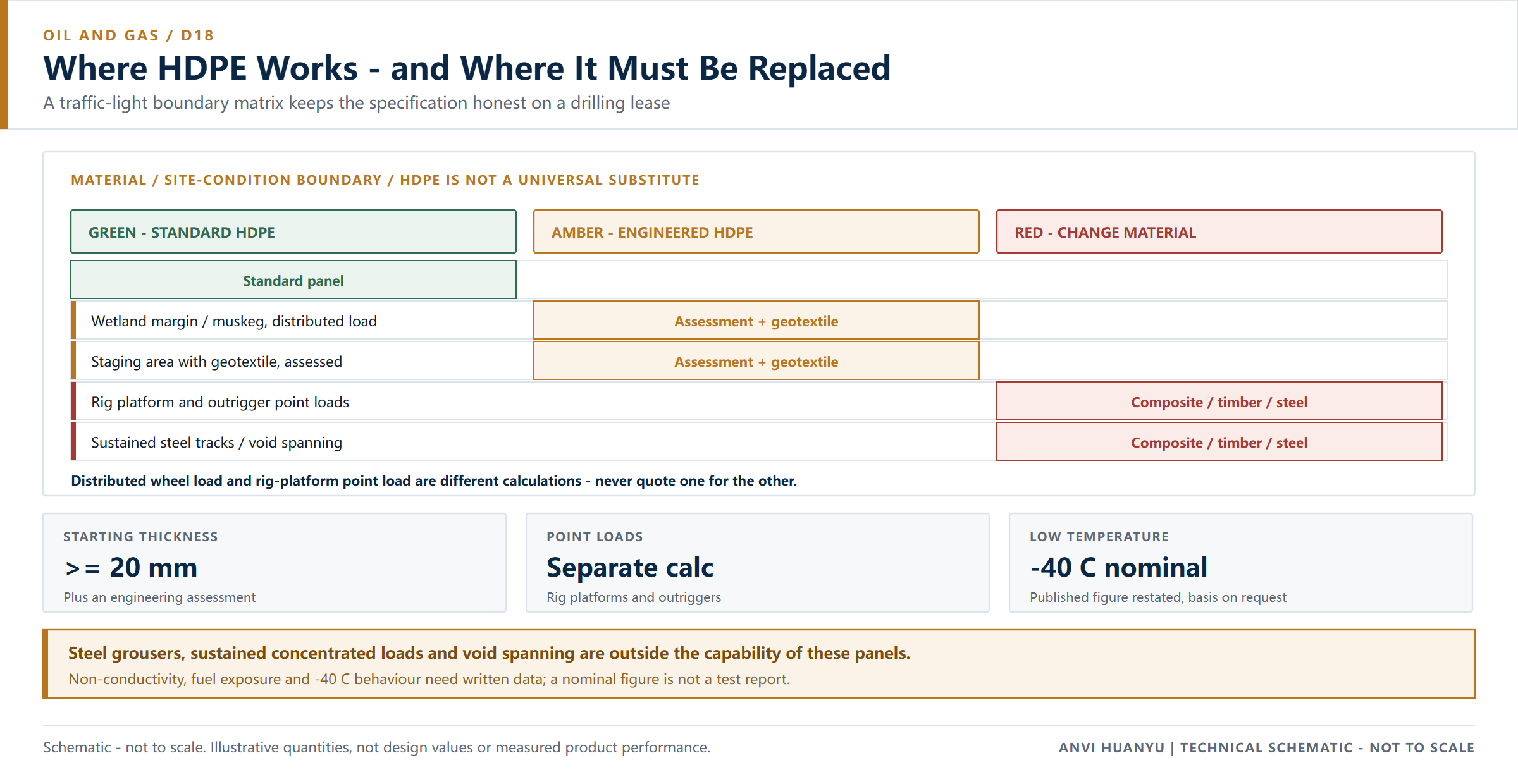
Original asset: material and site-condition boundary matrix
Green means standard HDPE is a reasonable starting point; amber means HDPE only after a documented site-specific assessment; red means change the material, not the thickness. An engineering screening aid, not a certified design value.
| Site condition / load case | Load path | HDPE status | If not HDPE, evaluate | Reason |
|---|---|---|---|---|
| Lease road, rubber-tyred tankers, dry prepared ground | Distributed wheel | Green — 20 mm | — | Load spreads over a tyre patch, then the panel |
| Lease road, saturated clay margin | Distributed, reduced bearing | Amber — 20 mm + geotextile + derating | Timber bog mat | Saturated soil loses 30–50% of dry bearing capacity (industry guidance) |
| Pipe yard / staging, light plant | Distributed static | Green — 15–20 mm | — | Low consequence, reusable, washable |
| Fuel or chemical handling apron | Distributed + chemical | Amber — confirm formulation | Steel or containment-rated system | General resistance is not a spill certification |
| Electrically classified area | Distributed + static/electrical | Amber — confirm safety case | Anti-static rated product | Non-conductive ≠ classified or dissipative |
| Wetland margin / muskeg | Distributed, very low bearing | Amber — permit, geotextile, assessment | Timber bog mats / ground improvement | Subgrade governs; panels migrate |
| Seasonal permafrost, frozen | Distributed while frozen | Amber — thaw-settlement assessment | Engineered platform | Frozen bearing is seasonal |
| Sustained steel-track traffic | Concentrated grouser contact | Red | Composite, timber or steel | Grousers cut and abrade HDPE |
| Crane outrigger / critical lift | Concentrated point load | Red | Rated outrigger pad | Point load, bending, lift plan |
| Drilling rig substructure / mast | Concentrated reactions | Red | Engineered composite / timber / steel rig mats | Load path is a few feet, not a tyre field |
| Void, trench, culvert crossing | Span / bending | Red | Bridge or engineered crossing | Panels are not beams |
Original asset: point load versus distributed load on a rig platform
| Aspect | Distributed wheel load (access layer) | Concentrated rig or outrigger point load (platform) |
|---|---|---|
| Contact geometry | Tyre patch, then spread over the panel footprint | Small float or substructure foot near a panel centre |
| Panel behaviour | Bends modestly between supported areas; load shared across linked panels | Local plate bending; effective area far below the full 2.98 m² |
| Governing check | Axle group ÷ spread area vs derated ground bearing | Peak reaction ÷ allowable bearing pressure vs a rated element |
| Effect of more thickness | Raises stiffness, still does not fix the subgrade | Raises stiffness but does not make the whole board effective |
| Relevant published figure | 80 / 100 / 120 t nominal distributed static on firm level ground | None — these ratings are not point-load capacities |
| Correct supplier answer | A thickness starting point plus a subgrade assessment | A rated engineered pad or rig mat, or an honest “we cannot supply this” |
| Documentation needed | Coverage take-off, derating, connection layout | Load chart / substructure reactions, ground report, arrangement drawing, sign-off |
Where a lift plan or permit applies, obtain a site-specific engineering assessment. Confirm against the heaviest machine on site, not the fleet average. This is a selection starting point, not a certified design value.
What it saves: a cost and compliance view you can audit
The honest comparison is a reusable, washable access layer versus a crushed-stone lease road or a timber bog mat fleet, including environmental close-out. A stone road buys aggregate, grading and then excavation, removal, disposal and restoration. A timber fleet buys heavy placement plant, absorbs drilling fluids and carries a decontamination burden between leases. An HDPE field buys a container of panels, a telehandler and a wash-down; the subgrade stays intact.
Cost per use = (delivered cost + handling + deployment labour + cleaning
 + decontamination + storage + losses + reinstatement)
÷ number of deployments| Factor | Crushed-stone lease road | Timber bog mat fleet | Reusable HDPE access layer |
|---|---|---|---|
| Material movements per 200 m route | Multiple lorry loads plus removal | Heavy haulage and placement plant | Roughly one container, then site handling (industry reference range at 20 mm) |
| Reinstatement | Excavate, remove, dispose, restore | Recover, clean, repair or replace | Lift, wash, store flat |
| Cross-site transfer risk | Aggregate left in situ | Soil, seed and absorbed fluids on mats | Washable surface; protocol still required |
| Reuse across leases | None | Limited by breakage and contamination | Panels redeploy across wells and spreads |
| Weather / thaw sensitivity | Degrades after rain and thaw | Absorbs water, gains weight | Surface intact; subgrade still governs |
| Rig platform capability | Not applicable | Engineered rig mats, yes | No — wrong product |
Break-even depends almost entirely on how many times the same panels are redeployed — see our cost and ROI guide. For a single remote well with no follow-on work, hiring may beat buying.
Why this mat — not a lighter panel or another material
| Option | Where it fits | Why we would not choose it here |
|---|---|---|
| 12.7 mm HDPE | Pedestrian routes, finished-surface protection | Under a loaded tanker it deflects and joints work loose |
| 15 mm HDPE | Short staging on firm, dry ground | Marginal for continuous laden access on thawing ground |
| 20 mm HDPE (access starting point) | Lease roads, staging, wetland margins | The practical ceiling — not a rig platform |
| 25–30 mm+ HDPE / composite | Engineered heavy cases only | Heavier, fewer panels per container; does not fix a point load |
| Engineered composite / steel rig mat | Drilling substructure, heavy concentrated loads | Correct tool for the platform; higher unit cost, known rated capacity |
| Timber bog mats | Very soft ground, one-off heavy access | Absorbs water and fluids, heavy, breaks, cross-site contamination pathway |
| Steel plates | Short, very high point loads | Needs lifting plant, corrodes, conductive; see HDPE vs steel mats |
- Why not the cheaper, thinner board? On a lease road the cost is not the panel, it is the interruption and reinstatement. A working joint under a braking tanker costs far more than the difference between 12.7 and 20 mm.
- Why not simply the thickest board? Beyond 20 mm, weight, handling and container utilisation deteriorate, and extra stiffness will neither fix an unprepared subgrade nor turn a distributed panel into a rated rig platform.
The four hand holes and eight connector holes let linked panels resist braking forces on bends; a mismatched batch does not sit flat. For heavy surrounding platforms see heavy-duty panels. A mine haul road has a different dominant risk, abrasion — see the mining page. For all uses, the application hub.
Why ≥20 mm and an engineering assessment is our starting specification
Work the selection chain in order; the figures are an illustrative engineering check, not a certified design value.
| Step | What to establish | Illustrative check |
|---|---|---|
| 1 | Heaviest vehicle and axle group | 40 t loaded tanker, rear axle group ≈ 26 t (assumed) |
| 2 | Tyre contact pressure | High at the patch; the panel’s job is to spread it |
| 3 | Ideal spread over one panel | 26,000 kg × 9.81 ÷ 2.98 m² ≈ 86 kPa as a rigid plate |
| 4 | Real effective area | HDPE deflects between supports; at 60%, ≈ 143 kPa |
| 5 | Subgrade allowance | Dry compacted granular soil tolerates this; saturated clay often does not (industry guidance: 30–50% loss) |
| 6 | Safety margin | Add 15–20%; specify against the heaviest machine, never the fleet average |
| 7 | Conclusion | ≥20 mm on prepared ground with geotextile, plus an assessment for any platform, wetland or permafrost case |
- We have not used published nominal ratings as a capacity. Our published reference ratings — 80 / 100 / 120 t for 12.7 / 15 / 20 mm — are nominal figures for evenly distributed static loading on a firm, level subgrade. They are not certified design values and must not be used as point-load capacity, crane outrigger capacity, or a permit-to-bridge voids. We publish no test method, sample thickness, support span or test report for these figures; they are labels, not design inputs.
- Confirm the thickness convention. Base sheet or overall height including raised tread; the difference can approach 10 mm and changes stiffness, stacking and edge ramps. See how to choose ground mat thickness.
- Thickness does not address a platform load case. Where a lift plan or permit applies, obtain a site-specific engineering assessment — and where the matrix is red, change material.
Common mis-specifications: choosing by average vehicle weight; treating a nominal tonnage as permission to place a rig foot; buying thicker HDPE for a steel-track abrasion problem; assuming −40 °C covers impact brittleness without the test basis; skipping the wetland or thaw assessment.
Common failure modes on an oil-and-gas site
| Failure | What it looks like | Cause | Prevention |
|---|---|---|---|
| Joint opening on bends | Gaps along a continuous seam | Unstaggered seams, braking tanker loads | Half-panel stagger; appropriate connectors; re-inspect after first pass |
| Edge settlement at a margin | Outer panel sits low | Narrow lane, no shoulder on soft ground | Widen at bends; supported shoulder or second row |
| Grouser cutting | Gouges and shavings on the vehicle face | Steel-track traffic | Change material; do not upsize HDPE |
| Star cracks at hand holes | Cracks radiating from cut-outs | Concentrated rig or outrigger load near a hand hole | Exclusion zone; rated pad |
| Thaw migration | Panels tilt as ground softens | Seasonal bearing loss | Seasonal assessment, geotextile, re-inspection after thaw |
| Chemical attack / swelling | Surface change in a spill zone | Unreviewed fuel or solvent exposure | Confirm formulation; contain spills; wash and inspect |
| Contamination carry-over | Soil or seed tracked to the next lease | No wash-down record | Wash, log, inspect between sites |
| Creep in storage | Warped panels after a season | Long unsupported stacks in heat | Store flat and supported; rotate stock |
What to verify with any supplier before you buy
Ask every bidder — including us — for the same things:
- Is the published load figure static, dynamic, distributed or point, and what were the sample thickness and support span? A rig-platform question needs a point-load admission, not a tonnage.
- Is the quoted thickness the base sheet or overall including tread?
- Can the crew place panels by hand, or is lifting plant required on the lease? Settle it with a sample panel; the material boundary matrix above, not a weight figure, decides whether HDPE belongs on this site.
- What is the thickness tolerance, and how is batch consistency recorded across a split lease order?
- What is the material declaration — resin grade, regrind or PCR content, UV stabilisation — and what chemical-resistance data supports the exposure?
- Does the supplier publish a test basis for the
−40 °Cnominal figure, or is it an unverified label? - Which connectors are supplied, and are they compatible across thicknesses and future orders?
- Can the supplier provide a report with an identifiable method and issuing laboratory, and a written statement of where the product must not be used?
- What is the warranty text in writing, and is it transferable to an EPC or rental counterparty?
Rig-access orders are frequently split across production batches, and panels with a different measured thickness or resin blend will not sit flat when linked or age alike under UV and fuel exposure. Dated working photographs of the line, a thickness check and the loading operation are available with a quotation. They confirm that a check is performed; the measured thickness per batch, the material declaration and the UV/chemical data remain separate written items, none of which an image can supply.
Specification summary for an oil-and-gas access layer
| Item | Starting specification |
|---|---|
| Panel role | Lease/access road, staging and working layer — not a rig platform or outrigger pad |
| Panel | 1,220 × 2,440 mm HDPE, 4 hand holes + 8 connector holes, dual-face tread |
| Thickness | ≥20 mm for access; confirm base-sheet vs overall convention |
| Subgrade | Drained, geotextile separation layer; saturated clay, muskeg and permafrost require derating |
| Joints | Half-panel stagger; listed 610 × 2,440 mm panels at row ends |
| Connections | Every panel; type selected for turning and braking loads |
| Change-material triggers | Rig substructure, crane outrigger, sustained steel tracks, void spanning, unbounded soft ground |
| Environmental | Wash-down and decontamination record between sites; permit conditions govern |
| Low temperature | −40 °C published nominal; no test basis published, no field performance inferred |
| Reference ratings | 12.7 / 15 / 20 mm → 80 / 100 / 120 t nominal, distributed static on firm level ground — not certified design values, not point-load capacity |
| Assessment | Site-specific engineering assessment for platform, wetland and permafrost cases |
Frequently asked questions
Can HDPE mats replace timber bog mats? For access roads and staging, often yes — a washable, non-absorbent panel avoids the water uptake, breakage and cross-site soil, seed and hydrocarbon transfer associated with timber (industry reference). For an engineered rig platform or very soft unbounded ground, no: use engineered timber, composite or steel rig mats. The replacement is valid only inside the green and amber rows of the boundary matrix.
What mat for a drilling rig platform? Use an engineered composite, timber or steel rig mat designed for the substructure reactions, not a standard HDPE access panel. A rig substructure concentrates load on a few support feet; a standard panel is a distributed-load spreader. We will say so rather than quote a nominal tonnage that does not apply.
Do HDPE mats work on wetlands and permafrost? Conditionally, and only with a geotextile separation layer, an environmental permit review and a geotechnical assessment of the subgrade and thaw settlement. The panels do not absorb water and leave no aggregate to remove, which helps close-out, but frozen or saturated bearing capacity governs the design — thickness is the second lever, not the first.
Are they non-conductive? HDPE is an electrical insulator as a general polymer property (industry reference). That is a material characteristic, not a certified anti-static rating or a hazardous-area approval. If your site has static-dissipation or electrically classified requirements, put those in the safety case and ask for the test basis; do not treat “non-conductive” as compliance.
Does HDPE resist fuel and chemical spills? HDPE is generally resistant to many fuels and aqueous chemicals as a typical guideline, but resistance depends on the substance, concentration, temperature and exposure duration. We do not publish a chemical-resistance table for our formulation here; no formulation data is published here, and a spill-containment requirement should be reviewed against your own safety case.
What thickness should I specify for a lease road? Start at 20 mm on a prepared, drained subgrade and confirm against the heaviest axle group at the worst ground condition, with a 15–20% margin and subgrade derating. This is a selection starting point, not a certified design value. Add an engineering assessment for any platform, wetland or permafrost case.
Get a thickness and panel count for your site
Send the heaviest vehicle and axle group or rig substructure reactions, ground condition (including wetland, muskeg or permafrost), project duration and panel quantity required. We will return a recommended thickness with its basis, a panel count and connector layout, a container estimate, and — where the load case is outside HDPE’s scope — a plain statement that another material is required, to albert@hdpegroundmat.com or via our contact page.