
Ground Protection Mats for Utilities: One Standard Fleet Across Many Short Easement Sites
For dispersed utility easement work, 15 mm HDPE panels are the default and 20 mm plus geotextile is reserved for saturated clay and wetland margins; standardise one lightweight fleet that moves between dozens of short sites. Manual handling weight matters more than maximum tonnage here. Wetland permits, clean-in/clean-out and track-out control are mandatory; voids, lift pads and public-highway traffic are outside scope.
This page is about repeatability, not a single large project. For continuous-traffic geometry see temporary access roads; for the boards themselves see 4×8 ft ground protection mats and standard specifications.
What utility ground protection mats are
A utility mat system is a standardised crew-set carried on a truck, laid for hours or days at a pole, valve chamber, cable joint bay or water main repair, then recovered for the next site. Each standard panel is 1,220 × 2,440 mm, covers 2.98 m², has a dual-face tread, four hand holes and eight connector holes. Connected edge to edge, panels spread loads instead of rutting a field.
The typical fleet is light-to-medium: 4×4 pole and bucket trucks, digger derricks, 8–20 t excavators, cable trailers, small cranes and service vans — industry reference planning ranges, illustrative and not a design value. The load case is modest; what is extreme is the number of mobilisations: dozens of one- or two-day easement jobs in a season, often with no lifting plant and only two people to place the panels.
That changes the unit of specification: a utility buyer specifies a fleet that is lifted, counted, washed and re-laid forty times, not a road. A crew-set might be 60–100 panels covering a 70–120 m approach plus a work pad (typical guideline, illustrative, not a design value). With no telehandler, panels must be two-person liftable — panel weight, not maximum tonnage, decides whether the system works. Routes cross farmland, wetland margins and public-road verges, bringing landowner restoration, permit compliance, no seed transfer between catchments and mud control.
When to use them on an easement — and when not to
| Condition | Suitable | Notes |
|---|---|---|
| Job duration | Hours to ~2 weeks per site | Short, repeated deployments |
| Traffic | Light-to-medium rubber-tyred plant, occasional small crane | Count passes per site |
| Ground | Firm farmland to saturated clay margins with geotextile | Wetland margins need 20 mm and a permit |
| Access | Narrow easements, field gates, roadside verges | Cover the full approach, gate to work pad |
| Reinstatement | Landowner or tenant ground returned to original condition | Panels leave no aggregate behind |
| Permit | Wetland or protected-margin crossings with consent issued | Wash-in/wash-out may be a permit condition |
| Crew | Two people, often no lifting plant | Two-person handling governs deployment speed |
| Programme | Dozens of dispersed sites per season | One standard fleet, one method, repeated |
| Public interface | Track-out point onto a public road | Track-out mats and sweep-down required |
Do not use a standard HDPE panel when:
- The wetland or environmental permit is not yet issued. Ground protection does not replace a permit.
- The ground is deep, unbounded peat, standing water, flowing water or subject to scour. Mats migrate or float.
- The panels would bridge a ditch, culvert, trench or void as a bridge. They are load spreaders, not beams.
- The position is a crane outrigger or pole-setting lift pad — a point-load calculation; obtain a site-specific engineering assessment.
- The route carries public highway traffic or must meet a public-access specification without further assessment.
- Sustained steel-track traffic is expected — grousers cut HDPE.
- A permit requires certified design values; our published ratings are not.
- The set cannot be cleaned between sites where a biosecurity condition applies.
Stating these limits matters more here: the same error is applied forty times.
How to install and use them: one fleet across many short sites
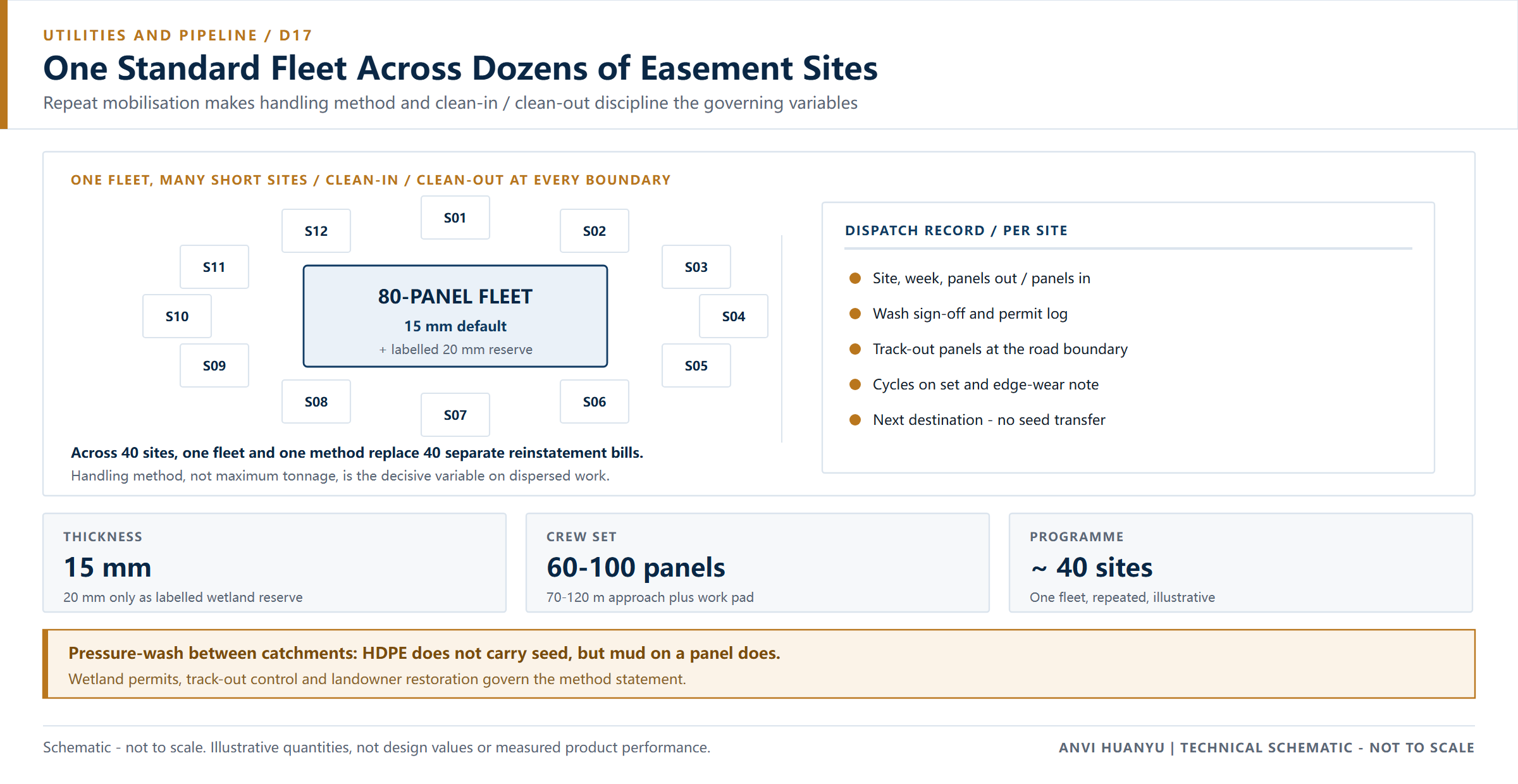
The crew-set and the multi-site rotation schedule
Standardise on one size (1,220 × 2,440 mm) and one thickness (15 mm) so any panel works at any site. Hold 20 mm panels plus geotextile as a separate, labelled reserve — a mixed-thickness field does not sit flat. An 80-panel crew-set covers 80 × 1.22 ≈ 98 m of single lane plus a two-panel work pad. The schedule below is an illustrative dispatch plan, not a design value.
| Site | Week | Scope | Panels deployed | Recovered | Clean-in / clean-out | Track-out panels | Next destination | Cycles on set | Inspection note |
|---|---|---|---|---|---|---|---|---|---|
| S01 | 1 | Pole replacement, wet farmland | 80 | 80 | Wash before leaving | 6 at field gate | S02 | 1 | 3 connectors replaced |
| S02 | 1 | Cable joint bay, dry stubble | 60 | 60 | Brush and inspect | 4 | S03 | 2 | None |
| S03 | 2 | Valve chamber, saturated clay margin | 80 + 20 (20 mm reserve) | 100 | Pressure-wash, permit log | 6 | S04 | 3 | 2 panels edge-worn |
| S04 | 2 | Telecom cabinet, roadside verge | 40 | 40 | Sweep and track-out check | 8 (public road) | S05 | 4 | None |
| S05 | 3 | Water main repair, pasture | 80 | 80 | Wash, seed check | 6 | S06 | 5 | 1 connector replaced |
| S06 | 3 | Transmission pole, peat margin | 80 + 20 | 100 | Wash, permit log | 6 | S07 | 6 | 1 panel retired |
| … | … | … | … | … | … | … | … | … | … |
| S12 | 6 | Final reinstatement audit | — | 100 | Full wash, store flat | — | Yard | 12 | Batch record filed |
The schedule treats the fleet, not the site, as the thing managed: panels on the truck, panels returned, wash sign-off and next destination. A set three panels short stalls the next site.
| Item on the truck | Why it travels with the set | Record to keep |
|---|---|---|
| Panels, counted by thickness | Mixed 15 and 20 mm sets do not sit flat | Count out / count in |
| Spare connectors | Repeated make-and-break is the main wear item | Replacements log |
| Geotextile roll and pins | Wet margins and separation | Grade and overlap used |
| Track-out mats | Public-road mud compliance | Placement and sweep check |
| Wash kit and brush | Clean-in/clean-out; no seed transfer | Wash sign-off |
| Permit copy and landowner contact | Wetland and access consent | Permit number, signed access |
| Inspection sheet | No engineer attends most sites | Rut, joint and edge checks |
The 7-step sequence
- Walk the short approach. Mark the field gate, soft hollows, buried services, ditches and the public-road transition; photograph the pre-work ground condition as the restoration baseline.
- Confirm the permit and landowner access agreement before unloading, and mark the permitted boundary.
- Drain and prepare. On saturated clay roll out geotextile with generous overlap; never lay over standing water.
- Start on firm ground and build outward. Stagger by half a panel, vehicle tread up, connect every panel, close row ends with listed custom sizes.
- Place track-out mats at the public-road exit and a wash point — a compliance item, not a courtesy.
- Run one laden vehicle at walking pace, then re-inspect for edge settlement, joint opening and rut depth; log the result.
- Recover backwards to firm ground, pressure-wash, inspect, count in, sign the clean-out, stack flat on the truck, file the rotation log, then release the set.
The full handling and recovery procedure is in how to install ground protection mats.
What they save: restoration, track-out and repeat mobilisation
The cost of a utility job is rarely the panel: it is the landowner claim, reinstatement, and a crew returning to a site they thought finished. Without a mat set, a bucket truck cuts ruts in wet pasture and imported stone must later be excavated and removed. Mud on a public road brings sweeping costs or a notice. With no pre-work photograph, there is no baseline to close the job against.
| Cost line | Without a mat set (per short site, illustrative framework) | With one standard crew-set |
|---|---|---|
| Ground damage | Ruts in pasture and topsoil; ploughing, reseeding, re-turfing | Surface protected; lift and go |
| Reinstatement | Import stone, then excavate, remove, dispose, restore | None; no aggregate left behind |
| Landowner claim | Complaint, negotiation, compensation, rework visit | Documented pre-work condition, signed off |
| Public road | Mud tracked out; sweeping and possible notice | Track-out mats at the exit, sweep check |
| Permit and biosecurity | Seed or spores carried between catchments | Wash-in/wash-out log |
| Crew time | Return visit to fix ruts | One mobilisation |
| Across 40 sites | 40 separate reinstatement bills | One fleet, one method, repeated |
Illustrative cost framework, not a quotation or a design value. Substitute your own reinstatement rates, day rates and landowner agreements.
Use this with your own rates:
Cost per site = (fleet cost ÷ sites served) + deployment labour + wash + transport
 + track-out control + reinstatement + claims provision
The fleet is amortised over dozens of sites, not one project. See the cost and ROI guide and buying guide. A single large project is specified differently — see temporary access roads and light-duty ground protection mats.
Why these mats — not a lighter panel or another material
| Option | Where it fits on an easement | Why not here |
|---|---|---|
| 12.7 mm HDPE | Pedestrian routes, turf, finished surfaces, very light access | Marginal under repeated laden bucket trucks on damp ground |
| 15 mm HDPE (recommended default) | General dispersed utility work, two-person handling | The balance of stiffness and carry weight |
| 20 mm HDPE + geotextile | Saturated clay and wetland margins | Heavier; two-person lifts slow across dozens of moves — keep as a labelled reserve |
| 25–30 mm+ HDPE | Engineered cases only | Needs lifting plant, and most crews have none |
| Plywood | Nothing on a wet route | Delaminates, swells, can carry seed; see HDPE vs plywood mats |
| Steel plates | Short, very high point loads | Needs lifting plant, corrodes, conductive; see HDPE vs steel mats |
| Timber bog mats | Deep peat, one-off heavy access | Absorbs water, gains weight, transfers seed between sites, hard to clean |
| Gravel or stone | Permanent works | Excavation, disposal, reinstatement; not recoverable across forty sites |
- Why not the thickest panel for safety? It must be lifted by two people, twice a day, at forty sites. A 20 mm default adds handling time and fatigue and still does not fix a saturated subgrade. Keep 20 mm in a labelled reserve.
- Why not the cheapest thin board? 12.7 mm is correct for turf and pedestrian protection — see landscaping mats — but on damp farmland under a laden bucket truck it deflects and joints open. The saving is spent on re-laying and a landowner complaint.
HDPE suits this buyer: it is non-absorbent, so a panel weighs the same in rain as in the yard; it can be pressure-washed between catchments, which a clean-in/clean-out protocol requires; and a dual-face tread puts the pedestrian side up at a work pad. Four hand holes allow two-person placement, eight connector holes link the field under shear, and the decisive number is panel weight, not tonnage — confirm the handling method with a sample panel rather than a catalogue figure.
Why 15 mm is the default for dispersed utility work
The figures below are an illustrative engineering check, not a certified design value.
Heaviest vehicle → axle load → tyre contact pressure → spread over the panel
→ subgrade derating → 15–20% margin → 15 mm conclusion (starting point)| Step | What to establish | Illustrative check |
|---|---|---|
| 1 | Heaviest vehicle on an easement | 18 t bucket or digger truck, rear axle ≈ 12 t (assumed for this example) |
| 2 | Contact pressure | Concentrated at the patch; the panel’s job is to spread it |
| 3 | Ideal spread over one panel | 12,000 kg × 9.81 ÷ 2.98 m² ≈ 40 kPa if the whole board acted as a rigid plate |
| 4 | Real effective area | HDPE deflects between supports, so at 60% effective area ≈ 66 kPa |
| 5 | Subgrade allowance | Firm farmland tolerates this; saturated clay often does not (industry guidance: saturated soil loses 30–50% of dry bearing capacity, saturated clay −25~35%) |
| 6 | Safety margin | Add 15–20%; specify against the heaviest machine, never the fleet average |
| 7 | Conclusion | 15 mm default; 20 mm + geotextile only where step 5 fails or a permit demands it |
If load were the only consideration, 12.7 mm would pass. We start at 15 mm for repeated deployment across unsurveyed ground — the reserve is for a damp site, not a 100 t axle — and stop there because the same two people lift these panels at every site. Confirm against the heaviest machine on site, not the fleet average.
Our published reference ratings — 80 / 100 / 120 t for 12.7 / 15 / 20 mm — are nominal figures for evenly distributed static loading on a firm, level subgrade. They are not certified design values and must not be used as point-load capacity, crane outrigger capacity, or a permit-to-bridge voids. We publish no test method, sample thickness, support span or test report for these figures; they are labels, not design inputs. On an easement that mainly means: do not cite the 120 t figure to justify a pole-setting crane outrigger. Where a lift plan or permit applies, obtain a site-specific engineering assessment.
Three qualifications for any specification written from this page:
- This is a selection starting point, not a certified design value.
- Confirm the thickness convention — base sheet or overall including raised tread on both faces. The difference can approach 10 mm, and in a fleet mixing a 15 mm default with a 20 mm reserve a mismatch produces an uneven surface. See how to choose ground mat thickness.
- Thickness changes freight and handling. Thinner gauges mean more panels per container and a lighter lift on every deployment; published industry reference ranges put a 40 ft high-cube at roughly 300–350 panels at 20 mm, to be confirmed against actual stack height and packing method.
Common mis-specifications: specifying by maximum tonnage; buying 20 mm for every crew; mixing thicknesses in one unlabelled set; skipping the wash step between catchments; no track-out control at the public road; no pre-work condition record for the landowner.
Common failure modes on utility easements
| Failure | Visible sign | Cause | Prevention |
|---|---|---|---|
| Rutting across farmland | Tyre ruts in pasture | Approach not extended to the field gate | Cover the full approach; track-out mats at the gate |
| Landowner claim | Complaint at handover | No baseline, aggregate left behind | Before/after photographs, no stone, signed reinstatement |
| Wetland permit breach | Work inside a protected margin | Permit not checked before unloading | Permit copy on the truck, marked boundary |
| Seed or spore transfer | Vegetation at the next catchment | Skipped wash-down | Pressure-wash clean-in/clean-out, log the sign-off |
| Mud on the public road | Tyre tracks on the highway | No track-out mat at the exit | Track-out mats, sweep-down, wheel check |
| Joint opening in a wheel path | Continuous longitudinal gap | Unstaggered seams | Half-panel stagger; appropriate connectors |
| Handling delay or strain | Crew struggling, slow deployment | Panel too heavy for two people | Keep 15 mm default; 20 mm as reserve; confirm weight |
| Edge sinking on a wet margin | Outer panel drops | Saturated clay, no geotextile | Geotextile, 20 mm reserve, doubled wheel paths |
These failures are procedural.
What to verify with any supplier before you buy
A utility fleet places dozens of small orders over a season. The risk is not one bad panel; it is that the March batch does not match the January batch.
- Is the published load figure static, dynamic, distributed or point, and what were the sample thickness and support span? Will the supplier confirm in writing it is not an outrigger or lift-plan value?
- Is the quoted thickness the base sheet or overall including tread? The 15 mm default and 20 mm reserve must use the same convention.
- Is a two-person lift realistic twice a day across forty sites? Trial it with a sample panel at the first site — this is the decisive check here.
- What is the thickness tolerance and batch inspection record across multiple small-batch deliveries?
- What is the material declaration and UV stabilisation? Panels live exposed on a truck between jobs.
- What connectors are supplied, are they compatible across batches, and will a March connector fit a January panel?
- Can the supplier provide a written warranty, cleaning and handling instruction, and a wash-in/wash-out protocol for the method statement?
- Can the supplier provide a test report with an identifiable method and issuing laboratory, plus a loading quantity per 40HQ at 15 mm for the replenishment order?
Utility orders repeat in small quantities all season, which makes the January-to-March comparison more important than any single delivery. We can include dated working photographs of the line, a thickness check and a loading operation when we quote. Look at them for the process, not for equivalence: they cannot prove that two dispatches share the same thickness convention, connector fit or bundle count. Request the batch inspection record and the dispatch specification in writing.
Specification summary for a multi-site utility fleet
| Item | Starting specification |
|---|---|
| Panel | 1,220 × 2,440 mm HDPE, 4 hand holes + 8 connector holes, dual-face tread |
| Thickness | 15 mm default; 20 mm + geotextile as a labelled reserve for saturated clay and wetland margins |
| Crew-set | 60–100 panels covering a 70–120 m approach plus work pad (illustrative) |
| Standardisation | One size, one default thickness; any panel fits any site |
| Dispatch record | Site, week, panels out/in, wash sign-off, track-out panels, next destination, cycles |
| Joint pattern | Half-panel stagger; listed 610 × 2,440 mm panels at row ends |
| Connections | Every panel; spare connectors carried on the truck |
| Compliance | Permit copy, landowner contact, pre-work photographs, clean-in/clean-out log |
| Track-out | Mats at every public-road exit; sweep-down before leaving |
| Exclusions | No lift pads, no void spanning, no unpermitted wetland work, no public-highway traffic, no sustained steel tracks |
| Reference ratings | 80 / 100 / 120 t nominal for 12.7 / 15 / 20 mm, distributed static on firm level ground — not certified design values; no test basis published, not for design use |
Frequently asked questions
How do line crews reach poles across wet farmland? Lay a 15 mm crew-set from firm ground at the field gate to the work position. On saturated clay add geotextile and the 20 mm reserve with doubled wheel paths. Place track-out mats at the gate, photograph the ground before work, and recover backwards at the end.
Can mats cross a wetland right of way? Only where the permit is issued and its boundary marked. Use 20 mm with geotextile at the margins, keep a wash-in/wash-out protocol so seed and soil are not carried between catchments, and never rely on panels over standing water or unbounded peat. A mat is not a permit.
What mat for a utility crane on an easement? No standard panel here is a rated lift pad. An outrigger applies a point load, and bearing area must be calculated from the outrigger reaction and allowable ground pressure. Our 80 / 100 / 120 t figures are nominal distributed static ratings, not certified design values. Where a lift plan or permit applies, obtain a site-specific engineering assessment.
Are mats reusable across many small sites? Yes — that is the entire economic argument. In the worked schedule one 80-panel set serves twelve sites in six weeks, with the count, wash sign-off and next destination recorded at each move. Recover, pressure-wash, inspect hand holes and connectors, count the set back in, and store it flat.
How do we avoid spreading grass seed between sites? Pressure-wash or brush panels clean before leaving a site and again on arrival if the permit requires it, and log the sign-off. HDPE is non-absorbent, so it can be cleaned between catchments in a way timber cannot; the wash step is what biosecurity conditions ask for. Keep track-out mats in the same cycle.
Why not just buy the thickest mat for every crew? With no lifting plant, the same two people place the set twice a day at dozens of sites. A 20 mm default adds fatigue and does not fix a saturated subgrade. Standardise on 15 mm, with 20 mm as a labelled reserve.
Get a thickness and panel count for your site
Send the equipment tonnage and axle groups, the ground or geotechnical condition, the works duration and season, the number of sites and mobile crew-sets, and the target panel quantity. We will return a recommended thickness with its basis, a crew-set panel count, a multi-site rotation schedule, and a container estimate — to albert@hdpegroundmat.com or via our contact page.