
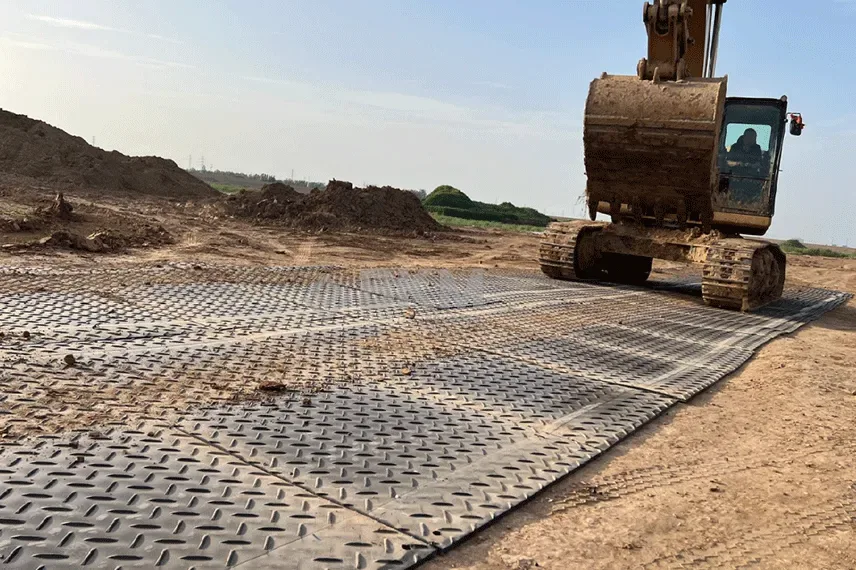
Short answer: choose heavy-duty HDPE mats when the surface will be moved, reused or washed between sites — they are a fraction of the handling weight, do not rot or absorb water, and spread their purchase price over many deployments. Timber crane and bog mats still earn their place for one-off extreme point loads on a hard, fully supported base, and where on-site repair of a wooden mat is practical. For most temporary access work, the deciding number is not the price per mat but the cost per deployment.
“Wood mats” is an imprecise term, and it causes a lot of bad comparisons. A thin plywood sheet and a 300 mm hardwood crane mat are completely different products with completely different jobs. This guide compares HDPE ground protection mats with the heavy end of the timber family — the thick hardwood mats variously called timber crane mats, bog mats, rig mats or swamp mats. If you are weighing up plywood instead, see our dedicated HDPE vs plywood comparison.
What counts as a timber mat (and what it doesn’t)
A timber mat in the sense buyers mean here is a thick panel built from hardwood beams or lumber, bolted or pinned together, used to spread the load of cranes, drilling rigs and very heavy tracked plant. Typical constructions range from roughly 200 mm to 400 mm in depth and are measured in tonnes rather than kilograms. They are engineered to be stiff and to survive extreme local pressure on oilfield and utility sites.
That is a different product from a plywood sheet used for short-term turf cover or light vehicle access, and it is also different from the HDPE panels this site manufactures — moulded high-density polyethylene in standard 1220 × 2440 mm and 2000 × 4000 mm formats, from 12.7 mm to 60 mm thick, that interlock to form a continuous working surface. We keep the two timber categories on separate pages so neither competes for the other’s search intent: heavy timber here, plywood in the companion guide. A third comparison covers steel plates if you are also considering that route.
Head-to-head comparison
Six factors decide almost every material selection we see. The table is deliberately qualitative on the timber side: timber construction varies widely, so any fixed number would be misleading. Verify any supplier’s written rating for the exact product you are buying.
| Factor | Heavy-duty HDPE mat | Timber / bog / rig mat |
|---|---|---|
| Handling weight | 58 kg for a 1220 × 2440 × 20 mm mat — a two-person lift. Larger formats need a forklift, not a crane. | Very heavy; machine placement is assumed on every move. |
| Load behaviour | Flexes to follow the ground and spread pressure, then recovers. Top specification rated up to 120 t on firm level ground, subject to conditions. | Very stiff with excellent tolerance of extreme local loads on a hard, supported base. |
| Water, rot and chemicals | Non-porous; no rot, swelling or delamination; inert against fuels, brines and many chemicals. | Absorbs water; susceptible to rot, splitting and insect damage over time. |
| Surface and safety | Moulded traction on both faces; smooth-back option for finished surfaces; no splinters or protruding fasteners. | Splinters and exposed bolts can be a puncture hazard and can mark soft surfaces. |
| Cleaning and biosecurity | Pressure-washes clean; does not trap water, oil or seed between sites. | Hard to sanitise; retains moisture, oils and organic debris. |
| Reuse and end of life | Multi-year reuse across projects; recyclable; retains resale value. | Shorter service life outdoors; disposal is a cost, not an asset. |
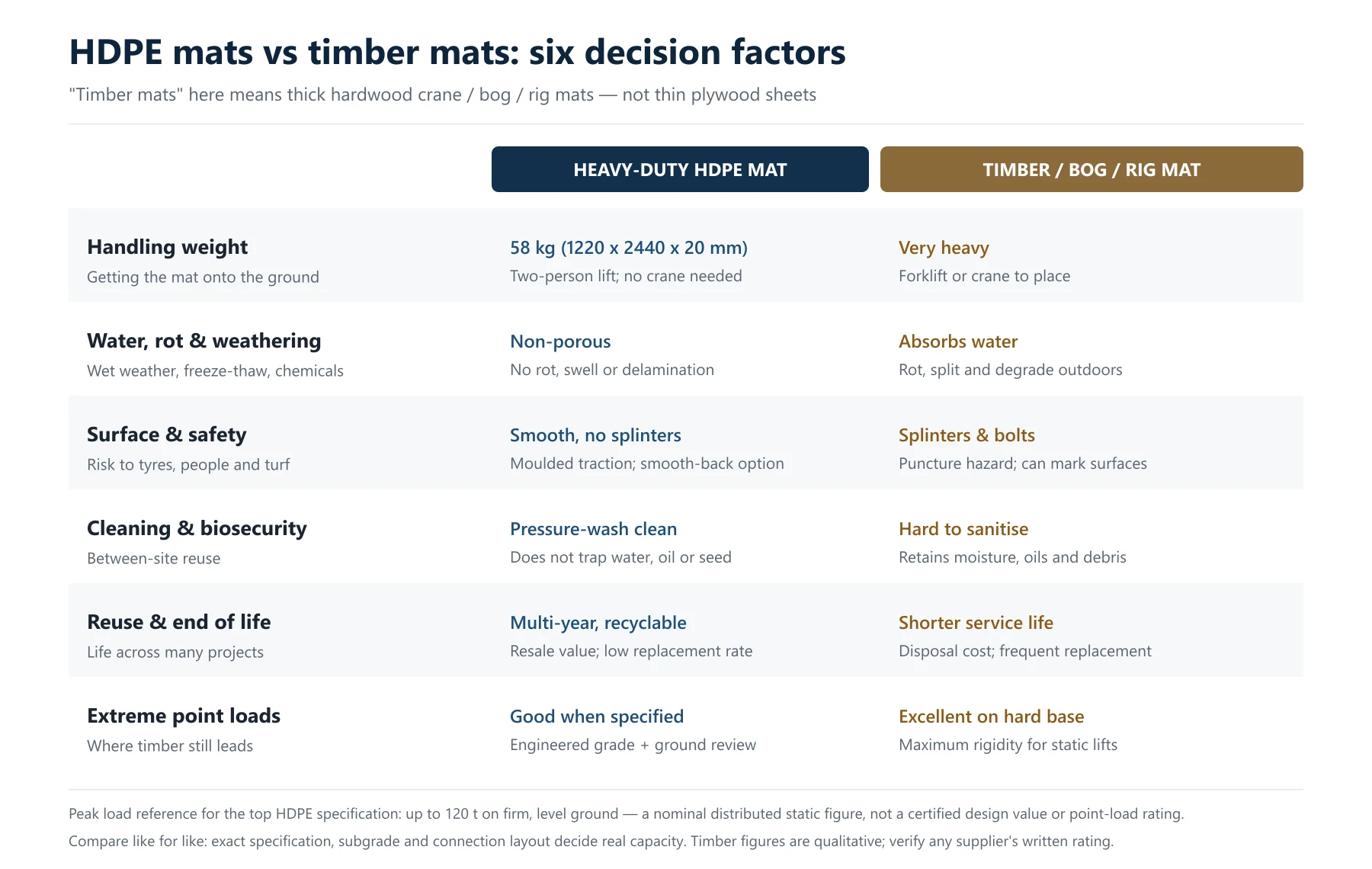
Load figures are always conditional on ground bearing capacity, thickness and connection layout. Treat any headline tonnage as a reference, not a design value.
Weight and handling: the logistics difference
This is the gap that buyers feel first. A thick timber mat is a machine-handled product from the moment it arrives: forklifts, telehandlers or cranes are scheduled, operators are booked, and every reposition touches the programme. An HDPE mat in the common 1220 × 2440 mm format at 20 mm is 58 kg — genuinely light enough for two people to carry and lay by hand, with no lifting plant on the budget.
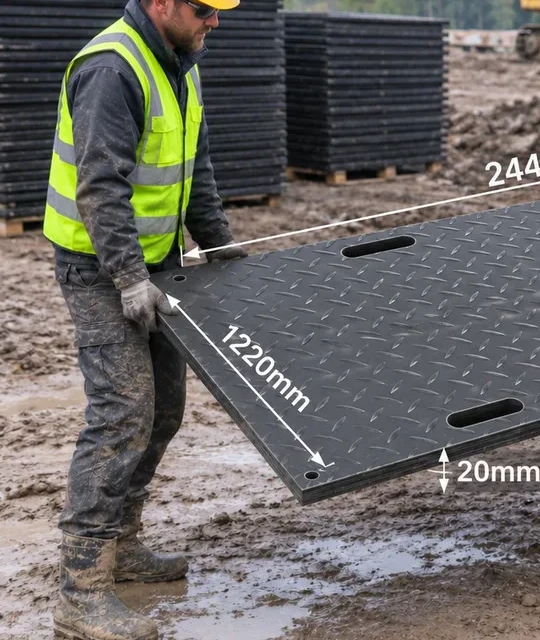
On a short, static job the weight difference is an inconvenience. On a linear right-of-way, a festival build and strike, or any access route that advances with the work front, it becomes the dominant cost. Fewer machine moves mean lower fuel, fewer operator hours, less site congestion and a smaller safety exposure around lifting. It also changes where the mats can be used at all: a hand-laid system works in tight access, on finished surfaces and on sensitive ground where bringing in a crane would defeat the purpose of the mat.
We manufacture six gauges from 12.7 mm to 60 mm in two standard sizes, plus custom dimensions, so the handling weight can be matched to the load rather than defaulting to the heaviest option. The full size and weight specification lists every format; our thickness selection guide explains how to choose a gauge against ground conditions and equipment.
Water, rot and weathering
Ground protection is most needed in exactly the conditions that destroy wood. Timber absorbs water, which drives swelling, warping, splitting and eventual rot; repeated wet-and-dry cycles shorten its service life, and outdoor exposure adds insects and weathering. A mat whose load capacity degrades as it weathers is a mat that has to be inspected, replaced and disposed of on a schedule.
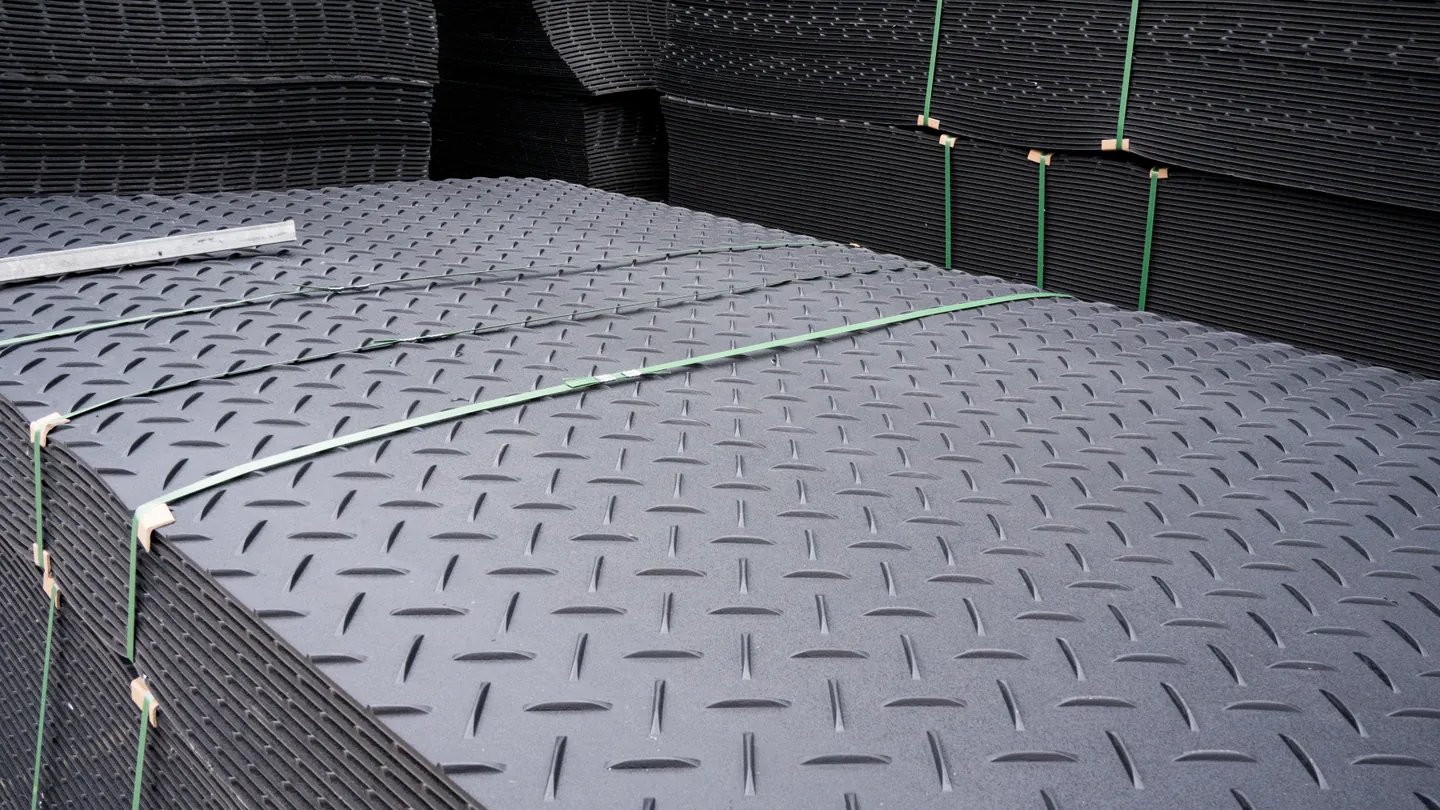
HDPE is non-porous. It does not take on water, so its weight and dimensions stay stable, and it does not rot, delaminate or support insect damage. UV-stabilised grades retain impact resistance in cold climates — our heavy-duty mats are rated for service down to −40 °C — and the material is inert against the fuels, salts and many of the chemicals found on industrial sites. That stability is why the same HDPE mat performs close to identically on day one and after years of redeployment, while a timber mat’s behaviour drifts with every season it spends outdoors.
Surface protection and cleanliness
Both materials spread load, but they interact with the surface below very differently. Timber’s rigid edges and high dead weight can crush turf, mark paving and stress shallow services; splinters and exposed bolts are a puncture risk for tyres and personnel. On landscaped, finished or high-value surfaces, that matters as much as the load rating.
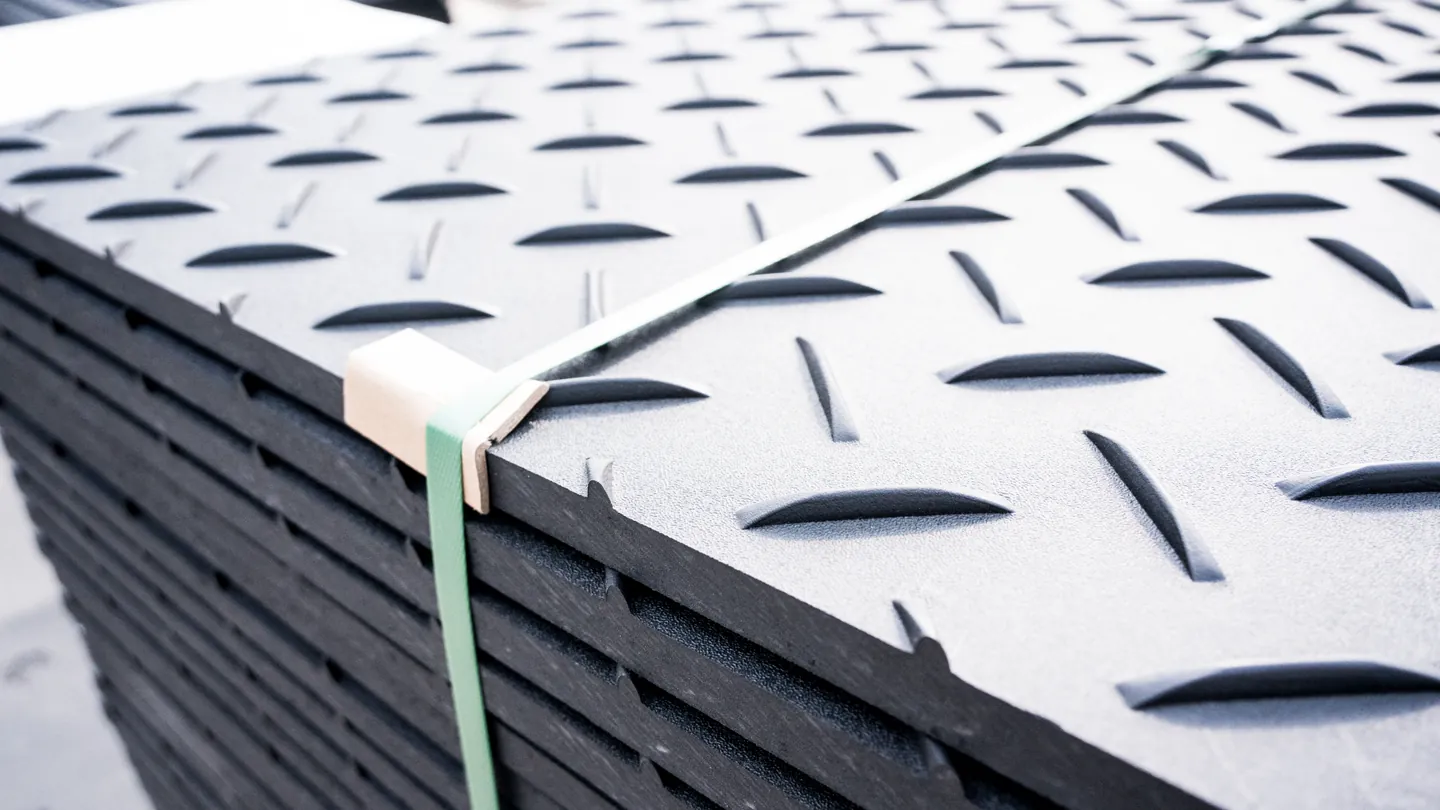
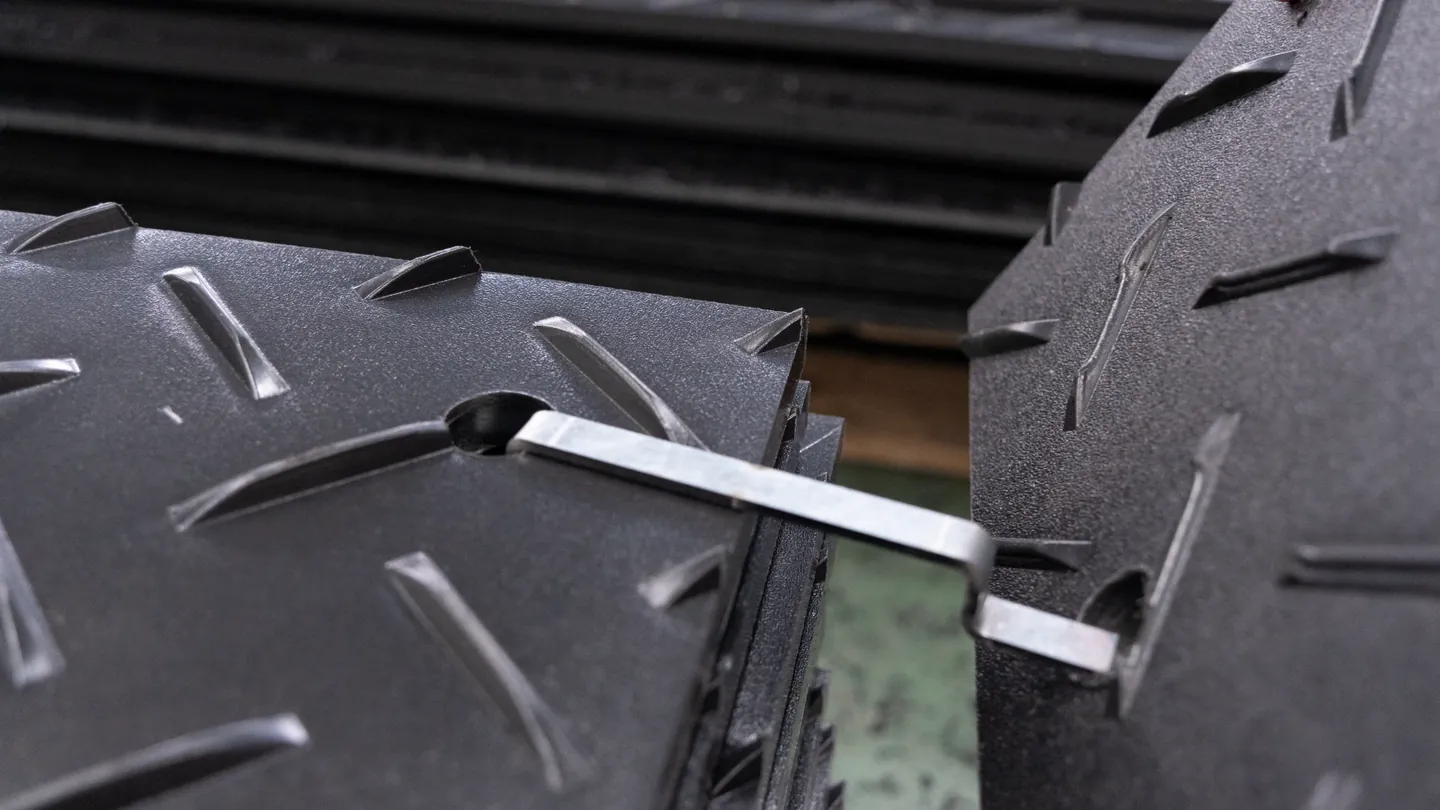
HDPE can be specified with an aggressive traction pattern for vehicles and a milder pedestrian-grade or smooth reverse for turf, asphalt and finished paving. It conforms to moderate ground undulation instead of digging in, and because the surface is seamless and non-porous it pressure-washes clean in minutes. That has a second benefit on any project with biosecurity or environmental obligations: an HDPE mat does not carry soil, weed seed or pathogens from one site to the next, whereas a wooden mat that has absorbed moisture and organic matter is difficult to sanitise. For teams moving between sensitive sites — renewables, utilities, agriculture — that difference is often the deciding factor. Interlocking connector systems also keep a run of mats tracking as one surface rather than shifting at the joints.
Service life and cost per use
The purchase price favours timber. The economics over a fleet’s life usually do not. A timber mat has a shorter service life in wet outdoor use, needs more frequent replacement, costs more to move on every deployment, and carries a disposal cost at the end. An HDPE mat costs more to buy once, then gets reused across many projects with no anti-corrosion treatment, no deformation inspection after every hire and a recyclable end of life.
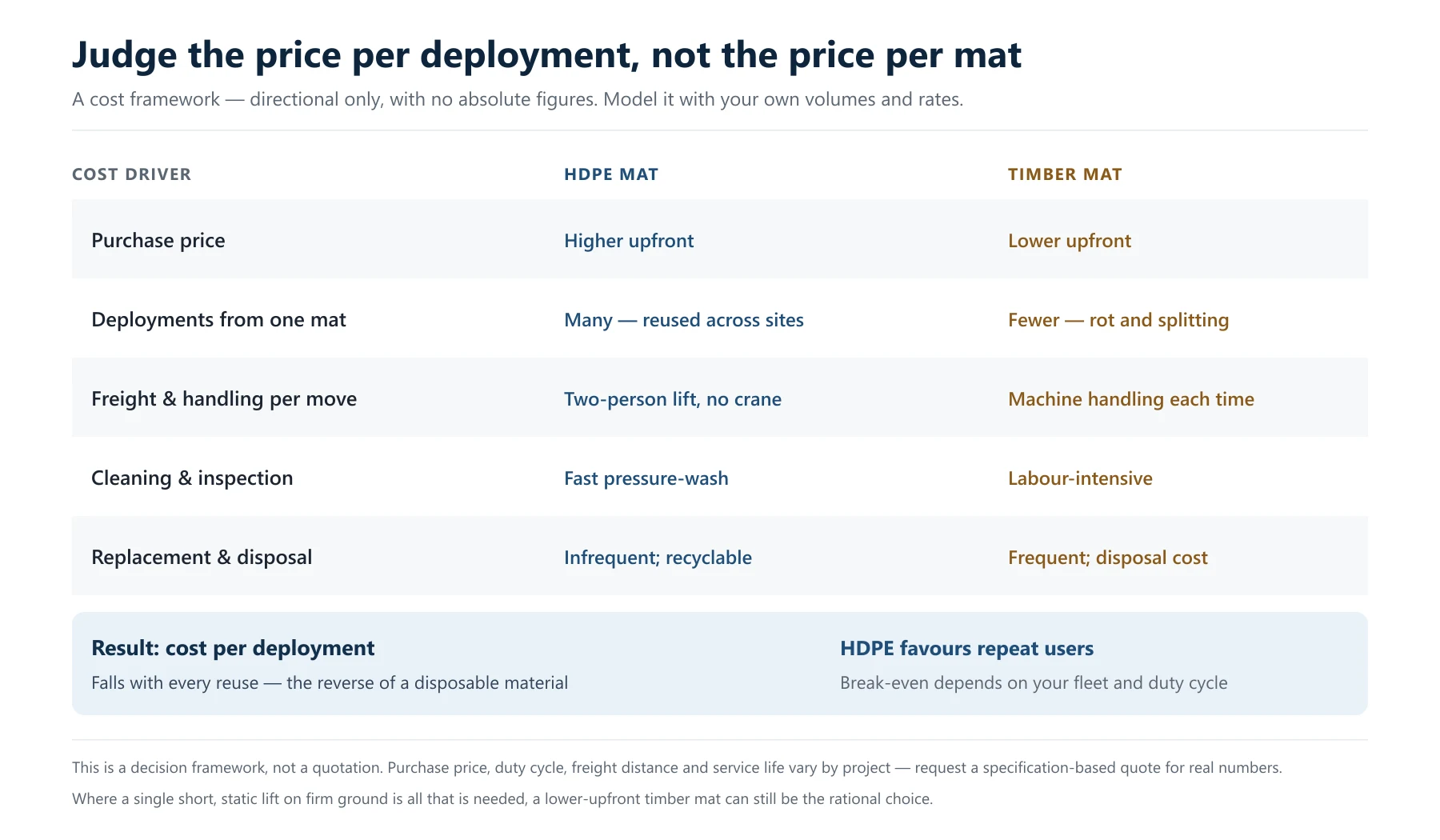
The right way to compare is to divide the total cost of ownership by the number of deployments. Purchase price, freight and handling, cleaning and inspection labour, replacement rate and disposal all go into that number. On repeat work, the material with the higher upfront price often has the lower cost per deployment — which is why rental fleets and contractors running sequential projects move to reusable HDPE first. Our cost and ROI guide works through the model; the buying guide covers the wider specification process.
No absolute prices are given here because they depend on specification, volume and destination. Ask for a quote against a defined load case and ground condition rather than comparing headline mat prices.
Where timber mats still make sense
An honest comparison names the cases where the other material wins. Specify timber, or a hybrid system, when:
- A single extreme concentrated point load sits on a hard, fully supported base — for example a one-off heavy crane lift on a prepared pad where maximum rigidity is the requirement.
- On-site repair is a practical advantage — a damaged timber beam can sometimes be replaced locally where a polymer mat would be taken out of service.
- The mat is a short-term, static installation and the weight is paid once rather than amortised across redeployments.
- The working environment involves sustained high temperatures or hot work for which a polymer surface is unsuitable.
Everything else — temporary access, repeated deployment, soft or sensitive ground, restricted access and distant logistics — is where HDPE wins on total cost, safety and programme certainty. The application overview maps these conditions project by project.
How to specify either material
Before requesting a quotation, write down four things: the ground condition (soil type, moisture, bearing value, buried services); the real load case (maximum axle load and maximum point load, static or dynamic); how many times the surface will be moved; and what the surface underneath is worth. Those four inputs settle the material choice faster than any brand comparison.
For an HDPE specification, add dimensions, thickness, rated load for that exact thickness, weight per mat and connector type — two-way connectors for straight runs, four-way for pads and turning areas. We manufacture in-house with thickness inspection on every batch, and will build custom sizes and thicknesses around a defined load case. See how the mats are compression moulded in our factory, or review the heavy-duty range before you specify.
Frequently asked questions
Are HDPE mats stronger than timber crane mats?
It depends on what “stronger” means. Timber is stiffer and tolerates extreme local loads on a hard base very well. HDPE is designed to flex and spread load over soft ground, which is what most ground protection actually requires; the top specification carries a peak reference of up to 120 t on firm, level ground, subject to ground conditions and specification. For spanning or extreme point loads, timber or steel may still be the engineered answer.
How long do timber mats last compared with HDPE?
Timber service life varies widely with moisture, handling and species, and drops sharply in repeated wet conditions. A well-maintained HDPE mat is reusable across many projects over multiple years and is recyclable at end of life. Ask any supplier for warranty terms rather than relying on a generic industry lifespan figure.
Are timber mats cheaper than HDPE?
Usually cheaper to buy, often more expensive to own. Freight and machine handling on every move, shorter replacement intervals, cleaning labour and disposal all add up. On repeat deployments the lower cost per use of a reusable HDPE mat typically outweighs its higher purchase price. Model it with your own volumes.
Can HDPE mats replace timber crane mats or bog mats?
For many temporary access and laydown applications yes, provided the thickness and connector layout are specified for the real load and ground. For a single extreme point load on a hard base, or a spanning application, a thick timber mat or steel plate may still be required. Never extrapolate a general load figure to an outrigger case — have the load and subgrade reviewed.
Can timber and HDPE mats be used together?
Yes, and many sites do: timber or steel under a static heavy lift, HDPE on the haul route and high-traffic corridors where weight and reuse matter. Keep different materials in separate zones rather than mixing them within a single connected run, where uneven thickness creates steps and weak points.
Do HDPE mats get slippery when wet?
They are manufactured with a moulded anti-slip texture on both faces, and a pedestrian-grade pattern can be specified on the reverse. That is a significant advantage over smooth or wet timber and over steel, both of which lose traction when wet or muddy.
Are HDPE mats environmentally better than timber?
On Lifecycle grounds usually yes: a reusable, recyclable mat avoids repeated logging, replacement and disposal, and it does not leach treatment chemicals into sensitive ground. Timber is a natural material, but its shorter life and disposal burden are the trade-off. The strongest environmental case is reuse across many sites.
What sizes and thicknesses are available?
Standard HDPE formats are 1220 × 2440 mm and 2000 × 4000 mm, in six thicknesses from 12.7 mm to 60 mm, with custom dimensions and thicknesses available for a specific load case or site layout. See the specifications page for the full table.