
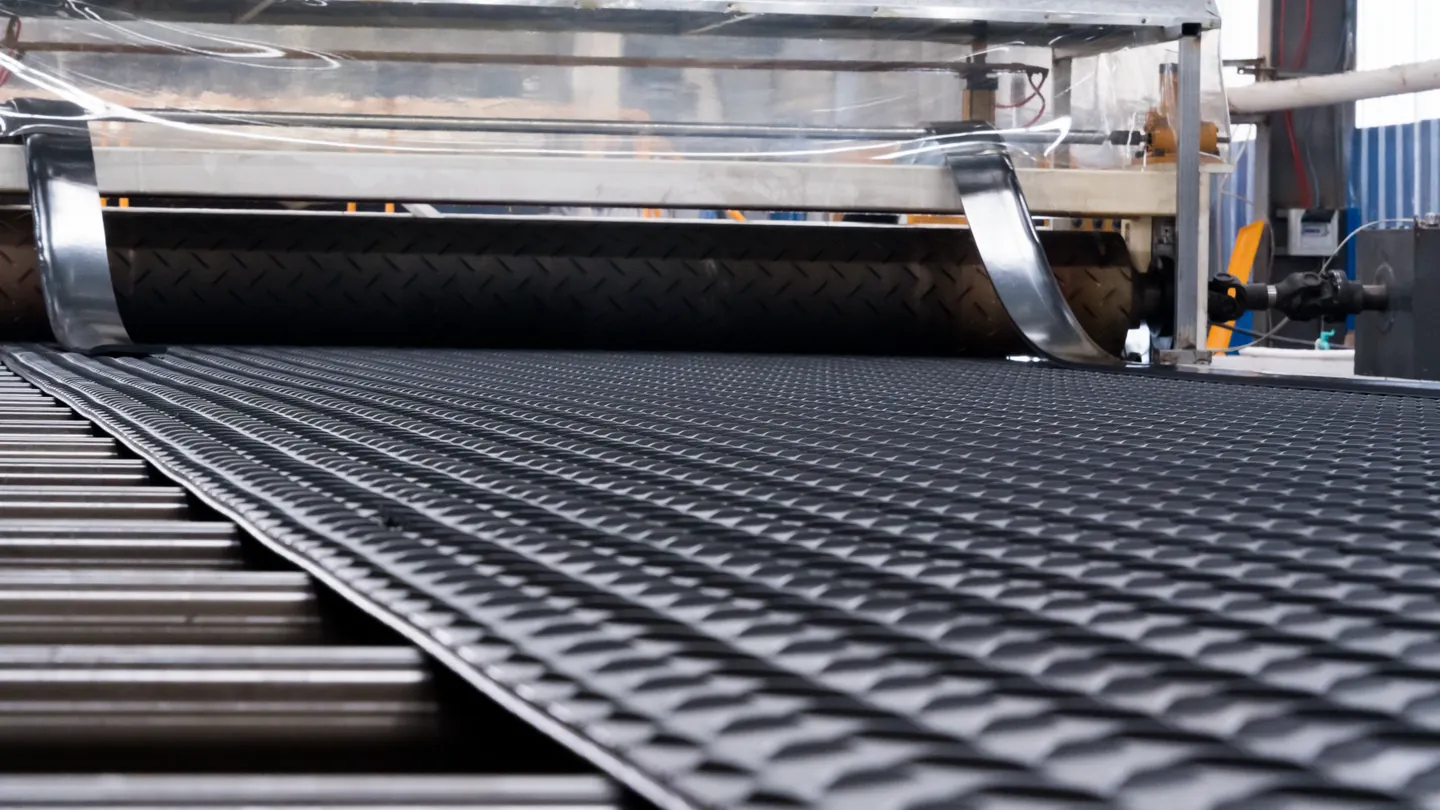
Short answer: a compression molded HDPE ground protection mat is made by placing a precisely weighed charge of high-density polyethylene resin into a heated steel mold, closing the press and applying high pressure until the material flows, fuses and fills the cavity. It cools into one dense panel with the traction pattern and edges formed in the same step — no layers, no voids, no weak plane. The process, not just the resin, decides how long the mat survives on site.
For procurement teams and contractors, “how is it made” is not a trivia question. It is the fastest way to tell a rental-grade mat from a cheap sheet that will crack after a season. This article walks through the eight stages of production at our factory, explains what compression molding changes in the finished mat, and gives you the questions to ask any supplier before you order.
How mats are made: the short version
Every compression molded mat passes through the same eight stages:
- Raw material — HDPE resin plus a controlled additive package
- Weighing & charging — a measured charge for each panel
- Edge trimming & sizing — precision-cut sides and exact net dimensions before molding
- Compression molding — heat and pressure in a closed steel mold
- Cooling & demolding — controlled cooling, then release
- Surface texture — the traction pattern is formed in the mold
- Drilling connector holes — holes and interlocks machined into the edges
- Inspection — dimensional, weight and visual checks
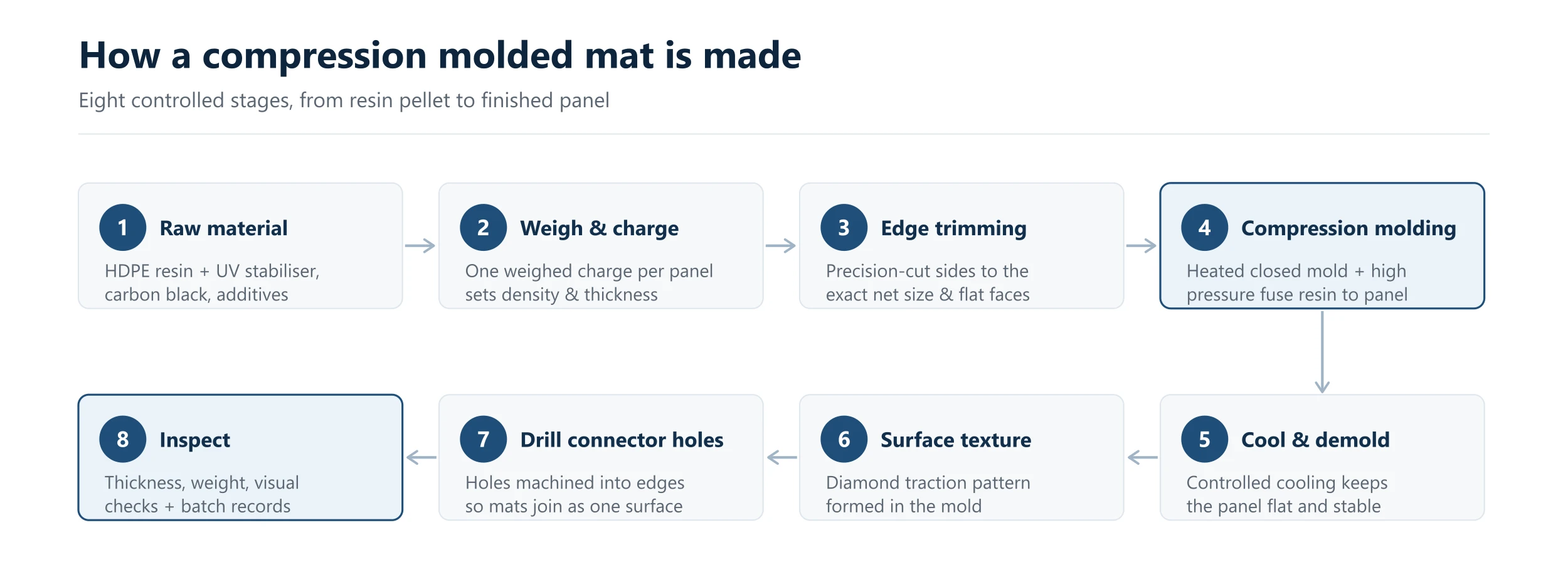
Two things separate a good mat from a bad one at this stage: the quality of the resin going in, and how consistently the process is controlled. The rest of this guide explains both.
Step 1 — Raw material: it starts with the resin
Ground protection mats are made from high-density polyethylene (HDPE), a thermoplastic valued for its high strength-to-weight ratio, chemical resistance and low water absorption. But “HDPE” on a datasheet is not enough — buyers should ask what else is in the mix.
A rental-grade mat charge typically contains:
- HDPE resin — the base polymer. Virgin resin gives the most predictable strength and stress-crack resistance; recycled content can be used, but its source and consistency matter, because variable molecular weight creates weak spots.
- UV stabilisers and carbon black — protect the polymer from sunlight so the mat does not become brittle outdoors. This is what separates an outdoor mat from an indoor plastic sheet.
- Antioxidants and colour masterbatch — protect the material during repeated heating and give the mat its colour for site identification.
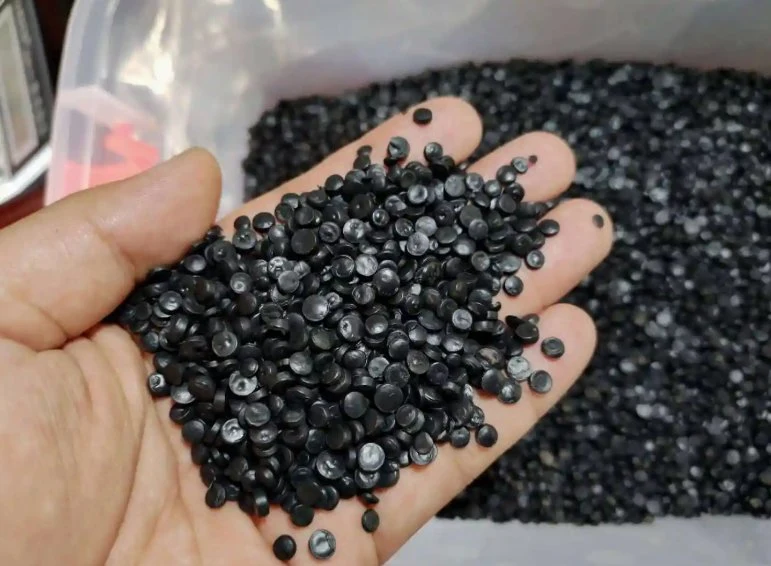
This is the first place a low-cost mat and a long-life mat diverge. A supplier using unspecified recycled flake with a minimal additive package can make a mat that looks identical on delivery day and fails early under UV exposure or repeated loads. Ask what resin grade and UV package go into the mat — a factory that knows its own material will answer directly.
Step 2 — Weighing and charging the mold
Each panel begins as a weighed charge of material. The operator doses the resin and additives to a set mass, then loads the charge into the mold cavity.
That weight is not cosmetic. Because the mold volume is fixed, the mass of material in each charge determines the density and thickness of the finished panel. Under-charge a mold and the mat is light and porous; over-charge it and the material flashes at the parting line. Consistent weighing is what lets a factory hold a thickness tolerance across a whole production run — and what lets you stack mats safely, knowing each one is the same gauge. At this stage we also record the batch, so any panel can be traced back to its material lot.
Step 3 — Edge trimming and sizing
Before the panel enters its final molding stage, its edges are precision-trimmed to the exact net size. A cutting head runs along the sides of the board, shaving the edges to a clean, straight line and bringing every panel to the same defined width and length.
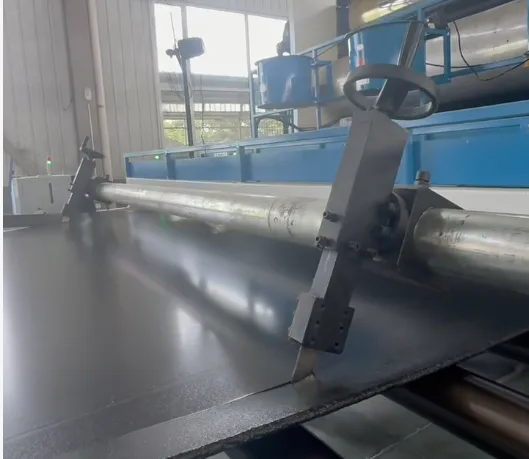
This step is what makes a mat dimensionally accurate. Because the sides are cut flat and smooth to a fixed size, each finished panel has a consistent footprint — it stacks squarely, lies flat on the ground and butts up flush against the next mat with no gaps or overhang. Put simply, this is the stage that decides whether a board comes out exactly the size it should be, with side faces that are smooth and free of rough edges.
It also matters for safety and handling: a clean, smooth edge is easier and safer to work around on site than a rough, ragged one, and uniform dimensions mean a rental fleet can mix panels from different production runs and still connect them cleanly.
Step 4 — Compression molding: where the mat is actually made
This is the defining stage. In compression molding, a measured charge is placed into an open, heated steel mold. The mold closes and a hydraulic press applies high pressure while the mold is held at temperature. The HDPE softens and flows under pressure, filling the cavity and fusing into a homogeneous mass, then is held under pressure while it consolidates.
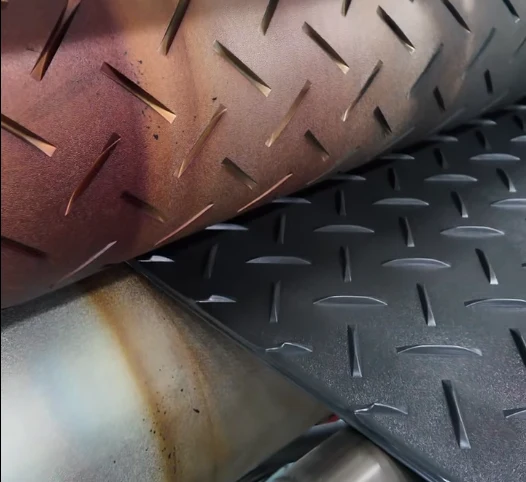
Three things happen at once:
- Heat brings the HDPE to a flowable state without degrading it.
- Pressure forces the material to fill every corner of the cavity and compacts it into a dense, void-free sheet.
- The mold gives the panel its exact dimensions, edges and surface pattern.
Because the material flows inside a closed mold rather than being pushed through a die, compression molded HDPE is uniform from top to bottom — no layered skin, no internal voids, no weak plane where a crack can start. It is also the process that makes thick panels possible: while extrusion is generally limited to thin sheet, compression molding produces mats from 12.7 mm all the way to 60 mm.
The result is a panel whose strength is the same in every direction and in every mat — exactly what a load-distribution application needs. Our heavy duty ground protection mats are made on this process.
Step 5 — Cooling and demolding
Once the mat has consolidated, it is cooled under controlled conditions before the mold opens. Cooling is a quality step, not a waiting step: if a thick HDPE panel is released too hot or too fast, it can warp or lock in internal stress that shows up later as cracking or premature failure. Controlled cooling keeps the panel flat and dimensionally stable — one reason compression molded mats stack squarely and sit evenly on uneven ground.
When the mold opens, the finished panel is released. It already carries its final thickness, edges and surface texture from the mold; very little secondary work is needed.
Step 6 — Surface texture
The anti-slip traction pattern is molded into the surface during Step 4 — it is not a coating or applied film that can wear off. Most mats carry a diamond or similar pattern on one or both faces, and a smoother reverse can be specified where the mat lies on turf or finished paving. This is the texture that gives a mat its grip in mud, rain and frost, and because it is part of the panel, it lasts as long as the mat does.
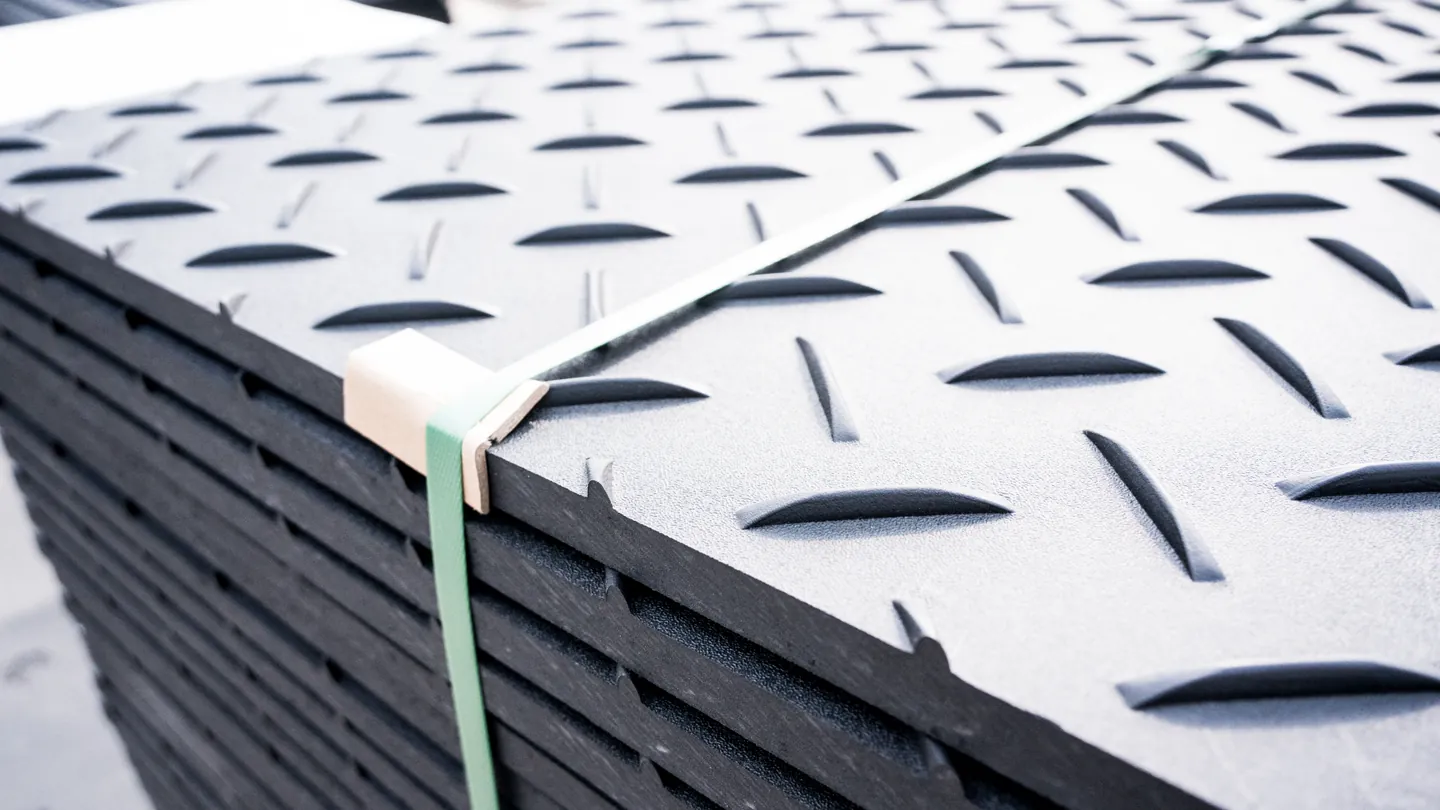
The edge is already cut to its exact size in Step 3, so no further trimming is needed here. The connection points are the remaining machining step, covered next.
Step 7 — Drilling the connector holes
After trimming, the panel goes through a separate machining step: the connector holes and interlocking features are cut into the edges. This is not part of the molding cycle — the holes are drilled or machined to a fixed position so every mat in a batch lines up with the next.
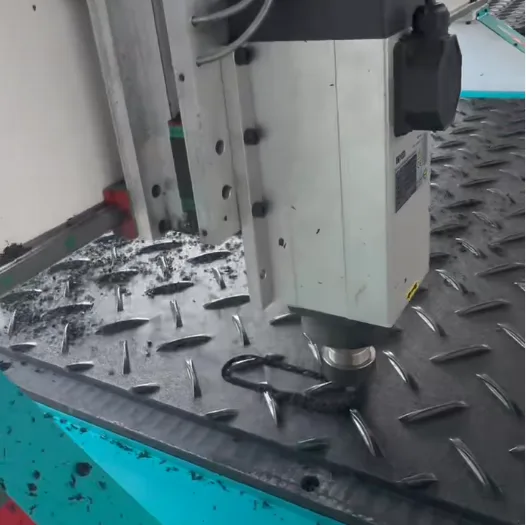
That precision matters more than it looks. Connection points are what let individual mats lock into a continuous surface, so loads transfer across joints instead of digging in at the seams. If holes are off-position or poorly cut, mats will not join cleanly, gaps open up, and the weakest point in the whole road becomes the joint. Consistent hole placement is also why a rental fleet can mix panels from different batches and still connect them on site.
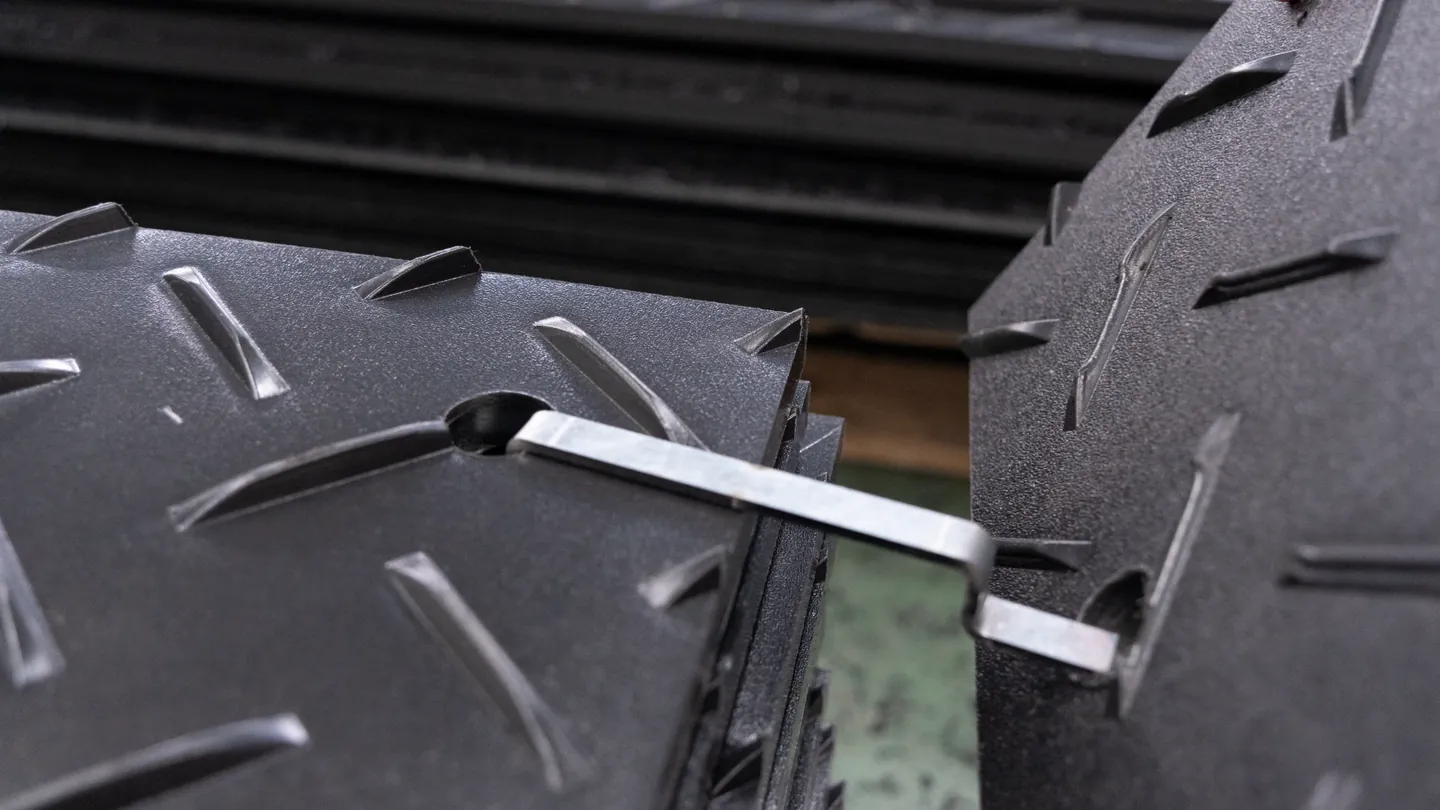
If your site needs a connected roadway rather than isolated pads, see ground protection mat connectors and how they affect layout.
Step 8 — Inspection and quality control
Every mat is checked before it leaves the factory. Quality control here is about process and dimensional consistency — confirming that each panel matches its specification and that the molding process stayed in control.
- Thickness and flatness — measured against the ordered gauge, with a straight edge and tape check across the panel.
- Unit weight — compared with the target mass for that size and thickness. Consistent weight means consistent density and material content.
- Visual inspection — looking for cracks, voids, damaged edges, flash or surface defects.
- Connector fit — confirming holes and interlocks are clean and mate correctly.
- Batch records — process parameters and inspection results logged against the material lot for traceability.
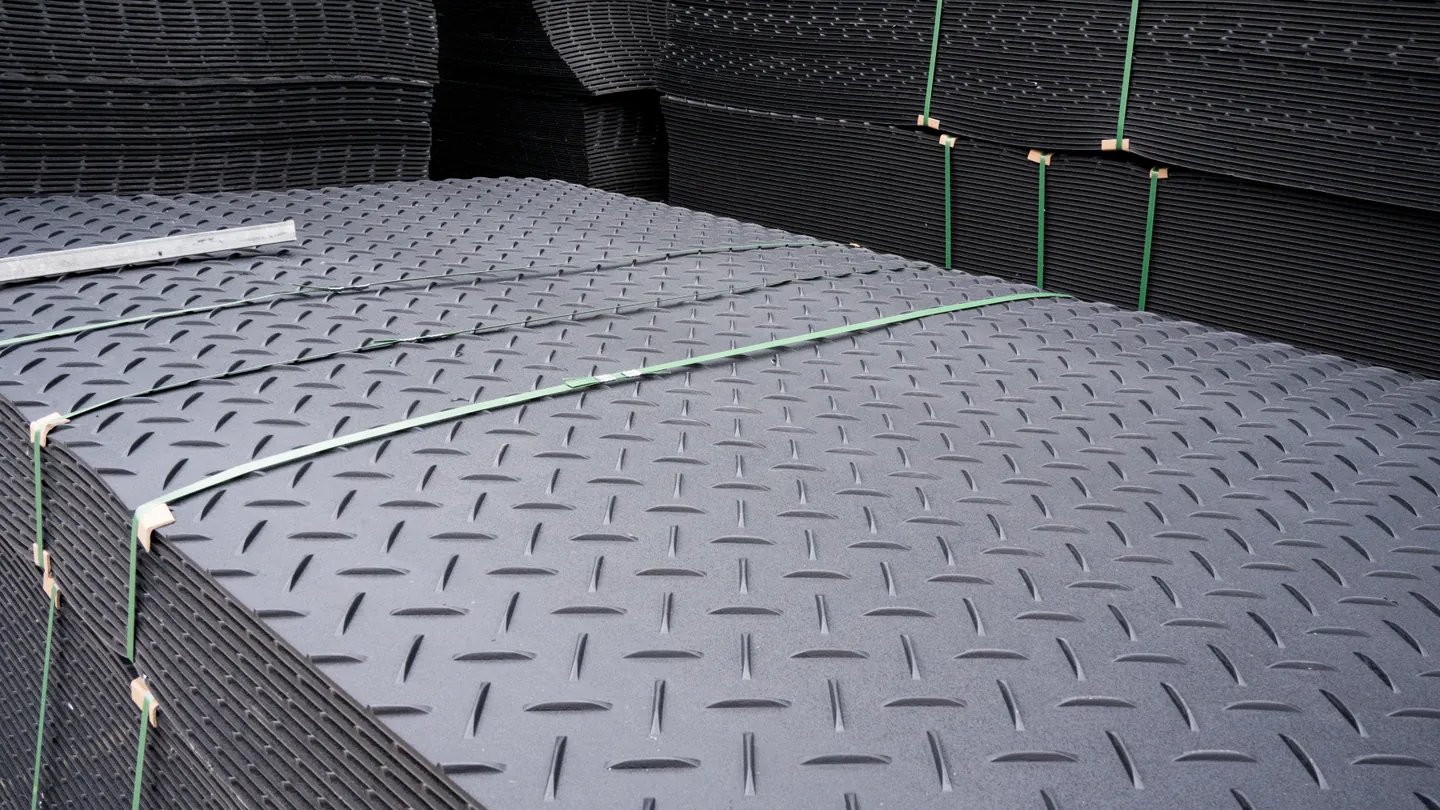
A factory that can walk you through these checks — and show the records — is telling you something real about how it controls quality. For the full list of sizes, thicknesses and unit weights, see our ground mat specifications.
Compression molded vs extruded: why the process matters
This is the question buyers ask most once they learn there are two ways to make an HDPE mat. Both start with polyethylene; they are not the same product.
| Factor | Compression molded mat | Extruded sheet mat |
|---|---|---|
| How it is made | Charge placed in a closed heated mold, pressed under high pressure | Molten plastic pushed through a die, cut to length |
| Internal structure | Dense and homogeneous — no layers, no voids | Layered, less dense structure |
| Thickness range | 12.7–60 mm and beyond | Generally limited to thin sheet (~12 mm typical) |
| Dimensional consistency | Every mat formed in the same mold — near-identical | Cut to length; small variations between sheets |
| Under point loads | Resists cracking and deformation | More likely to flex, bend or crack under repeated load |
| Stacking | Identical panels stack square and stable | Variation makes tall, safe stacks difficult |
| Best for | Heavy equipment, soft ground, repeated rental use | Pedestrian routes, light carts, firm dry ground |
Neither process is wrong — extruded sheet is cheaper and fine for light, occasional use on firm ground. But if the job involves vehicles, soft or uneven soil, freeze–thaw cycles or repeated deployment, compression molding is the process that holds up. A cheap sheet that cracks after one season is not cheaper once you add replacement cost, downtime and site restoration. That is the argument we make in detail on cost & ROI.
How can you tell which process a mat used? Cut a sample and look at the cross-section: compression molded HDPE is uniform through its thickness, while extruded sheet shows layering. Molded mats are also near-identical edge to edge and carry a texture that is part of the surface rather than a pressed-on skin.
What the process means for buyers
Manufacturing method is not an abstract technicality — it shows up in four things you actually pay for:
- Predictable performance. Every mat behaves the same way, so your load plan and layout assumptions hold across the whole roadway.
- Longer service life. A dense, void-free, UV-stabilised panel survives repeated handling and weather instead of failing early.
- Safer storage and transport. Consistent dimensions mean stable stacks and predictable truck loads.
- Lower cost per use. A mat that lasts many projects beats a cheaper mat replaced every season.
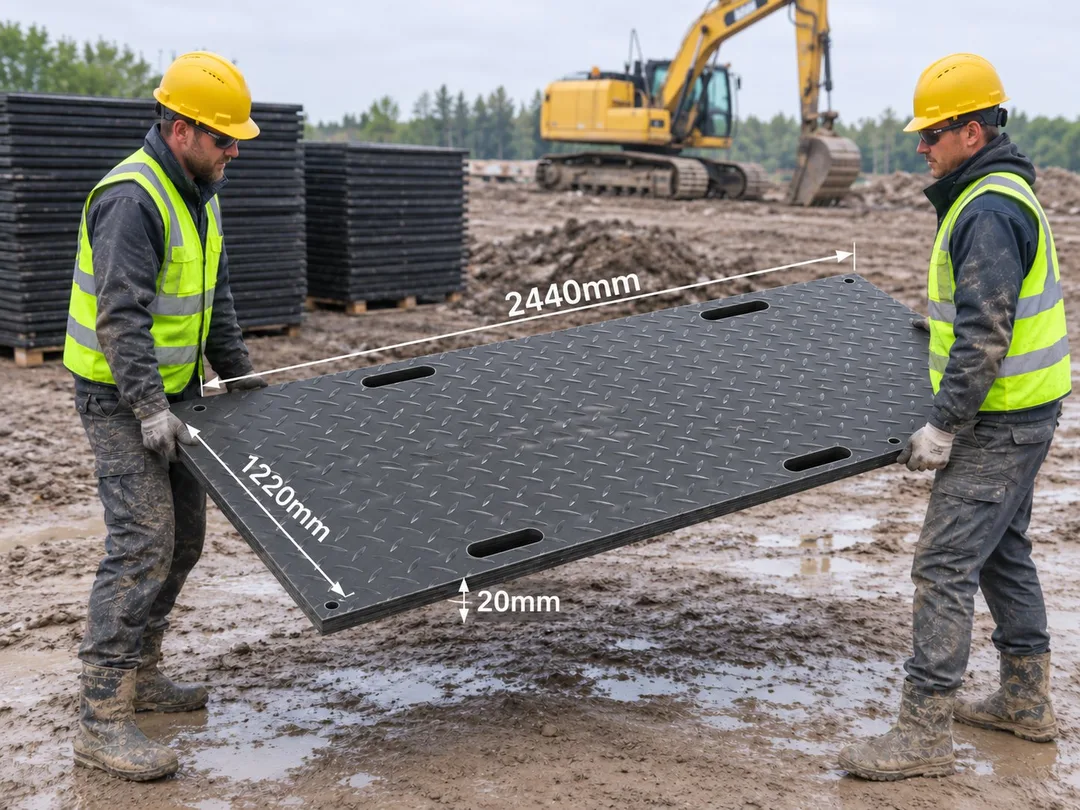
Standard compression molded formats are 1220 × 2440 mm and 2000 × 4000 mm, in six thicknesses from 12.7 mm to 60 mm, with custom sizes available. Unit weights run from 36.83 kg (1220 × 2440 × 12.7 mm) to 480 kg (2000 × 4000 × 60 mm) — a 1220 × 2440 × 20 mm mat is 58 kg, a genuine two-person lift. See the full size and weight table or start with our HDPE ground protection mats range.
Peak load reference for the top specification is up to 120 t on firm, level ground — a nominal distributed static figure, not a certified design value or point-load rating. Real capacity depends on subgrade, thickness and connection layout. If you are unsure which thickness your site needs, use the thickness selection guide rather than extrapolating from a headline number.
How to verify a manufacturer’s process
Because the process matters, the fastest way to qualify a supplier is to ask process questions. A real factory answers them easily:
- What resin grade goes into the mat — virgin or recycled, and what UV package? Vague answers here are a red flag.
- Is the mat compression molded or extruded? Ask to see the molds and the press, not just finished goods.
- What thickness range can you actually mold? A supplier whose range stops at 20 mm may not be compression molding heavy panels.
- How do you control thickness and weight consistency? Look for a documented process, not a claim.
- What inspection and batch records do you keep? Traceability separates a factory from a reseller.
- Is the traction pattern molded in or applied on top? Molded texture lasts; applied texture wears.
If you want to see how we answer these questions in practice, read about our factory or request a sample and a factory walkthrough.
Frequently asked questions
How is an HDPE ground protection mat actually made?
A weighed charge of HDPE resin and additives is placed in a heated steel mold, compressed under high pressure until it fuses and fills the cavity, then cooled and released. The traction pattern, edges and thickness are formed in the mold in the same step, before final trimming, connector machining and inspection.
What is compression molding and why does it matter for ground mats?
Compression molding forms a part by placing material in a closed heated mold and pressing it under high pressure. For ground mats it produces a dense, uniform panel with no internal layers or voids — better resistance to cracking, more consistent load distribution and the ability to make thick, heavy-duty panels.
How can you tell if a mat is compression molded or extruded?
Look at a cut cross-section: compression molded HDPE is uniform through its thickness, extruded sheet shows layers. Molded mats are also nearly identical in dimensions from one to the next, and their traction texture is part of the surface rather than a pressed-on layer.
Are HDPE mats made from virgin or recycled plastic?
Both are used in the industry. Virgin HDPE offers the most predictable strength and stress-crack resistance; recycled content can be used but its source and consistency matter. Always ask the supplier which grade and UV stabiliser package they use.
Why does a compression molded mat cost more upfront?
The process is slower, uses heavier tooling and can use more material per panel. The premium is recovered through longer life, lower breakage, safer stacking and fewer replacements — see the cost & ROI page.
What thicknesses can compression molding produce?
Our compression molded range runs from 12.7 mm to 60 mm, in 1220 × 2440 mm and 2000 × 4000 mm formats, with custom sizes available. Extrusion is generally limited to much thinner sheet.
What quality checks happen during production?
Incoming material checks, mold temperature and pressure monitoring, thickness and flatness measurement, unit-weight comparison, visual inspection for surface and edge defects, connector fit checks and batch-level records — process and dimensional controls that keep every panel consistent.
Does the anti-slip texture wear off?
No — on a compression molded mat the diamond texture is formed in the mold as part of the panel surface, not applied as a separate coating, so it lasts as long as the mat itself.
The short version
A mat’s performance is decided before it reaches the site — in the resin, the mold and the press. Compression molding turns HDPE resin into a dense, uniform, dimensionally consistent panel that resists cracking, stacks safely and lasts for repeated use. Extruded sheet is cheaper for light duty, but it is not a substitute where loads, soft ground or long service life matter.
If you are specifying mats for a real project, the next step is to match thickness and size to your ground conditions — start with the buying guide or talk to our technical team about your load case.
Go deeper: still weighing the material choice? See our side-by-side guide to HDPE ground protection mats vs steel plates — where each one wins, what it costs to move and install, and how to decide for your site.