
Ground Protection Mats for Landscaping: Why 12.7 mm Is the Right Answer
For lawn, tree-care and garden access, specify 12.7 mm HDPE panels with the pedestrian tread face up: they protect roots and decorative surfaces and stay two-person portable. 20 mm is overspecification here. These panels protect plants during repeated light access — not crane outrigger pads, temporary bridges, haul roads or permanent driveways.
This page is about protecting plants, root zones and decorative surfaces over a season of repeated light access. Covering a lawn for a single weekend event with a crowd, service vans and a fast strike is a different load case; see ground protection mats for events. The landscaping buyer optimises for the lightest panel two people can move weekly; the event buyer for visitor comfort and trip-free edges.
What ground protection mats for landscaping are
A landscaping ground protection mat is a removable, hand-portable panel laid over turf, a root zone, decorative paving or a finished driveway so mowers, small loaders, wheelbarrows, chippers and light utility vehicles can pass without rutting the soil, compacting fine roots or marking the surface. Each 1,220 × 2,440 mm (4 × 8 ft) HDPE panel covers 2.98 m² (32 sq ft), has dual-face tread — a pedestrian face and a vehicle face — and is moulded with 4 hand holes and 8 connector holes. On a lawn or decorative surface the finer pedestrian tread faces up; the aggressive vehicle tread would imprint the surface the panel is there to protect.
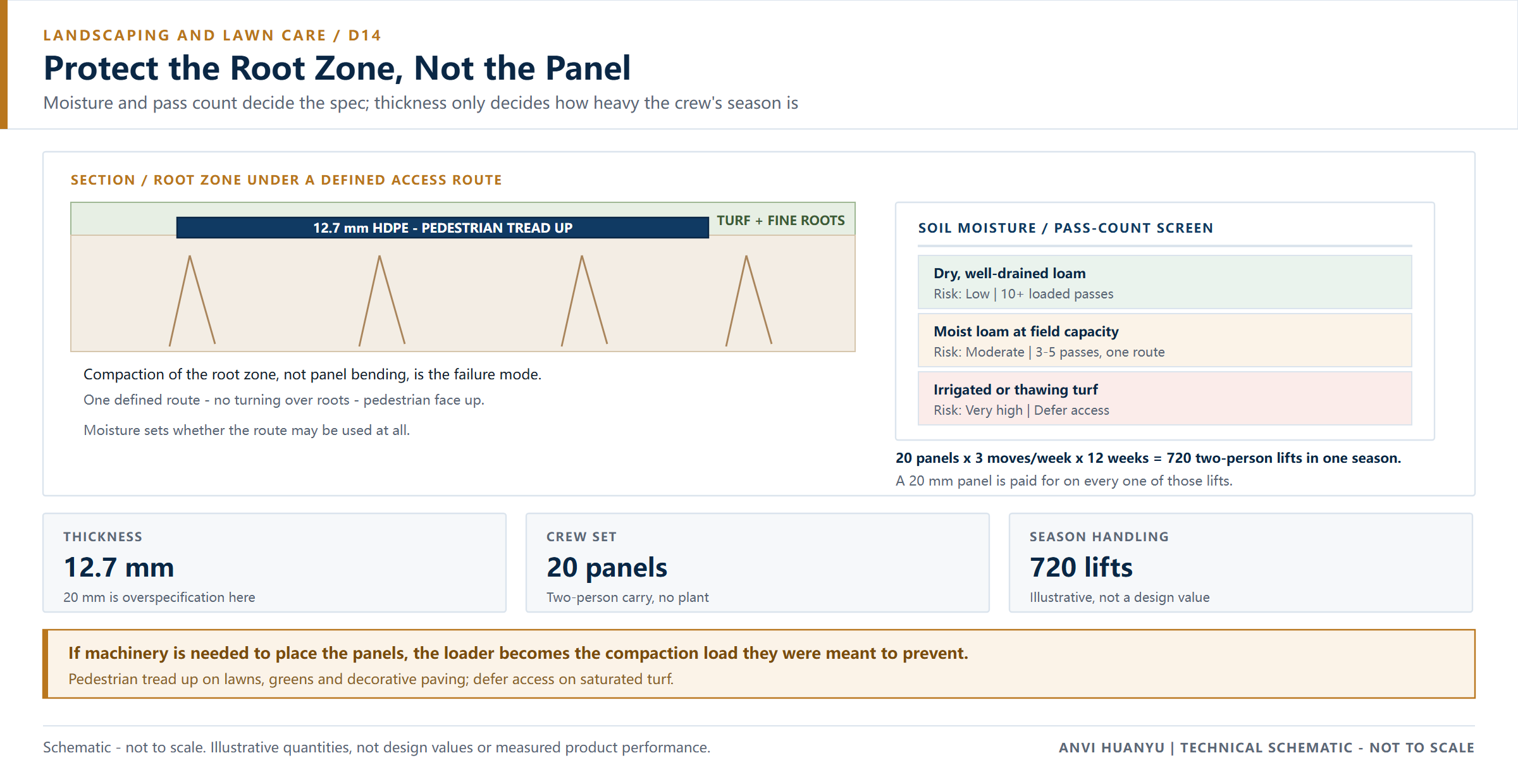
The distinction that matters here is root-zone protection. Fine absorbing roots sit close to the surface and are damaged by compaction long before a rut is visible. A panel spreads a wheel load over 2.98 m² rather than a tyre patch, lowering contact pressure, but it does not make wet soil incompressible. It is one control among several: define a single route, keep repeat passes to it, avoid turning over a root zone and stay off saturated ground. That is why the conclusion is the lightest workable board, not the stiffest — a heavier board pushes a crew toward machinery, and the machinery is itself a compaction load.
Typical equipment is a ride-on mower, a compact loader on turf tyres, a towed chipper, a wheelbarrow and occasionally a small telehandler. Loaded dump trucks, tracked excavators and cranes are not in scope. Standard sizes are on our 4 × 8 ft ground protection mats and specifications pages. Lawn protection mats is the product; a turf and root-zone access plan is the arrangement — defined route, moisture window, pass count, tread orientation, cleaning and storage. A contractor who orders only a panel count usually omits the moisture window, and a “protected” lawn still ends up compacted.
When to use them — and when not to
| Condition | Suitable | Notes |
|---|---|---|
| Work type | Mowing, tree care, hedge work, planting, garden machinery access, light driveway use | Repeated light passes over a season |
| Equipment | Ride-on mowers, compact loaders on turf tyres, chippers, wheelbarrows, light 4×4s | Keep to one defined route |
| Ground | Dry to moderately moist turf, decorative paving, finished driveways | Saturated soil is the derating case |
| Root zones | Mature trees, specimen planting, golf greens surrounds | Compaction, not panel bending, governs |
| Handling | Two-person carry, no lifting plant | This is the reason 12.7 mm is specified |
| Duration | A maintenance season of repeated access | Panels redeploy along the work front |
| Reinstatement | Lawn or paving handed back unmarked | Pedestrian tread up; wash before storage |
Do not use our type of HDPE panel when:
- Heavy plant — a laden dump truck, tracked excavator, piling rig or crane outrigger. A heavy point load needs a rated pad or heavier system.
- Sustained steel-track traffic — sharp grousers cut and abrade HDPE.
- Bridging a void, trench, culvert, service or uncompacted backfill — these panels are load spreaders, not beams or temporary bridges.
- Saturated, recently irrigated or thawing ground that cannot be drained — defer access; a thicker board compacts the root zone just as surely, and machinery to place it makes it worse.
- A permanent driveway or public-access route requiring a certified specification without a separate assessment.
- A seamless, joint-free decorative finish — a connected panel field has visible joint lines.
Where a lift plan, permit or tree-protection order applies, obtain a site-specific engineering or arboricultural assessment. We would rather tell an arborist to keep machinery off a root zone than imply otherwise.
How to install and use them on a lawn or root zone
Landscaping installation is judged by how little the crew disturbs the ground. This seven-step sequence is written for that; a fuller procedure is in how to install ground protection mats.
- Walk the route and define a single path. Mark the root zone of any mature tree, decorative paving and the wettest spots; one route confines unavoidable compaction to a strip that can be aerated later.
- Check soil moisture first. Dry or moderately moist turf tolerates light passes; saturated or thawing turf does not. Defer, rather than add thickness.
- Lay geotextile only where separation is needed, then start on firm ground and work outward; never span a hollow or service trench.
- Orient the pedestrian tread face up. On a lawn or paving, the aggressive vehicle tread would mark the surface you are protecting.
- Connect the panels you will traffic and stagger joints by half a panel. Four hand holes and eight connector holes let two people place and link a run without machinery; see connector types and interlocking options.
- Keep turning and repeat passes off the root zone. Run one light vehicle at walking pace, then check for edge settlement, joint opening and turf imprint.
- Recover from the far edge backwards, wash and store flat; inspect hand holes and connectors and stack supported. Aerate the route at hand-back where specified.
Original matrix: root-zone compaction, soil moisture and pass count
Pass counts here are illustrative industry reference values, not design values; a site trial and the day’s ground condition set the real number.
| Soil moisture / condition | Compaction sensitivity | Illustrative light passes before visible rutting | Recommended action |
|---|---|---|---|
| Dry, well-drained sandy loam | Low | 20+ light mower passes | 12.7 mm, pedestrian tread up; still rotate the route |
| Moist loam at field capacity | Moderate — fine-root risk | 3–5 loaded utility-vehicle passes | One defined route; no turning over root zones |
| Wet / saturated clay | High — smears and pumps | 1 laden pass can rut | Do not traffic; defer, or drain and separate first |
| Recently irrigated or thawing turf | Very high | 0 — defer access | Wait; panels reduce but do not eliminate compaction |
| Critical root radius of a mature tree | Severe — fine roots damaged below visible rutting | Minimise any repeat traffic | Spread the load, cap passes, keep heavy machinery off entirely |
A panel can look intact while the soil beneath is already compacted. Thickness is not the lever here — moisture, route discipline and pass count are.
What it saves: a cost comparison you can audit
The honest comparison is mats versus ruts, reinstatement and a machine to place the boards. A compact loader that bogs on a wet lawn can cost a day of programme plus a re-turf claim; a defined route avoids both. The more useful comparison is 12.7 mm versus 20 mm, because the thicker board is often bought “to be safe” and then costs more in the currency this trade cares about — crew time.
Cost per use = (delivered cost + handling + deployment labour + cleaning + storage
+ losses + reinstatement) ÷ number of deployments| Factor | Bare ground / plywood | 12.7 mm HDPE panels | 20 mm HDPE panels |
|---|---|---|---|
| Rut and reinstatement risk | High | Low, if moisture window respected | Low, but no better at these loads |
| Placement | n/a | Two people, by hand | Often needs machinery, which compacts soil |
| Passes over a season | Uncontrolled | Defined, repeatable route | Same, but slower to reposition |
| Freight per panel | n/a | Lowest | Higher; fewer panels per container |
| Turf marking | Plywood stains and splinters | Pedestrian tread up, clean | Same risk, more weight on the turf |
The break-even point is the number of times the crew moves the same set. Our cost and ROI guide sets out the calculation. Use your own crew rate, move frequency and season length rather than an invented case; the account below shows how.
Original account: two-person carries and labour hours over a season
Handling method is set by a sample-panel trial; the time below is a typical guideline, not a design value.
| Line | Assumption (illustrative) | Result |
|---|---|---|
| Panels in the set | A small tree-care / lawn crew | 20 panels (12.7 mm; two-person carry) |
| Repositioning moves per week | Crew shifts the access path as the work front advances | 3 moves / week |
| Weeks in the maintenance season | Illustrative | 12 weeks |
| Two-person lifts per move | One per panel | 20 |
| Total two-person lifts | 20 × 3 × 12 | 720 two-person lifts |
| Time per lift, ~15 m carry and place | 1.5–2 min (typical guideline; illustrative, not a design value) | ≈ 18–24 crew-hours / season |
| Single-person equivalent | 720 × 2 people | 1,440 person-lifts |
| If 20 mm panels were chosen | Heavier; may need a machine for every move | More crew or machinery, no load benefit, more compaction |
Seven hundred and twenty two-person lifts is a real season’s handling cost, paid at 12.7 mm. Choose 20 mm and the same 720 moves are slower, may need a loader — and the loader is precisely the compaction load the panels were meant to keep off the root zone.
Why this mat — not a lighter panel or another material
| Option | Where it fits in landscaping | Why we would not choose it here |
|---|---|---|
| 12.7 mm HDPE (recommended) | Lawns, root zones, decorative paving, driveways, repeated light access | The lightest panel that spreads the load, protects the surface and stays two-person portable |
| 15 mm HDPE | A one-off heavier machine on firm ground | Marginal extra weight for a load case that rarely appears in this trade |
| 20 mm HDPE | Continuous heavy haul roads, tracked plant | Overspecification here — weight, machinery and lost handling time (see the account above) |
| Plywood | One-off dry cover on a hard surface | Absorbs water, delaminates, splinters, can stain turf — see HDPE vs plywood mats |
| Steel plate | Short, very high point loads | Needs lifting plant, corrodes, conductive, marks turf |
| Bare ground / no protection | Firm, dry, dispensable surface | Rutting, compaction and a reinstatement claim |
Why not the thickest board? Because 20 mm is overspecification here, and its cost is concrete: heavier lifts on every one of the 720 moves, a machine brought onto the root zone, and fewer panels per container. Why not the cheapest sheet? Plywood swells on a wet lawn, splinters under a wheelbarrow and can stain decorative paving. Our light-duty range is built for this load class.
Pedestrian tread face up on lawns and paving; a light or clear colour option is often requested to reduce heat build-up and marking, but availability and surface finish are on request rather than stated as fact. Panels must be washed before storage and stacked flat and supported.
Why 12.7 mm is the right thickness — the derivation chain
Work the selection chain in order. The figures below are an illustrative engineering check, not a certified design value.
| Step | What to establish | Illustrative check |
|---|---|---|
| 1 | Heaviest machine | A compact utility loader on turf tyres, roughly 2–3 t laden — not a dump truck |
| 2 | Contact pressure | A turf tyre at low inflation; a fraction of a construction axle group |
| 3 | Ideal spread over one panel | 3,000 kg × 9.81 ÷ 2.98 m² ≈ 9.9 kPa if rigid |
| 4 | Real effective area and the real limit | HDPE deflects between supports; use a reduced effective area. Here the governing limit is soil compaction and root damage, not panel bending |
| 5 | Subgrade allowance | Dry turf tolerates light repeated loading; saturated or thawing turf compacts (industry guidance: wet soil loses 30–50% of dry bearing capacity) |
| 6 | Safety margin | Add 15–20% only if a genuinely heavier machine is confirmed; otherwise the moisture window and route discipline are the margin |
| 7 | Conclusion | 12.7 mm, pedestrian tread up, two-person carry; 20 mm is overspecification here |
Three qualifications apply:
- We have not used our published nominal ratings in this calculation. Our published reference ratings — 80 / 100 / 120 t for 12.7 / 15 / 20 mm — are nominal figures for evenly distributed static loading on a firm, level subgrade. They are not certified design values and must not be used as point-load capacity, crane outrigger capacity, or a permit-to-bridge voids. We publish no test method, sample thickness, support span or test report for these figures; they are labels, not design inputs.
- Confirm the thickness convention. Ask whether a quoted figure is the base sheet or overall including raised tread; the difference can approach 10 mm (industry reference) and changes stiffness, stacking height and the edge a wheelbarrow meets. See how to choose ground mat thickness.
- Thickness changes freight and ergonomics. At 20 mm the same container carries fewer panels than at 12.7 mm (industry reference range, to be confirmed), and every panel is heavier at every one of the season’s moves.
This is a selection starting point, not a certified design value. Confirm against the heaviest machine on site, not the fleet average. Where a lift plan or permit applies, obtain a site-specific engineering assessment. Common mis-specifications: ordering 20 mm “to be safe” then needing a machine, treating a dry-weather trial as permission to traffic saturated turf, laying vehicle tread down on paving, and assuming an intact panel means uncompacted soil.
Common failure modes and how to avoid them
| Failure | What it looks like | Cause | Prevention |
|---|---|---|---|
| Hidden soil compaction | Grass yellows weeks later, panel looked fine | Trafficking wet turf, too many passes | Respect the moisture window; cap passes; aerate |
| Root-zone damage | Decline in a mature tree after works | Turning and repeat passes over the critical root radius | One defined route; keep machinery off |
| Rutting at the entrance | Ruts where the loader turns in | No firm transition, wet ground | Start on firm ground; extend the route |
| Tread imprint on paving | Pattern pressed into decorative paving | Vehicle tread face down | Pedestrian tread face up |
| Two-person strain / machinery brought in | Crew uses a loader to place panels | Over-specified 20 mm panels | 12.7 mm; confirm two-person handling |
| Panel migration | Boards creep on a slope | Unconnected field | Connect and stagger; re-inspect |
| Staining | Marks under stored panels | Unwashed panels, wet plywood alternative | Wash before storage; use HDPE |
| Edge trip for a wheelbarrow | Wheel catches a lip | Unramped, unconnected edge | Connect every panel; ramp where needed |
What to verify with any supplier before you buy
For a landscaping enquiry, ask every bidder — including us — for the same seven things. This tells you what to request, not what we already supply.
- Is the load figure static, dynamic, distributed or point, with sample thickness and support span?
- Base sheet or overall including tread?
- Is a genuine two-person lift sustainable across a full season of moves? Time it with a sample panel — 720 lifts make handling method, not a catalogue figure, the decisive variable.
- Thickness tolerance and batch consistency record? A light panel that varies will not sit flat with its neighbours.
- Material declaration — virgin HDPE, regrind or PCR, UV stabilisation, colour or finish option?
- Connectors supplied, compatible across future orders?
- A test report with an identifiable method and laboratory plus cleaning and storage instructions? A number without a method is a claim, not a specification; our FAQ answers general questions only.
With 12.7 mm panels, uniformity across a batch is the whole point: one heavy panel in a two-person crew-set changes how the field sits. We can send dated working photographs of the line, a gauge being read on a finished panel and the pallets being wrapped for export. Treat them as proof of the routine, not of the result — the thickness convention, per-batch measurement and tolerance still have to arrive in writing.
Specification summary for a lawn and root-zone access route
| Item | Starting specification |
|---|---|
| Panel | 1,220 × 2,440 mm HDPE, 4 hand holes + 8 connector holes, dual-face tread |
| Thickness | 12.7 mm; 20 mm is overspecification here |
| Tread orientation | Pedestrian face up on lawns, root zones and decorative paving |
| Handling | Two-person carry; no lifting plant |
| Route | One defined path; no turning over root zones; moisture window enforced |
| Season account | 20 panels × 3 moves / week × 12 weeks = 720 two-person lifts (illustrative) |
| Exclusions | Not for heavy plant, outriggers, void spanning, sustained steel tracks, saturated ground or permanent driveways |
| Reference ratings | 80 / 100 / 120 t nominal, distributed static on firm level ground — not certified design values |
Frequently asked questions
What thickness for lawn protection? 12.7 mm with the pedestrian tread face up. A ride-on mower, compact loader on turf tyres and wheelbarrow do not justify more, and the lightest workable panel is the one a two-person crew will reposition. Reserve heavier only for a confirmed heavier machine.
Will mats damage grass roots? The panels spread the load over 2.98 m² but do not make wet soil incompressible. Fine-root compaction is governed by soil moisture, pass count and turning — not panel thickness. Keep a dry-to-moderately-moist window, one route, capped passes and no turning over the critical root radius.
Can one person carry a 4×8 mat? Our 12.7 mm panel is specified for two-person handling, not one. Trial a sample panel before you plan the crew. A 20 mm panel is heaviest still and one reason it is overspecification here.
Are clear mats available for lawn protection? A light or clear colour option is often requested to reduce heat build-up and visual marking. Availability will be confirmed on request, not stated as given. Whatever the colour, pedestrian tread up and a clean panel protect the surface.
Why is 20 mm overspecification for landscaping? The loads are light and the real limit is soil compaction, not panel bending. 20 mm adds weight to every one of the season’s 720 two-person lifts, may force a machine onto the root zone — itself a compaction load — and reduces panels per container, with no load case.
Can I use the same panels on a construction haul route? No — a laden dumper or tracked excavator needs 15–20 mm, staggered joints and a designed entrance; see ground protection mats for construction. A 12.7 mm panel under a laden axle will deflect and its joints will work loose.
Get a thickness and panel count for your site
Send the heaviest machine and its tonnage, soil or turf condition, the route length and number of moves, project duration and the panel quantity you are planning. We will return a recommended thickness with its basis, a panel count and a container estimate — to albert@hdpegroundmat.com or via our contact page.