
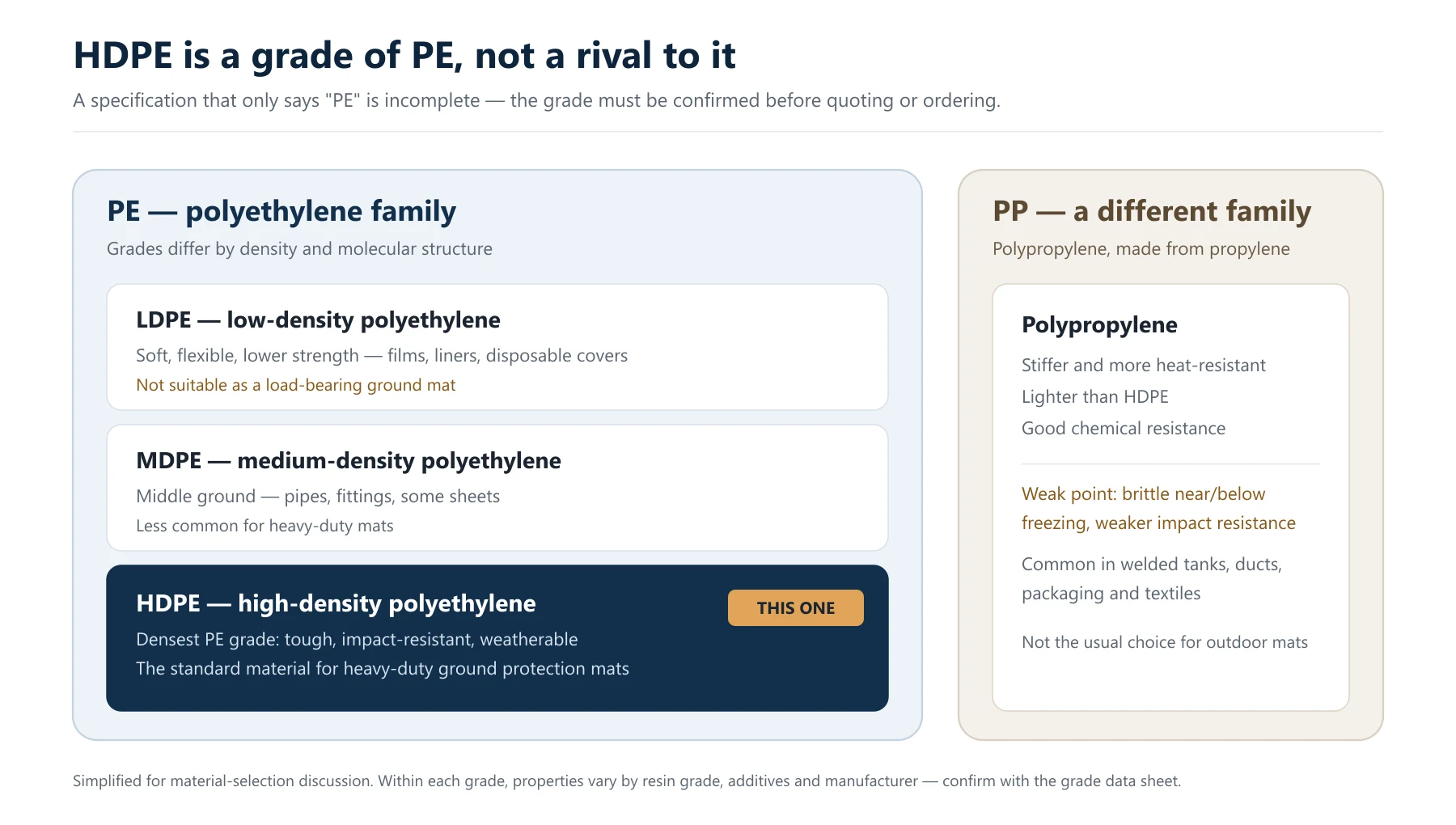
Short answer: for a load-bearing ground protection mat, specify HDPE (high-density polyethylene). It stays tough in freezing weather, absorbs impact without cracking, and has a long track record outdoors. PP (polypropylene) is stiffer and more heat-resistant, but it turns brittle near freezing and is the usual choice for welded tanks, ducts and packaging — not for mats that take traffic on a cold, wet site. One clarification first: PE is the wider polyethylene family, and HDPE is simply its high-density grade. So “HDPE vs PE” is not really a contest between two materials.
Buyers often send an enquiry that says only “PE mat” or ask whether a cheaper PP mat will do the same job. The material named on a drawing changes the price, the performance and the service life, so it is worth settling the question properly. This guide compares HDPE and PP on the properties that actually matter on site, gives typical values with their limits, and ends with a checklist you can put straight into your next RFQ. If you want the broader context on how the mats are produced, see how HDPE ground protection mats are made.
First, the names: PE, HDPE and PP
Most of the confusion comes from the names, so let us clear them up before comparing anything. PE stands for polyethylene, a family of plastics made from ethylene. Within that family, grades are distinguished mainly by density and molecular structure:
- LDPE (low-density polyethylene) — soft and flexible, used for films, liners and disposable covers. Too weak to carry traffic as a mat.
- MDPE (medium-density polyethylene) — a middle grade used in pipes and fittings.
- HDPE (high-density polyethylene) — the densest, stiffest and toughest of the common PE grades, and the standard material for heavy-duty ground protection mats.
PP, or polypropylene, is not a grade of PE at all. It is a different polymer, made from propylene, with its own strength profile. When someone asks for “HDPE vs PE”, what they usually mean is either “which PE grade should I specify?” or “is ordinary PE the same as HDPE?” The answer to both is: the grade has to be named. A purchase order that says only “PE” leaves the most important variable undefined — a supplier can technically quote a soft LDPE film grade and still have met the letter of the order, which is why vague specifications so often lead to disappointing mats.
The density differences are modest but meaningful: typical HDPE sits around 0.95 g/cm³ and PP around 0.90 g/cm³, which is why PP is described as the lighter material. Density alone, however, does not predict how a mat performs — how the resin is processed matters just as much. A compression-moulded HDPE panel behaves very differently from a thin extruded sheet of the same plastic, which is one more reason to evaluate a mat as a finished product rather than by its resin name.
Throughout this article, figures are typical, general-purpose values for each material. Exact properties vary by resin grade, additive package and manufacturer — always confirm against the grade data sheet for the product you are actually buying. Treat the comparison as a starting framework for a specification discussion, not as engineering approval for a particular load case.
HDPE vs PP: six properties that matter
Here is the comparison in one view. The six factors below are the ones that repeatedly decide material selection for temporary ground protection.
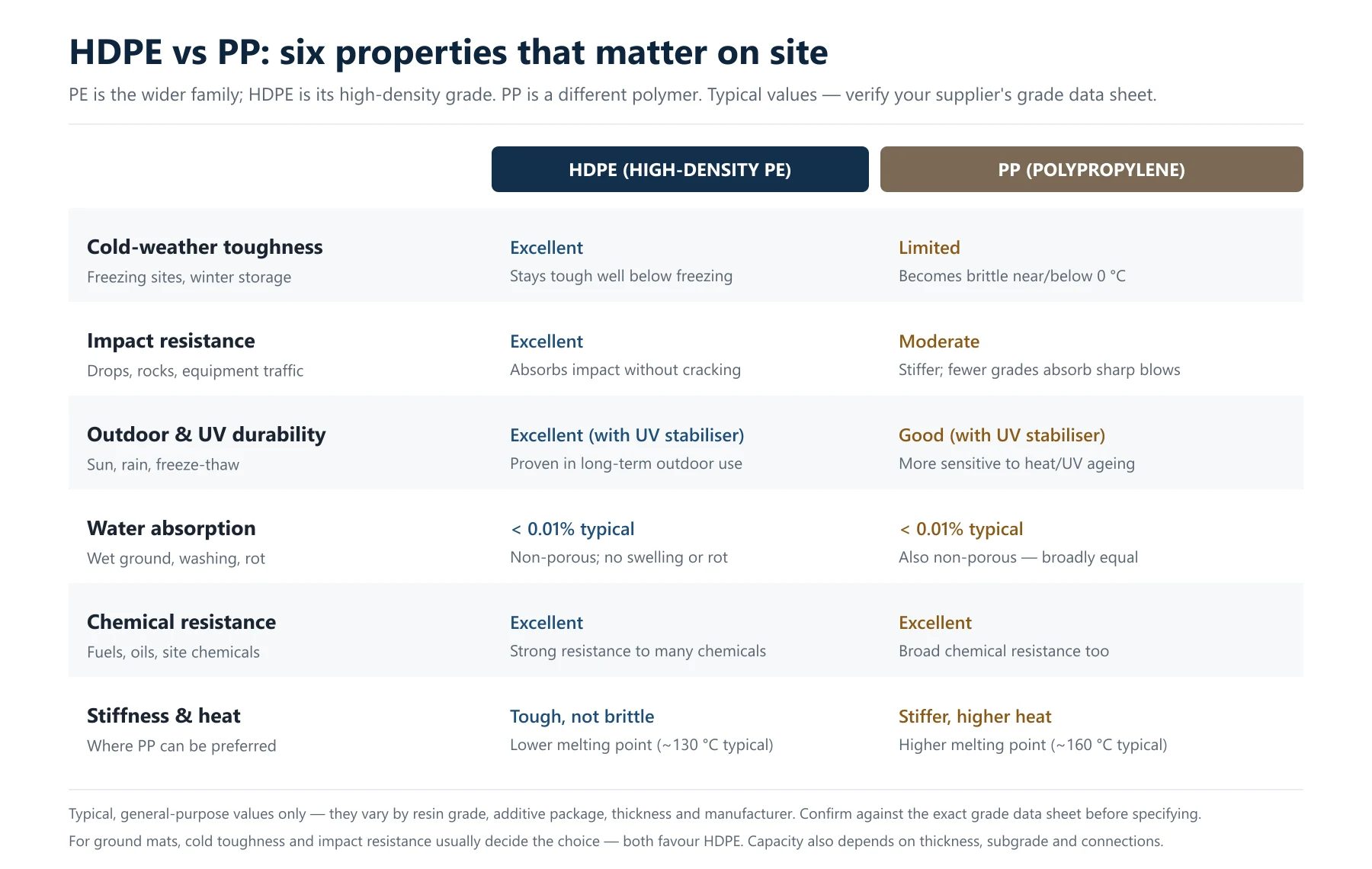
Cold-weather toughness. This is the single biggest difference. HDPE keeps its impact resistance well below freezing; PP begins to embrittle near and below 0 °C. For a mat stored outdoors in winter, dropped from a truck, or laid on a frozen site, that gap decides whether a panel flexes or cracks.
Impact resistance. HDPE absorbs sharp blows — falling rocks, tracked equipment, steel edges — without cracking. PP is stiffer but generally less able to absorb a sudden impact, especially in the cold.
Outdoor and UV durability. Both polymers need a UV stabiliser for long-term sun exposure, and both are used successfully outdoors when it is specified. HDPE has the longer established record in permanently exposed panels and liners; PP is more sensitive to heat and UV ageing over time.
Water absorption. Effectively a tie. Both are non-porous, with typical water absorption below 0.01%. Neither rots, swells or delaminates the way timber does — one reason both beat organic materials on wet ground.
Chemical resistance. Another near tie for general site chemicals, fuels and oils. PP is often praised for chemical service, but HDPE is also highly resistant and, importantly, has better resistance to environmental stress cracking. For the chemicals a construction or events site normally encounters, either material copes; the difference rarely decides a mat purchase.
Stiffness and heat. Here PP genuinely wins. It is stiffer and has a higher melting point (roughly 160 °C versus about 130 °C for HDPE, both typical). That is why PP dominates welded tanks, ducts and hot-fill applications. Stiffness alone, however, is not what makes a good ground mat — a mat must flex slightly over uneven ground without cracking, which favours the tougher HDPE. A material that is too rigid can bridge a small void and then fail at the edge; one that is tough enough to flex distributes the load more forgivingly. This is also why recycled-content and low-grade sheets, whatever the resin label, are a false economy: inconsistent material behaves unpredictably under exactly the impact and cold that a mat must survive.
Why cold-weather toughness decides it
If you take only one thing from this guide, take this: a ground mat lives a hard life at low temperatures. It is delivered in winter, lifted by two people, dropped onto hard ground, and driven over on a site that may be frozen. A material that becomes brittle near freezing is a liability in exactly the conditions when ground protection is most needed — mud, frost and thaw.
HDPE’s molecular structure lets it deform under an impact and recover, rather than shatter. PP’s higher stiffness becomes a weakness here. This is also why the point-load conversation belongs with the engineering, not the resin name: a mat’s capacity depends on thickness, the subgrade beneath it and how the panels are connected, not on the plastic alone. For the site-level comparison, see HDPE mats versus steel plates and HDPE mats versus timber mats.
Why ground protection mats use HDPE
Put the property list together and you get four practical requirements for a temporary access mat — and HDPE meets all four:
- Survives impact. Repeated traffic, drops and sharp objects without cracking.
- Works in all weather. Stable through rain, mud, freeze-thaw and sun, with the right UV stabiliser.
- Does not absorb water. No rot, swelling or delamination; pressure-washes clean between projects.
- Reuses many times. Tough enough to survive repeated lifting, stacking and redeployment — the basis of a lower cost per use.
That is why essentially every heavy-duty temporary mat on the market is moulded from HDPE. Our own HDPE ground protection mats are compression moulded from high-density polyethylene in six thicknesses from 12.7 mm to 60 mm. If you are undecided on gauge, our thickness selection guide matches thickness to ground conditions and equipment. The manufacturing route matters as much as the resin: compression moulding forms the traction pattern and edges in one dense panel, with no layers or weak planes.
On load, we state one careful reference: the top specification reaches up to 120 t on firm, level ground — a nominal distributed static figure, not a certified design value or a point-load rating. Real capacity must be checked against the site’s ground assessment and the exact specification.
Where PP (and LDPE) still make sense
HDPE being the right choice for mats does not make PP or LDPE inferior materials — they simply solve different problems. Being straight about this is useful, because it tells you whether a supplier is matching the material to your job or just selling what they have.
PP is often preferred for fabricated process equipment that must hold its shape and be welded reliably: chemical tanks, scrubbers, ventilation ducts and pickling equipment. Its higher stiffness and heat resistance are real advantages there. It also appears widely in packaging and textiles, where fatigue resistance and low weight matter. In a temperature-controlled indoor setting with little impact, a PP sheet can be perfectly adequate.
LDPE (and other low-density PE grades) excel where flexibility and low cost matter more than strength: protective film, disposable covers and short-term wrapping. They are not credible for a structural mat that carries vehicles.
For an outdoor, reusable, load-bearing mat that must survive winter and rough handling, neither displaces HDPE. If you need help matching a material and gauge to your conditions, send us your site details and we will specify against the actual duty cycle.
How to specify the material in your RFQ
A vague material name is the fastest route to a misleading quote. When you request a price, put these points in writing so every supplier prices the same thing:
- Name the grade: “HDPE”, not “PE” or “plastic”. If the supplier proposes PP, ask why.
- State the density or grade data: request the resin grade or a data sheet, not just a material label.
- Confirm UV stabilisation if the mats will live outdoors.
- Specify thickness and panel size — see the size and weight specifications for the standard options.
- Describe the load and subgrade: equipment type, ground condition and whether mats will be connected.
- Ask about colour, texture and connectors so the panels work as a system.
Two suppliers quoting “a PE mat” can be offering very different products. Naming HDPE, the grade and the thickness removes most of that ambiguity — and it is the single easiest way to compare quotes fairly.
Frequently asked questions
Is HDPE the same as PE?
Not exactly. PE (polyethylene) is the material family; HDPE (high-density polyethylene) is one grade within it, alongside LDPE and MDPE. A specification that only says “PE” is incomplete — ask the supplier to confirm the grade.
Is HDPE stronger than PP?
It depends on which property you mean. PP is stiffer and more heat-resistant. HDPE is tougher under impact and keeps that toughness at low temperatures. For a ground mat that takes traffic and cold, HDPE’s toughness is usually the deciding factor.
Does PP become brittle in cold weather?
General-purpose PP tends to lose impact resistance and become brittle near and below freezing. Exact behaviour depends on the grade — copolymer grades can be better — so check the data sheet if cold service is expected. This is a key reason HDPE is preferred for outdoor mats.
Can polypropylene be used for ground protection mats?
It can be made into a panel, but for reusable outdoor mats that carry traffic, HDPE is the standard choice because of its impact toughness and cold-weather performance. PP is more common in welded equipment, packaging and indoor sheets.
Are HDPE and PP waterproof?
Yes. Both are non-porous with typical water absorption below 0.01%, so neither rots or swells. That is why plastic mats outperform timber in wet conditions — a point also covered in our comparison with timber mats.
Is HDPE recyclable?
Yes, HDPE is widely recyclable (typically resin code 2), and a tough mat that is reused for years keeps it out of the waste stream far longer than a disposable cover. Ask your supplier about recycling options at end of life.
Ready to specify the right material?
If you have a site, a load and a timeline, we can help you choose the gauge and configuration rather than guess from a material name. For the full picture, start with the complete buyer’s guide to HDPE ground protection mats. Learn more about our factory or request a quote and specification sheet — send your panel size, thickness and ground conditions and we will respond with a recommendation.