
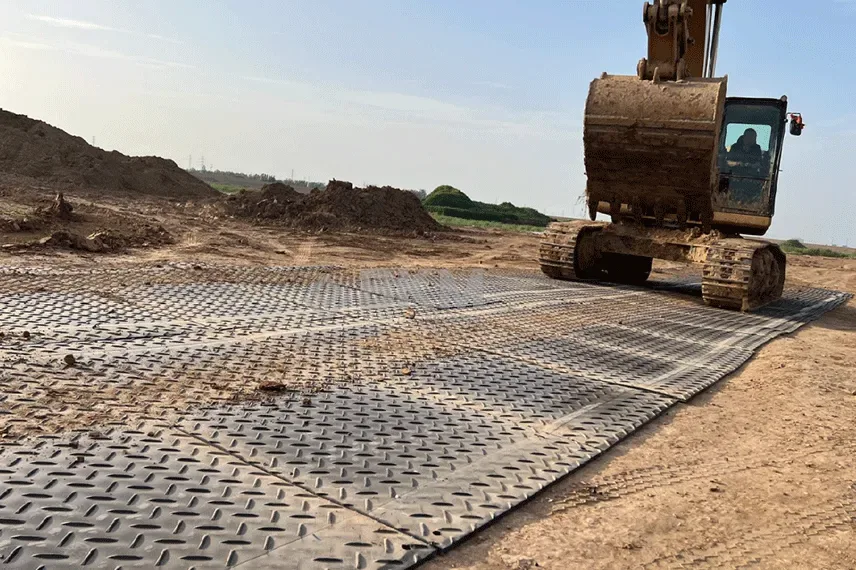
Short answer: pick the thinnest mat that spreads your load without over-stressing the ground below. For pedestrian traffic and firm ground, 12.7–20 mm is usually enough; for excavators, loaded trucks and average sites, 20–30 mm is the default; for soft subgrade, crane outriggers or extreme point loads, go 30–60 mm and have the load and ground reviewed. Thickness buys bending stiffness and load spread — not a headline load number — so the ground condition and the contact area matter as much as the weight of the machine.
Ask ten suppliers what thickness you need and you may get ten different answers. That is because thickness is not a standalone choice: it depends on what is driving over the mat, how soft the ground is underneath, how long the mats stay down and whether the load is spread across a wide footprint or concentrated at a single point. This guide gives you a repeatable way to decide, rather than a number to copy.
Quick answer: which thickness do I need?
If you want a starting point before reading the whole guide, use these three bands — then refine them with the ground and equipment details below.
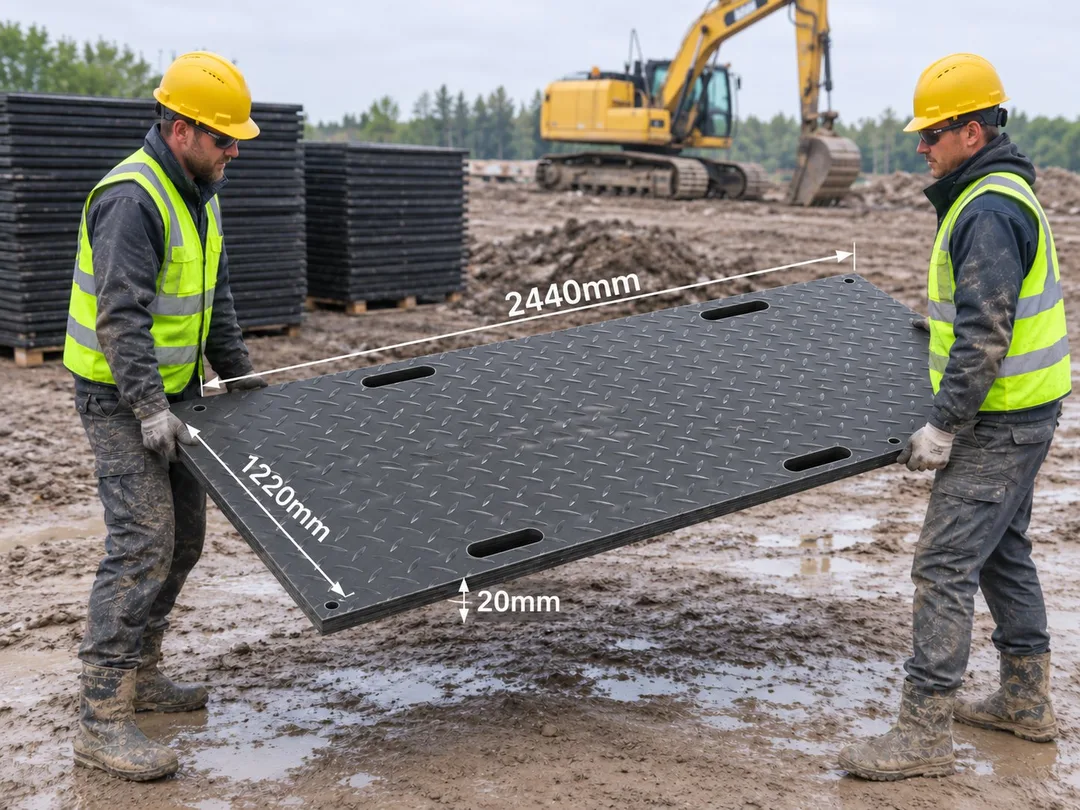
- 12.7–20 mm — pedestrian routes, hand tools, light vehicles and firm, dry ground. Surface protection and occasional traffic; a 20 mm mat in the 1220 × 2440 mm size is 58 kg, a two-person lift.
- 20–30 mm — the default band for excavators, loaders and loaded trucks on normal construction ground. Use 30 mm where the subgrade is soft or traffic is repeated.
- 30–60 mm — soft or saturated ground, crane outriggers, heavy plant and extreme point loads. The upper gauges are reserved for engineered applications and should be confirmed against the real subgrade.
These are starting points, not a substitute for a load review. Peak load reference for the top specification is up to 120 t on firm, level ground — a nominal distributed static figure, not a certified design value or a point-load rating. Real capacity depends on subgrade, thickness and connection layout. If you are unsure, talk to our technical team with your load case rather than extrapolating from a headline number.
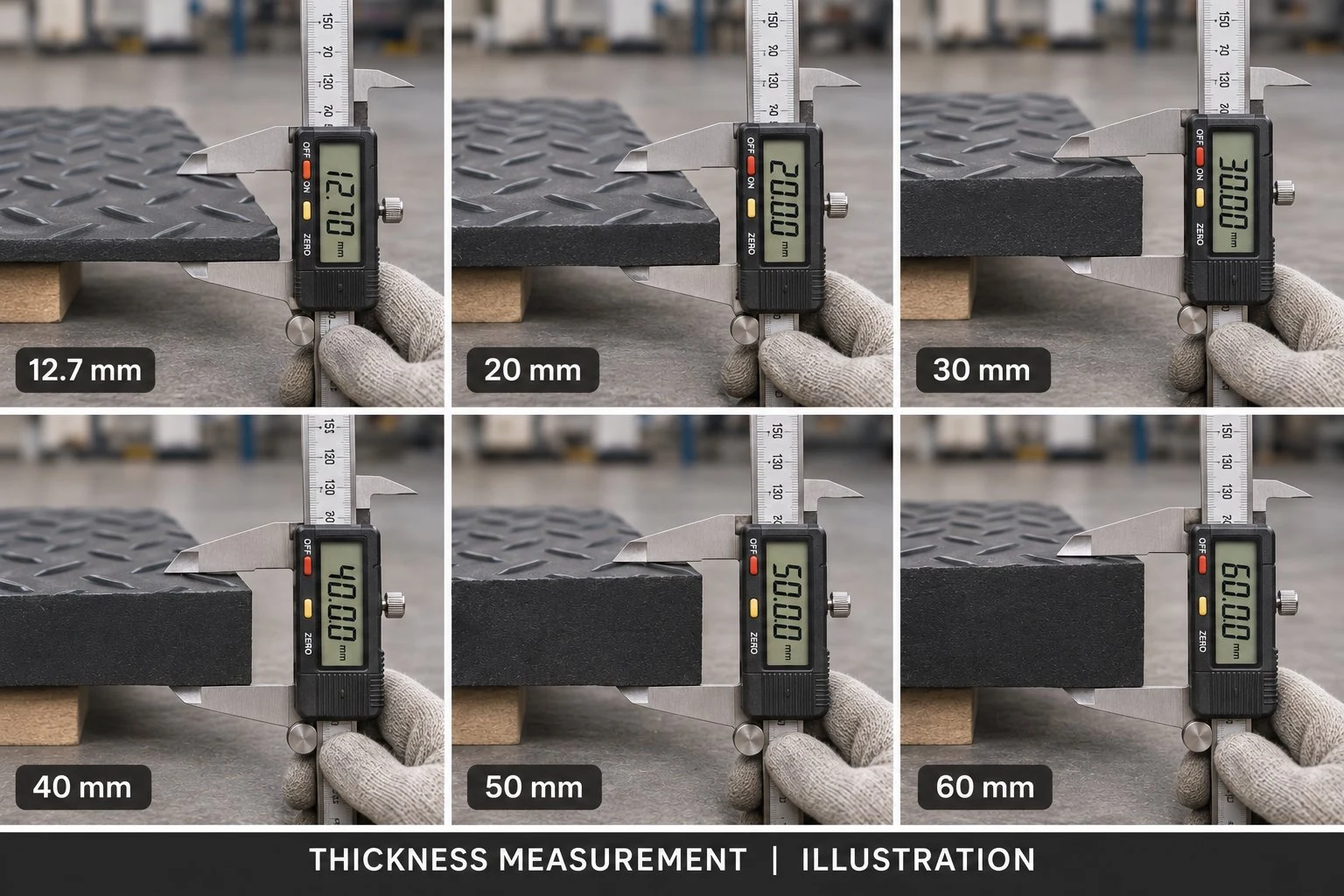
The six thicknesses at a glance
Our compression molded range comes in six gauges, in two standard panel sizes. Unit weight is worth watching as you move up the range: it rises in step with thickness and changes how the mat is handled on site.
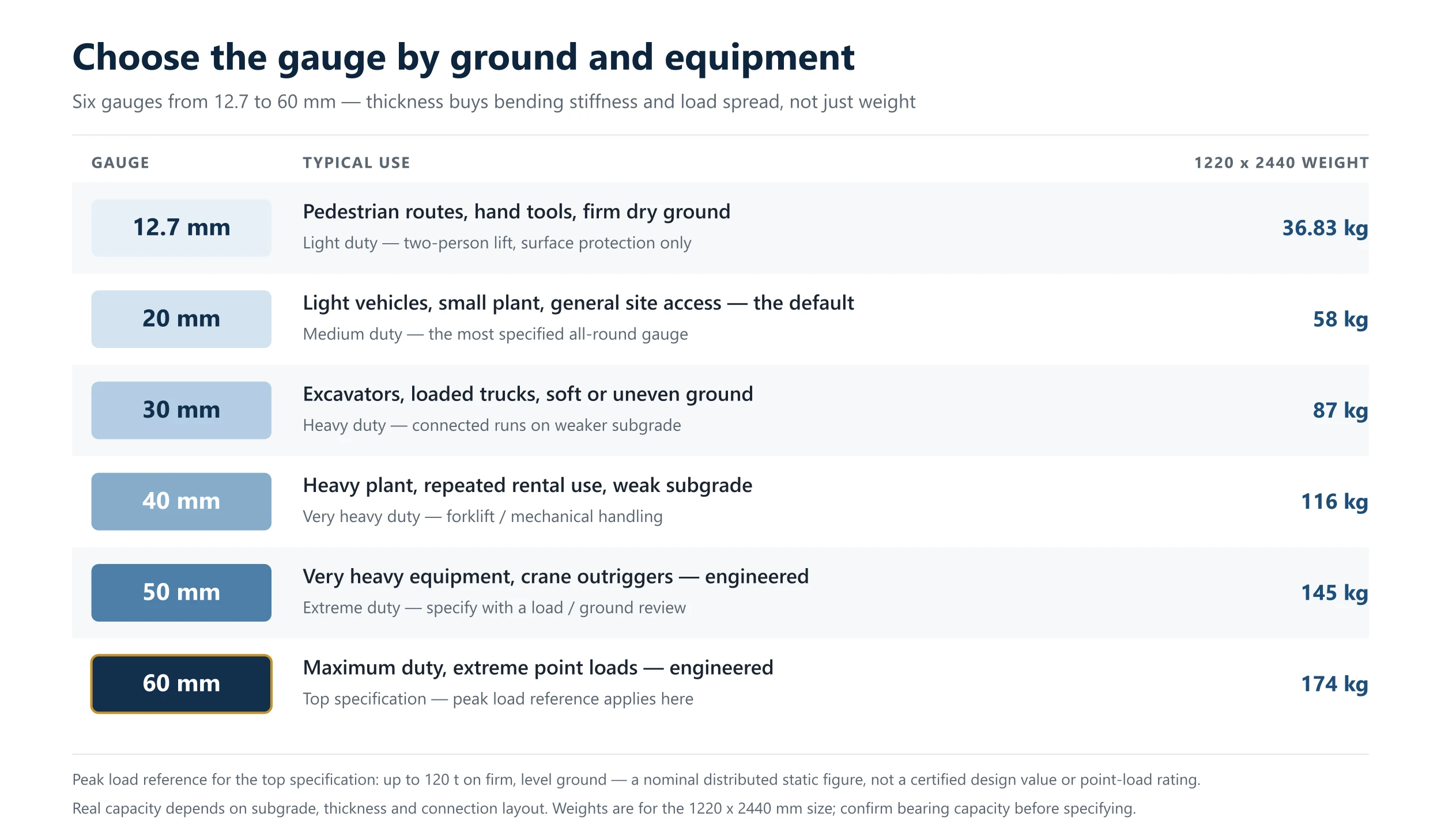
| Thickness | 1220 × 2440 mm | 2000 × 4000 mm | Typical use |
|---|---|---|---|
| 12.7 mm | 36.83 kg | 101.6 kg | Pedestrian, firm ground |
| 20 mm | 58 kg | 160 kg | Light vehicles, general access |
| 30 mm | 87 kg | 240 kg | Excavators, soft ground |
| 40 mm | 116 kg | 320 kg | Heavy plant, weak subgrade |
| 50 mm | 145 kg | 400 kg | Very heavy equipment, outriggers |
| 60 mm | 174 kg | 480 kg | Maximum duty, extreme point loads |
Custom sizes and thicknesses are available. For the complete size and weight table, see ground mat specifications; for the heavy-duty end of the range, see heavy duty ground protection mats.
The four inputs that actually decide thickness
Thickness is never chosen in isolation. Four variables drive the decision, and getting any one of them wrong will push you to the wrong gauge.
Equipment and contact area
A 30 tonne excavator on wide tracks spreads its weight far more gently than a small wheeled loader with a narrow contact patch. It is the pressure under the contact area, not the machine’s total weight, that the mat has to manage.
Ground bearing capacity
The subgrade sets the limit. Firm, dry ground can take a thinner mat; wet, silty or recently disturbed ground needs a thicker, stiffer panel to spread the same load. If the ground fails, the mat fails with it.
Duration and traffic
A mat laid for a single delivery behaves differently from one carrying daily traffic for months. Repeated passes fatigue the ground and the mat, so longer deployments justify a thicker gauge and connected joints.
Point loads vs distributed loads
A crawler track distributes load along its length; a crane outrigger or a jack concentrates it into a small pad. Concentrated point loads are the harshest case and usually demand the upper gauges plus an engineered review.
Selection table: thickness by ground and traffic
Use this table as a first-pass filter. Find your ground condition and traffic type, then read across to the suggested gauge, whether joints should be connected, and whether a separation layer is worth adding.
| Ground / traffic | Suggested gauge | Connect every joint? | Notes |
|---|---|---|---|
| Firm ground, foot traffic | 12.7–20 mm | No | Surface protection; geotextile optional on turf |
| Firm ground, vans / light plant | 20 mm | Recommended | The standard all-round choice |
| Normal site, excavators / trucks | 20–30 mm | Yes | Use 30 mm if the ground is uneven |
| Soft or wet subgrade | 30–40 mm | Yes | Add geotextile; prepare the base where possible |
| Weak ground, heavy repeated traffic | 40–50 mm | Yes | Engineered layout; mechanical handling |
| Crane outriggers / extreme point loads | 50–60 mm | Yes | Load and ground review required — see crane and outrigger pads |
Connections matter as traffic gets heavier: locked joints let mats act as one continuous surface, so loads transfer across seams instead of digging in at them. See ground protection mat connectors and our guide to ground mats on soft ground for layout detail.
Base thickness vs overall thickness
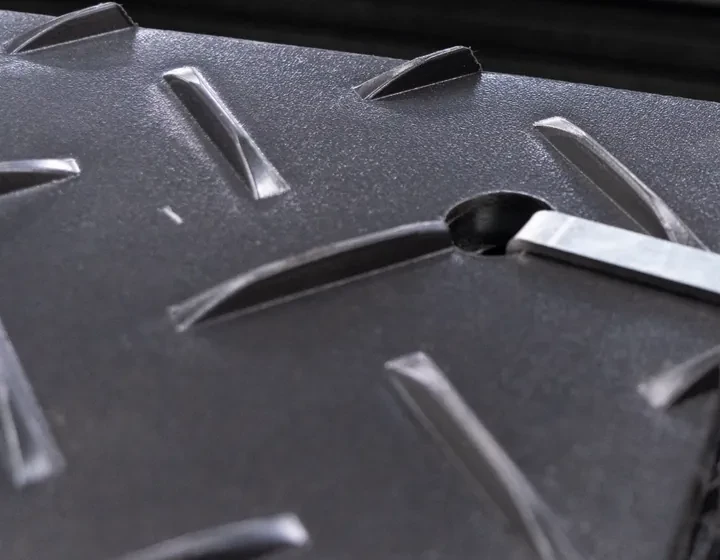
This is the most common source of specification errors, and the easiest to avoid once you know it. Base thickness is the solid plastic substrate. Overall thickness includes the raised anti-slip texture — the diamond or similar pattern pressed into one or both faces.
Two mats quoted as “20 mm” can therefore have different base thicknesses if one is measured over the texture and the other is not. Because bending stiffness comes from the solid substrate, a mat with a thicker base but the same overall figure will be stiffer and spread load better. When comparing quotes, always ask which figure is being quoted and compare like for like.
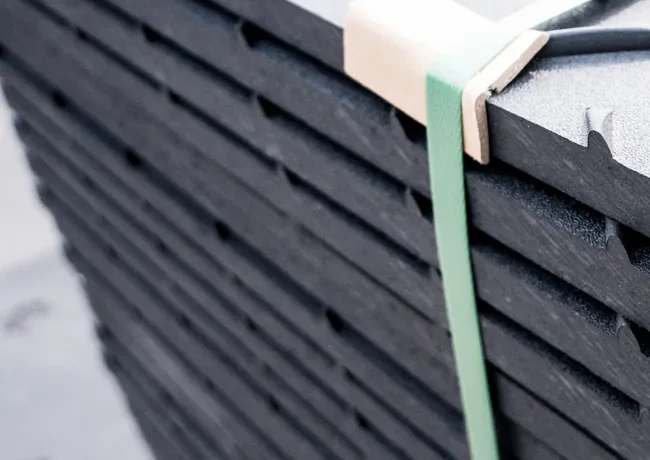
The texture itself does useful work — it is what gives the mat grip in mud, rain and frost — but it should not be counted as structural thickness. If a supplier cannot tell you the base thickness clearly, treat that as a question worth chasing before you specify.
Why thickness changes behaviour
A ground protection mat is a plate resting on soil. When a wheel or outrigger pushes down, the mat bends and spreads that force over a wider patch of ground. The critical point is that bending stiffness rises much faster than thickness — roughly with the cube of the thickness for a simple beam — while weight rises only in direct proportion.
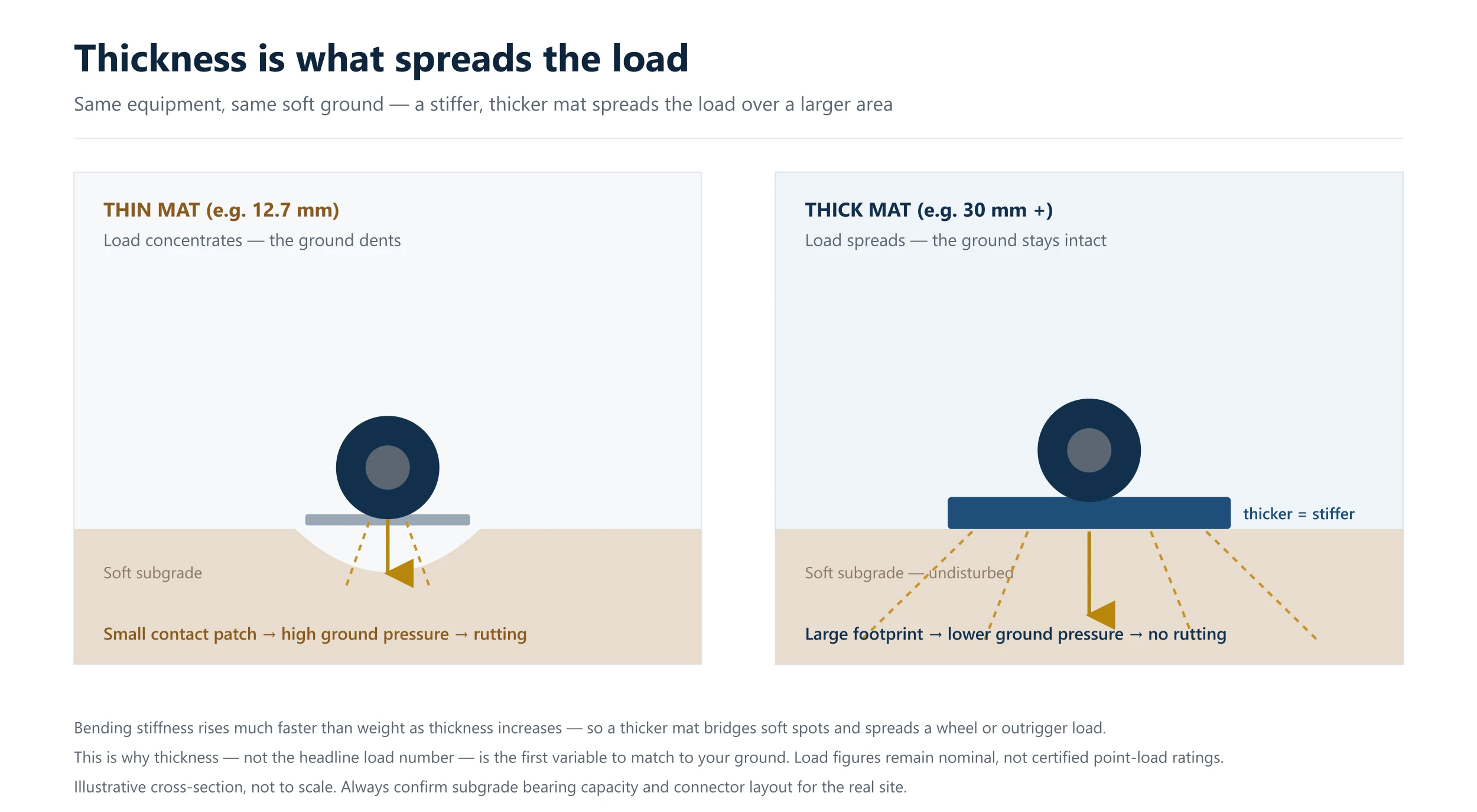
That is why moving from 20 to 30 mm can feel like a much bigger step than the 50% weight increase suggests: the mat resists bending far more effectively, bridges small soft spots and pushes the load out across a larger footprint. It is also why simply adding weight does not fix an undersized mat — a heavier but thin panel still bends and concentrates load at the contact point.
Our mats are compression molded, which keeps the material dense and uniform through the full base thickness, so the stiffness you specify is the stiffness you get across the whole panel.
Match thickness to equipment
Translate the machine into a gauge using its contact pressure and how it will move across the site:
- Pedestrians, trolleys, hand tools — 12.7 mm on firm ground; 20 mm where you want a more robust reusable panel.
- Pickups, small loaders, site vehicles — 20 mm is the workhorse gauge; move to 30 mm on softer ground.
- Excavators, dump trucks, loaded plant — 20–30 mm, with 30 mm preferred for repeated routes or uneven subgrade.
- Crane outriggers, jacks, extreme point loads — 30 mm and above, selected through a load and ground review, never from a general load figure.
Remember the handling trade-off. A 1220 × 2440 mm mat at 20 mm is 58 kg — a two-person lift. At 40 mm it is 116 kg and at 60 mm it is 174 kg, both of which need mechanical handling. Choose a gauge the crew can actually place and move safely.
The safety margin rule
Never size a mat exactly to your expected maximum load. Ground conditions vary, loads shift and traffic is rarely as even as planned. As a practical rule, add roughly 15–25% headroom above your expected maximum before choosing a gauge, then re-check it against the weakest ground on the route.
Be careful with published load figures. The peak reference for our top specification is up to 120 t on firm, level ground — a nominal distributed static figure, not a certified design value or a point-load rating. It is a comparison point, not a number to design to. The same mat on soft, wet or sloping ground will carry substantially less, which is exactly why the buying guide starts with the ground, not the load.
Common mistakes
The same errors show up on site again and again. Avoiding them costs nothing and saves a failed roadway:
- Shopping the load number, ignoring the ground. A headline load figure measured on firm ground says little about performance on soft subgrade.
- Using a thin mat for a long deployment on soft ground. Repeated traffic breaks down the ground under even a correctly rated mat; go thicker or prepare the base.
- Leaving joints disconnected under heavy traffic. Unconnected seams are where mats rut, shift and fail first.
- Driving onto an unsupported edge or corner. Loads at a free edge defeat the load-spreading benefit and crack panels.
- Expecting a mat to span a trench or void. Mats distribute load over ground; they are not bridges.
- Mixing gauges in one connected run. Different thicknesses do not sit flush, creating steps and weak joints.
For the financial side of getting this right, see cost & ROI — an undersized mat replaced twice is rarely cheaper than the correct gauge bought once.
Frequently asked questions
Is a thicker mat always better?
No. Thicker means stiffer and heavier, but the right gauge is the lightest one that spreads your load without over-stressing the ground below. On firm ground with light traffic, a 12.7 or 20 mm mat is enough and is far easier to handle. Oversizing adds cost and handling effort without adding useful performance.
What thickness do I need for a 20 to 30 tonne excavator?
For a 20 to 30 tonne excavator on firm to moderately soft ground, 20 to 30 mm is the usual range. On soft or wet subgrade, or where the machine tracks repeatedly over the same route, move to 30 mm or above and connect the mats at every joint. Confirm the ground bearing capacity for the real site before finalising.
What is the difference between base thickness and overall thickness?
Base thickness is the solid plastic substrate before the anti-slip texture; overall thickness includes the raised diamond pattern on one or both faces. Two mats quoted at the same overall thickness can have different base thicknesses and therefore different stiffness. Ask suppliers which figure they quote and compare like for like.
Can I mix mat thicknesses on one site?
You can, but avoid mixing thicknesses within a single connected run. Differing gauges do not lie flush, which creates steps at the joints, poor connector fit and weak points where loads dig in. Use one gauge per run and group different thicknesses into separate zones.
Do crane outriggers need a special mat?
Crane outriggers concentrate very high loads into a small area, so they need thick, engineered mats — typically 30 mm and above — selected with a load and ground review. Never extrapolate a general load figure to an outrigger case; the subgrade and the outrigger footprint govern.
How much safety margin should I add to the load rating?
As a practical rule, add roughly 15 to 25 percent above your expected maximum load rather than sizing to the headline number. Treat any published load figure as a nominal distributed static reference on firm, level ground — not a certified design value or a point-load rating.
Will a thicker mat work on soft ground without ground preparation?
A thicker mat spreads load better, but it cannot make up for ground that is too weak to carry the traffic at all. On very soft or saturated ground, some preparation — such as a geotextile or a compacted base — is still needed. Thickness extends what the ground can take; it does not remove the ground’s limit.
How does thickness affect weight and handling?
Weight rises directly with thickness for a given panel size. In the 1220 x 2440 mm format, a 12.7 mm mat is 36.83 kg while a 60 mm mat is 174 kg. A 20 mm mat at 58 kg is a genuine two-person lift; thicker gauges generally need mechanical handling.
The short version
Choosing thickness is about matching stiffness and load spread to your ground and equipment — not chasing a load number. 12.7–20 mm for light traffic and firm ground, 20–30 mm for everyday plant and trucks, 30–60 mm for soft ground and concentrated heavy loads. Add headroom, connect the joints, and confirm the base thickness you are actually being quoted.
Want a second opinion on your site? Send us your equipment, ground conditions and route and we will recommend a gauge and layout — or start with the buying guide.