
Ground Protection Mats for Rental Companies: Why a Fleet Should Stock Only Two Thicknesses
For a rental fleet, standardise on two thicknesses — 15 mm light-duty and 20 mm heavy-duty — rather than stocking every gauge. Fewer SKUs mean compatible stacking, connectors that work across batches and better container utilisation, which beat full thickness coverage on cost per deployment. This is a buyer-type page about fleet procurement, not a description of one job site.
This is a buyer-type page, not a use-case page. The other pages describe a haul road, a crane lift or a drilling lease; this one describes the rental company, hire desk or distributor that buys mats once and rents them out hundreds of times. Its questions are SKU count, stacking, cross-batch connectors, container utilisation, UV ageing, hand-hole damage and transferable warranty. End users should see the application hub.
What a rental-fleet mat programme actually is
A rental fleet is an inventory asset, not a project purchase. You buy, deploy, recover, inspect, clean, store and send panels out again — and the panel that earns its keep is not the strongest one, but the one completing the most billable deployments before it is scrapped. For a one-off project, stiffness at the worst load case dominates; for a fleet, the dominant variables are utilisation, turnaround time, batch consistency, damage rate and freight efficiency.
A single extra SKU costs more than its purchase price: another stack height, another picking rule, another set of connectors and spares, a slow-moving line, a mixed-thickness field that does not sit flat, and a container in which thicker panels displace thinner ones. Stocking five thicknesses looks like coverage on a spreadsheet; in a yard it is five inventory lines and fewer panels per container.
Our product is a 1,220 × 2,440 mm HDPE panel covering 2.98 m² (32 sq ft), with four hand holes, eight connector holes and a dual-face tread. The hand holes let crews carry panels by hand and are the most common damage initiation point; the connector holes let a mixed-age fleet still be linked into one field; and the dual-face tread lets the same panel go pedestrian-side-up for an event job and vehicle-side-up for plant access. Reuse across unlike jobs is the entire economic case for a rental panel.
Repeat orders are the norm, so the first-order specification becomes the standard for years. Lock down thickness tolerance, connector geometry, material declaration, UV stabilisation and marking then — a second batch differing by a millimetre or a different connector will not mate with the first, and you will discover it on a customer’s site.
When a two-tier fleet makes sense — and when it does not
| Fleet situation | Two-tier 15 + 20 mm fit | Notes |
|---|---|---|
| Mixed light and heavy plant hire, regional | Good | 15 mm for light service vehicles and turf; 20 mm for plant access |
| Event and pedestrian work in the mix | Good with the pedestrian face up | One panel serves both markets |
| High deployment frequency, many small jobs | Good | Fast turnaround, simple picking, few spares |
| Importing / distributing by container | Good | Near the favourable end of published 20 mm ranges (industry reference) |
| Long outdoor storage between jobs | Conditionally — UV declaration required | UV ageing is a fleet-wide life driver |
| Customers requiring OEM branding | Conditionally — confirm in the order | Ask for the logo option and any tooling lead time in writing |
| Customers needing a transferable warranty | Conditionally — request the text | We do not state a warranty period here; ask for the text and its assignability |
| Crane outrigger or rated-pad hire | No | A standard HDPE panel is not a certified outrigger pad |
| Sustained steel-track plant hire | No | Grousers cut HDPE; an HDPE fleet is the wrong product |
| FRAS / fire-rated or anti-static hire | No | Not a rated product; separate compliance question |
| Permanent-road or void-spanning hire | No | Panels are load spreaders, not bridges |
Do not standardise a fleet on our panels when:
- Your customers’ dominant jobs are crane outriggers, critical lifts or engineered platforms; those need rated pads, and a hire descriptor implying otherwise is a liability.
- The fleet routinely serves sustained steel-track traffic or sharp-rock mining haul roads — see the mining page and oil and gas page.
- The hire requires a FRAS, fire-rated or certified anti-static product, or a documented rated capacity in a lift plan.
- The job is a permanent road, a public highway or a void crossing.
- You cannot obtain written warranty text, thickness tolerance and batch records; a fleet amplifies a small inconsistency across hundreds of deployments.
How to deploy, recover and turn the fleet
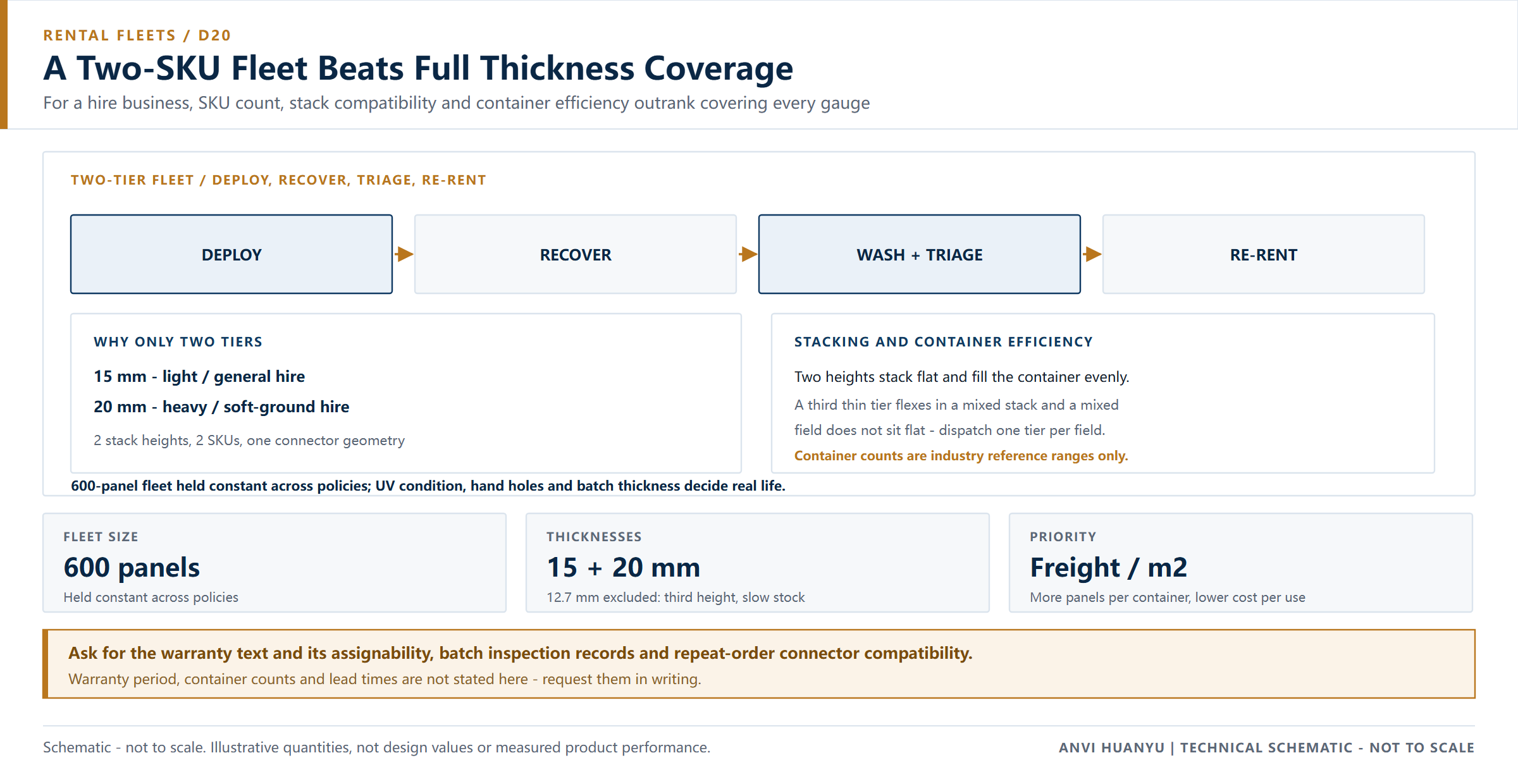
- Specify once, in writing, at the first order: thickness, the base-sheet-versus-overall convention, connector geometry, material declaration, UV stabilisation, colour and any OEM mark.
- Inspect on receipt, by batch: measure a sample, check hand holes and connector holes for cracking, confirm tread orientation, record the batch identifier.
- Pick by job band, not by guess: 15 mm for light vehicles, pedestrian routes and turf; 20 mm for plant access and repeated laden traffic.
- Lay on a prepared surface: grade and drain, use geotextile on soft ground, start from firm ground, stagger joints by half a panel, and connect every panel with the connection system. Full procedure: how to install ground protection mats.
- Mark the exclusion zones in the hire note: the panels are not outrigger pads, not bridges and not for sustained steel tracks.
- Recover and triage on return: wash off soil, then sort into return-to-stock, repair/inspect and scrap piles — before the panels go back into the stack.
- Inspect the high-damage points: hand holes, corners, connector holes and the vehicle-face tread; UV chalking, star cracks and edge splits are the early warnings.
- Store flat and supported, and log deployments: long unsupported stacks in heat encourage creep; rotate so the oldest deploy first, and record deployments per batch so cost per use can be calculated.
For quantity planning, lay panels with the 2,440 mm edge across the direction of travel: a 2.44 m lane and 1.22 m of route per panel. A 100 m single lane is roughly 82 panels before a 15–20% allowance for turns and bays — an illustrative calculation, not a design value. The more useful number is how many matched sets you can dispatch simultaneously: two tiers give two clean sets. Our 4×8 ft panels and custom sizes close row ends without field cutting.
Original asset: two-tier fleet turnover and cost-per-use model
Every number below is an assumed input or an index, not a quotation, a measured lifetime or a container figure for our panels. Substitute your own rates. The model compares three SKU policies for the same 600-panel fleet.
| Assumed input | Value used | Note |
|---|---|---|
| Fleet size | 600 panels | Held constant across policies |
| Deployments per panel per year, fast tiers | 12 | Assumed for a busy regional fleet |
| Deployments per panel per year, slow tiers | 3–5 | Slow movers go out rarely |
| Annual fixed carrying cost per panel | 26 index units | Storage, depreciation, inventory carrying |
| Handling + cleaning per deployment | 8 index units | Assumed |
| Delivered cost | 100 (15 mm) / 130 (20 mm) index | Index, not a price |
| SKU policy | Stock mix | Panel-deployments per year | Fixed cost per deployment (index) | Cost per deployment (index) | Reading |
|---|---|---|---|---|---|
| Two-tier: 15 + 20 mm | 400 × 15 + 200 × 20 | 400×12 + 200×12 = 7,200 | 15,600 ÷ 7,200 = 2.17 | 2.17 + 8 = 10.17 | Both tiers turn over; lowest cost |
| Three-tier: 12.7 + 15 + 20 mm | 300 + 200 + 100 | 3,600 + 2,400 + 400 = 6,400 | 15,600 ÷ 6,400 = 2.44 | 10.44 | Thin tier is a slow mover |
| Full range: 12.7 / 15 / 20 / 25 / 30 mm | 120 + 180 + 150 + 90 + 60 | 480 + 2,160 + 1,800 + 450 + 180 = 5,070 | 15,600 ÷ 5,070 = 3.08 | 11.08 | Five lines, several slow |
Adding a thickness does not add proportional revenue: the new tier goes out less often while its fixed carrying cost continues daily. If a customer needs 12.7 mm or 30 mm, treat it as a special order, not a stocked SKU. See the cost and ROI guide.
Original asset: stacking and container efficiency comparison
Container figures are industry reference ranges, to be confirmed against actual stack height and packing method — not our measured loading plan.
| Fleet policy | Stack profile | Connector cross-batch | 40HQ utilisation | Freight per m² (index) | Inventory complexity |
|---|---|---|---|---|---|
| Two-tier: 15 + 20 mm | Two stable, flat stack heights | One connector family across tiers and batches | Near the favourable 20 mm range — roughly 300–350 panels (industry reference) | Lowest | 2 SKUs, 2 stack heights |
| Add 12.7 mm | Third height; thin panels flex in a mixed stack | Same family, but a mixed field does not sit flat | Marginally more panels, but slow stock | Low | 3 SKUs |
| Add 25–30 mm | Heavy stack, reduced stability | Same family | Materially fewer — roughly 200–250 at 30 mm (industry reference) | Higher | 4–5 SKUs |
| Full range | Multiple heights, mixed pallets | Mixed fields do not mate cleanly | Worst average | Highest | 5 SKUs, 5 profiles |
Stacking compatibility is worth more than nominal coverage, and container efficiency beats full thickness coverage: every thicker tier displaces thinner panels in the same container, so delivered cost per square metre rises twice — once for resin, once for shipping.
What it saves: a fleet-level cost view
| Cost line | Full-range fleet | Two-tier fleet | Why it moves |
|---|---|---|---|
| Inventory carrying | 5 lines, several slow | 2 lines, both turning | Fixed cost spread over more deployments |
| Yard handling | 5 stack profiles, mixed pallets | 2 stack profiles | Faster picking, fewer mis-picks |
| Connector spares | Multiple families / tolerances | One family | Fewer parts, simpler purchasing |
| Freight per m² | Mixed container, thick tiers displace thin ones | Near the favourable 20 mm range | More panels per container (industry reference) |
| Repeat-order risk | 5 specs to re-verify | 2 specs to re-verify | Fewer variables to drift between batches |
| Damage / inspection | Mixed ages and thicknesses | Uniform tiers | Consistent inspection and stacking |
A two-tier fleet will occasionally turn down a job needing 12.7 mm or 30 mm — a deliberate trade, since the lost margin is smaller than a slow-moving SKU’s carrying cost and freight penalty. Sell such jobs as special orders. See HDPE vs plywood mats and HDPE vs steel mats.
Why this mat — not a thinner panel or another material
| Option | Role in a rental fleet | Why we would not standardise on it |
|---|---|---|
| 12.7 mm HDPE | Pedestrian, turf, finished-surface protection | Too light for plant access; as a third SKU it turns over slowly |
| 15 mm HDPE (tier 1) | Light service vehicles, events, dual use | Correct light tier; not the heavy tier |
| 20 mm HDPE (tier 2) | Plant access, mixed ground, repeated laden traffic | The practical ceiling; not a rated pad |
| 25–30 mm+ HDPE / composite | Engineered special orders only | Heavier, fewer panels per container, higher freight per m² |
| Engineered composite / steel rig mat | Rare heavy or platform jobs | Specialist stock, high unit cost, slow turnover |
| Timber bog mats | Very soft ground, one-off heavy access | Absorbs water, breaks, inconsistent dimensions |
| Steel plates | Short, very high point loads | Needs lifting plant, corrodes, conductive, high recovery cost |
- Why not stock every thickness so we never turn down a job? Because the cost of a slow-moving SKU is invisible on a price list and very visible in the yard. The model above shows three and five tiers producing fewer deployments and a higher fixed cost per deployment for the same 600 panels.
- Why not stock only the thickest, strongest panel? Because you would pay for weight and freight on every light job, crews would need machinery to place panels two people could otherwise carry, and extra stiffness still would not make the panel a rated outrigger pad.
The four hand holes and eight connector holes are fleet-critical: hand holes enable two-person placement; connector holes let a batch bought this year link to one bought three years ago, provided geometry and tolerance were specified at the first order. See heavy-duty panels, interlocking options and the buying guide.
Why the fleet stocks only two thicknesses — the procurement derivation
| Step | Procurement question | Finding | Implication |
|---|---|---|---|
| 1 | What do customers actually rent? | Demand clusters into a light and a heavy band | Two tiers cover the bulk of billable jobs |
| 2 | What does a third or fourth tier add? | Rare edge-case coverage, slow turnover | Special-order it; do not stock it |
| 3 | What does stacking require? | Consistent thickness for flat, stable stacks | Each extra tier adds a stack profile |
| 4 | What do connectors require? | One geometry across tiers and batches | Fewer tiers = one family, fewer spares |
| 5 | What does freight reward? | More panels per container | Thicker tiers displace thin ones (industry reference ranges) |
| 6 | What does repeat ordering require? | The same spec every year | Fewer SKUs = fewer variables to drift |
| 7 | What does the damage profile require? | Uniform inspection criteria and rotation | Two tiers make triage simple |
| 8 | Conclusion | 15 mm + 20 mm as the stocked fleet | Anything outside is a special order or another material |
- The ratings are not a stocking argument. Our published reference ratings — 80 / 100 / 120 t for 12.7 / 15 / 20 mm — are nominal figures for evenly distributed static loading on a firm, level subgrade. They are not certified design values and must not be used as point-load capacity, crane outrigger capacity, or a permit-to-bridge voids. We publish no test method, sample thickness, support span or test report for these figures; they are labels, not design inputs.
- When a panel goes out, the end user still checks the load case. Confirm against the heaviest machine on site, not the fleet average. This is a selection starting point, not a certified design value. Where a lift plan or permit applies, obtain a site-specific engineering assessment. Decline the job if the requirement is a rated pad.
- Confirm the thickness convention once, at the first order. Base sheet or overall height including raised tread; the difference can approach 10 mm and changes stiffness, stacking height and container count. See how to choose ground mat thickness.
Common mis-specifications: stocking a thickness for every conceivable job; buying on unit price instead of cost per deployment; failing to lock connector geometry so a later batch will not mate; ignoring UV stabilisation on a fleet stored outdoors; assuming a hire note can turn an access panel into a certified outrigger pad.
Common failure modes in a rental fleet
| Failure | What it looks like | Cause | Prevention |
|---|---|---|---|
| Hand-hole cracking | Star cracks from cut-outs | Forklift tines, dropped corners, rough handling | Lift by the holes correctly; triage on return; scrap rather than restock |
| UV chalking / embrittlement | Faded, chalky surface, crazing | Years of outdoor storage without adequate stabilisation | Ask for the material declaration; store covered; rotate stock |
| Batch thickness mismatch | Mixed stack sits unevenly; connectors will not seat | Second order to a different tolerance or convention | Specify tolerance and convention in writing; inspect by batch |
| Connector incompatibility | New batch will not link to old | Changed connector geometry or hole position | Lock the family at first order; test-mate a sample |
| Creep / warped stock | Permanently dished panels | Long unsupported stacks in heat | Store flat and supported; rotate oldest stock out first |
| Tread wear | Polished vehicle face, reduced grip | High deployment count on abrasive surfaces | Rotate panels between job bands; set a scrap criterion |
| Mixed-tier field not sitting flat | Trip edges, rocking panels | Customer ordered across two thicknesses in one field | Dispatch one tier per field |
| Edge and corner splits | Cracked corners | Dropped panels, unsupported stack edges | Corner protection in storage; scrap at inspection |
UV condition is a fleet-wide risk, so ask for the stabiliser package and weathering data in writing.
What to verify with any supplier before you buy
Ask every bidder — including us — for the same things:
- Is any published load figure static, dynamic, distributed or point, and what were the sample thickness and support span?
- Is the quoted thickness the base sheet or overall including tread?
- How many people turn one panel through deploy, wash, triage and re-rent? Measure a full cycle with a sample panel — the two-tier SKU decision rests on handling time, not a kg figure.
- What is the thickness tolerance, and how is batch consistency recorded, given a repeat order must mate with the first?
- What is the material declaration — resin grade, regrind or PCR content, UV stabilisation — and is there accelerated-weathering data for outdoor storage?
- Which connectors are supplied, and are they guaranteed compatible across thicknesses and future orders?
- What is the warranty text in writing, and is it transferable or assignable to your rental customers? We do not state a warranty period here; ask for the text and its assignability rather than a verbal assurance.
- Is an OEM logo or marking option available, and what is the tooling or lead-time implication?
- What is the repeat-order lead time and MOQ, and can the supplier commit to the same spec and connector geometry?
- Can the supplier provide an identifiable test report or QC record and a 40HQ loading plan at your chosen thickness?
A fleet buys a sequence of containers, so the practical check is whether later loadings match the first in stack pattern, palletisation and tier split. Dated working photographs of the line, a thickness check and the loading operation can accompany every quotation, including repeat orders. They are useful for comparing how a shipment is packed, but the written loading plan, batch inspection record and repeat-order specification are what actually lock the specification; a photograph is neither a container quantity nor a warranty.
Specification summary for a two-tier rental fleet
| Item | Starting specification |
|---|---|
| Page type | Buyer-type / fleet procurement — not a use-case page |
| Stocked tiers | 15 mm (light) and 20 mm (heavy) only; other thicknesses are special orders |
| Panel | 1,220 × 2,440 mm HDPE, 4 hand holes + 8 connector holes, dual-face tread |
| Connector family | One geometry across both tiers and all repeat batches; specify at first order |
| Stacking | Two flat, supported stack heights; rotate oldest stock out first |
| Container | Near the favourable 20 mm industry reference range (≈300–350 panels), to be confirmed |
| Inspection | On receipt by batch, on return after every hire; hand holes, corners, tread and UV condition checked |
| Warranty | Request the text in writing and whether it is assignable to customers; no period stated here |
| OEM / repeat orders | Confirm marking option, lead time and spec continuity in writing |
| Exclusions | Not outrigger pads, not bridges, not for sustained steel tracks, not FRAS-rated |
| Reference ratings | 12.7 / 15 / 20 mm → 80 / 100 / 120 t nominal, distributed static on firm level ground — not certified design values |
Frequently asked questions
What mats last longest in a rental fleet? Longevity is driven less by thickness than by UV stabilisation, hand-hole handling damage, batch consistency and deployments completed before scrapping. Ask for the material declaration, thickness tolerance and any weathering data, then track deployments per batch yourself. We do not publish a lifetime we cannot document.
How many mats fit in a 40HQ container? Published industry guidance puts a 40 ft high-cube container at roughly 300–350 panels at 20 mm and only 200–250 at 30 mm (industry reference range), to be confirmed against actual stack height and packing method. We do not state a container count as our measured figure; confirm the loading plan at your chosen thickness before you fix the order quantity.
Can mats be stacked and branded? Yes, stacking is core to a two-tier programme — two thicknesses give two stable, flat stack heights, and a single connector family keeps them compatible. For branding, request any OEM logo or marking option explicitly and confirm it, along with any tooling or lead-time implication, in the order rather than assuming it is included.
What warranty can I pass to my customers? Ask for the warranty text in writing and specifically whether it is transferable or assignable to your rental customers. We do not state a warranty period on this page, and a verbal assurance is not a document your customer can rely on. Treat the written text and its assignability as a first-order purchasing condition.
Why only 15 mm and 20 mm instead of a full thickness range? Because a fleet earns on deployments, not coverage. Extra thicknesses turn over slowly, add stack profiles and connector variables, displace thinner panels in the container and complicate repeat orders. The turnover model shows fewer deployments and higher cost per deployment for three- and five-tier fleets.
Will a later batch connect to my existing panels? Only if connector geometry, hole positions and thickness tolerance were specified at the first order and verified on receipt of each batch. Ask for the tolerance and batch inspection record, and test-mate a sample from every delivery before it enters stock — a mismatch found on a customer’s site is far more expensive than one caught in your yard.
Get a thickness and panel count for your site
Send the equipment tonnage mix your customers run, the ground conditions you typically serve, your deployment duration and cycle, and the quantity you plan to stock. We will return a two-tier 15/20 mm SKU recommendation with its basis, a panel count, a stacking and connector plan, and a container estimate — plus the written spec, tolerance and connector commitments you should hold us to on repeat orders — to albert@hdpegroundmat.com or via our contact page.