
Ground Protection Mats for Mining: Haul Roads, Abrasion and Where HDPE Reaches Its Limit
For rubber-tyred haul trucks on graded ground, start at 20 mm HDPE — but sharp rock abrasion and steel-tracked dozers are this material’s weak points. A 90 t class truck cannot be sized from a nominal tonnage chart; where sharp rock, steel tracks or concentrated static loads dominate, composite, timber or steel mats may be the correct choice.
This page is for the mine engineer comparing materials first, because a failed haul road stops the pit. For dimensions see standard specifications; for the general method see how to choose ground mat thickness.
A note on numbers: some suppliers publish a headline pressure or tonnage figure for their mats. That is that supplier’s claim under its own test conditions, sample thickness and support span. We do not reproduce such figures as our measured data, and every industry reference value here is labelled illustrative, not a design value.
What mining ground protection mats actually are
On a mine, a mat is a removable load-spreading layer for a haul road, dump area, exploration track or maintenance pad — not permanent pavement and not a rated platform for a shovel or crusher. Our panel is a 1,220 × 2,440 mm HDPE sheet covering 2.98 m² (32 sq ft), with four hand holes, eight connector holes and a dual-face tread. Linked edge to edge, it spreads a wheel load into the soil over a larger footprint than the tyre patch.
Mining differs from construction access in three ways: high cycle count, high dynamic load and abrasive material. A production haul road can see hundreds of loaded cycles a day for months, with braking on downgrades, turning at the dump, spilled rock on the surface and water trucks softening the subgrade. Braking works joints, turning pushes boards sideways, sharp rock abrades and punctures, and repeated dynamic loading fatigues both panel and ground.
Equipment spans utility vehicles, 40–60 t rigid and articulated haulers, 90 t class ultra-class trucks, wheel dozers and graders — and steel-tracked dozers and excavators. Rubber tyres and steel grousers impose completely different demands on a polymer panel; that is where most mining specifications go wrong. ground protection mats for mining is a broad category covering HDPE panels, timber bog mats, composite mats, steel plates and engineered FRAS-rated products; we do not claim a FRAS rating for our standard panels.
When to use them — and when not to
| Condition | Suitable | Notes |
|---|---|---|
| Prepared, graded, drained haul road, rubber-tyred trucks | Yes, 20 mm starting spec | Design for the heaviest axle group, not the fleet average |
| Temporary dump, stockpile or staging area | Yes for distributed loads | Avoid long-term static parking of loaded trucks on one panel |
| Drill-and-blast and exploration tracks | Yes, with geotextile on soft ground | Short-duration, mobile, redeployable |
| Maintenance and light-service pads | Yes, 15–20 mm | Low consequence, easy recovery |
| Wet or saturated clay sections | Conditionally, with derating and geotextile | Saturated soil loses 30–50% of dry bearing capacity (industry guidance) |
| Sharp, angular blasted rock on the running surface | Conditionally — abrasion-limited | Sharp rock is HDPE’s weak point; expect wear and puncture |
| Sustained steel-tracked dozer or excavator traffic | No | Grousers cut and abrade HDPE |
| Ultra-class truck main haul road, continuous | No — engineering assessment first | Consider engineered or steel/composite |
| Void, trench or uncompacted backfill crossing | No | Panels are load spreaders, not beams |
| FRAS or fire-rated underground requirement | No | Not a rated product; separate compliance question |
Do not use standard HDPE panels when:
- Sustained steel-track traffic is expected; grousers cut HDPE and a thicker board does not fix the mismatch — use composite, timber or steel.
- Sharp, angular blasted rock dominates and the criterion is long wear life; a steel or composite surface or a maintained aggregate road may be more economical.
- The panel must carry a concentrated point load — a crusher foot, shovel track, crane outrigger or a truck parked for hours. HDPE creeps under sustained static load, especially in heat.
- The route must bridge a void, trench, culvert or uncompacted backfill.
- The site requires a FRAS, fire-rated or certified anti-static product, or an engineered platform with a documented rated capacity.
- The ground is deep peat, silt or thawing fill with no bearing layer; panels migrate, ground improvement comes first.
How to install and use them on a haul road
Eight steps, with a traffic-cycle inspection regime and a spill housekeeping rule.
- Walk the route and divide it into ground zones; mark soft spots, water, services, braking zones and the firm-ground transition.
- Grade and drain before you lay; a mat over saturated soil pumps fines into the joints from the first loaded pass.
- Roll out geotextile with generous overlap, selected for the soil and anchored against wind.
- Start on firm ground and work outward; never span a hollow, trench or uncompacted backfill.
- Stagger joints by half a panel, vehicle tread up, and connect every panel with the connection system appropriate to braking loads.
- Keep the running surface clear of spillage; grader spill of sharp rock turns a distributed tyre load into an abrasive and puncture hazard.
- Run one laden truck at walking pace, re-inspect, then inspect by traffic count and after rain, thaw or spill.
- Recover, wash, inspect and store flat; check connectors, hand holes and the vehicle face for wear, and stack flat and supported.
For quantity, lay panels with the 2,440 mm edge across the direction of travel: a 2.44 m lane and 1.22 m of route per panel. A 500 m single lane is roughly 410 panels before a 15–20% allowance for turns and dump aprons — an illustrative calculation, not a design value. Our 4×8 ft panels and custom sizes close row ends without field cutting; full procedure: how to install ground protection mats. Published industry guidance puts a 40HQ at roughly 300–350 panels at 20 mm and 200–250 at 30 mm (industry reference range, to be confirmed against actual stack height and packing method).
Original asset: wear, service life and cost-per-use comparison
The service-life column is an illustrative relative index, not a measured lifetime or design value; substitute your own cycle counts.
| Material | Dominant wear under sharp rock | Relative service-life index (illustrative) | Handling / recovery | Cost-per-use driver | Where it wins / loses |
|---|---|---|---|---|---|
| 15 mm HDPE | Abrasion, puncture, joint working | Low | Light, manual/telehandler | Lowest unit cost, highest replacement rate | Wins on light, short, clean tracks |
| 20 mm HDPE | Abrasion, puncture, creep under static load | Medium | Light, telehandler | Balanced unit cost and cycles | Wins on rubber-tyred, graded, drained roads; loses under steel tracks |
| 25–30 mm+ HDPE / composite | Abrasion, but slower | Medium–high | Heavier, fewer panels per container | High unit cost, better cycles | Still loses to steel grousers |
| Timber bog mats | Crushing, splitting, water uptake | Low–medium | Heavy, needs plant | Cheap per unit, high breakage | Wins on very soft ground; loses on wear and transfer |
| Steel plates | Corrugation, edge bending, corrosion | High under abrasion | Very heavy, lifting plant | High freight and recovery | Wins under sharp rock and point loads |
| Engineered composite rig mat | Surface wear, engineered | High | Heavy, crane/plant | Highest unit cost, documented capacity | Wins on engineered platforms and ultra-class roads |
Cost per loaded cycle = (delivered cost + handling + deployment labour + cleaning
 + inspection + replacements + storage + reinstatement)
 ÷ number of loaded cycles actually survived
Original asset: failure and inspection cycle under heavy dynamic loading
Intervals are illustrative and tied to traffic count, not a design value. A production haul road needs a repeating regime, not a one-off check.
| Failure mode | Load driver | Early visible sign | Illustrative inspection point | Action | Consequence if missed |
|---|---|---|---|---|---|
| Joint opening | Braking on downgrade, turning shear | Gaps along a continuous seam | After first loaded shift, then per shift | Re-stagger, re-connect, replace worn connectors | Board separation, stoppage |
| Panel migration | Turning shear, soft subgrade | Boards creep forward or sideways | Weekly and after rainfall | Re-seat, add shoulder support | Rutting, edge trip hazard |
| Surface abrasion | Sharp angular rock under tyres | Polished or scuffed vehicle face | Weekly, after any spill | Rotate panels, improve housekeeping | Reduced stiffness, then cracking |
| Point puncture | Angular rock loaded by a tyre | Local hole or star split | Per shift on spill-prone sections | Replace panel; review spill control | Rapid tear, water ingress, downtime |
| Creep under static load | Loaded truck parked on one area | Permanent dish or warp | Before and after any static storage | Redistribute, rotate stock, limit parking | Permanent deformation |
| Hand-hole cracking | Concentrated load near a cut-out | Star cracks from hand holes | Weekly on dump aprons | Replace; keep concentrated loads off access panels | Panel fracture |
| Subgrade pumping | Saturated soil, no geotextile | Fines or water rising through joints | After rain or thaw | Drain, add geotextile, derate | Edge settlement, migration |
| Steel-track cutting | Grouser contact | Gouges, shavings, deep scoring | Immediate on any tracked incursion | Remove tracked plant; change material | Rapid destruction of the panel |
What it saves: a downtime-based view of the benefits
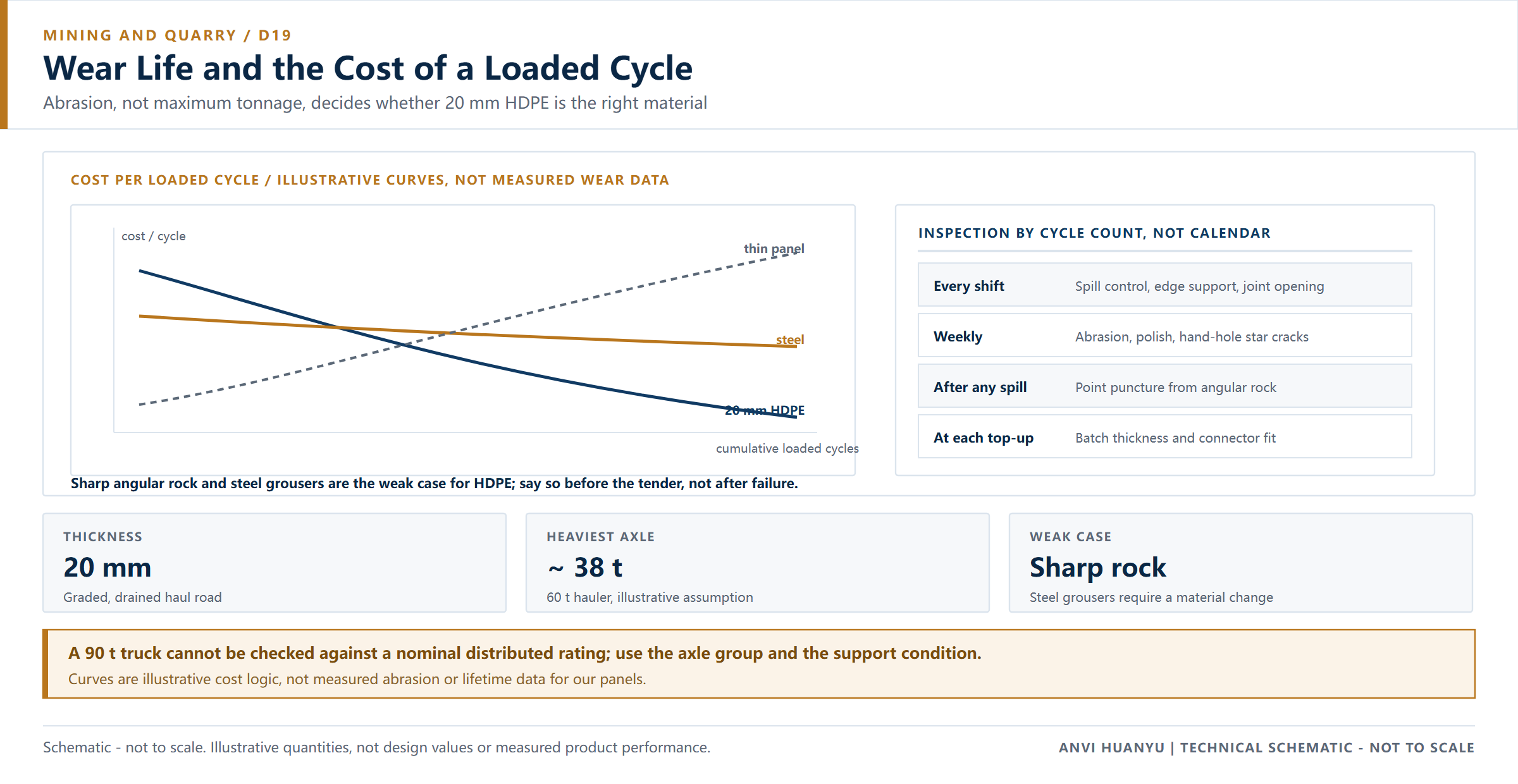
The comparison is a recoverable, redeployable surface versus a graded aggregate road or a consumable mat fleet, measured against a stopped pit. We will not invent an hourly downtime figure; use your own rate.
Downtime exposure = (hourly pit contribution margin + hourly plant hire
 + rework labour + haul-road rebuild cost)
× hours lost to a failed section| Control measure | Consequence if omitted | Who carries the cost |
|---|---|---|
| Correct axle-group and dynamic-load assessment | Undersized panel, fatigue cracking, rutting | Production delay, rebuild labour |
| Geotextile and drainage | Fines pumping, edge settlement | Grader time, re-laying, lost cycles |
| Spill housekeeping | Abrasion and point puncture | Premature replacement, stoppage |
| Repeating inspection cycle | Small crack becomes a mid-shift fracture | Unplanned downtime, recovery crew |
| Material switch where steel tracks or sharp rock dominate | Rapid destruction of HDPE panels | Full replacement, programme loss |
| Reusable surface at close-out | Excavate, remove, dispose, restore aggregate | Reinstatement and disposal |
Where HDPE delivers measurable value is redeployment: the subgrade stays intact and there is no aggregate to remove. Break-even depends on loaded cycles survived — see our cost and ROI guide. For a short campaign with cheap aggregate, a stone road may still win.
Why this mat — not a lighter panel or another material
| Option | Where it fits on a mine | Why we would not choose it here |
|---|---|---|
| 12.7 mm HDPE | Pedestrian routes, finished-surface protection | Under a loaded haul truck it deflects; puncture risk is high |
| 15 mm HDPE | Short, clean, low-cycle exploration tracks | Marginal for continuous laden haul traffic |
| 20 mm HDPE (starting point) | Rubber-tyred trucks on prepared, drained ground | The practical ceiling — not a steel-track or ultra-class solution |
| 25–30 mm+ HDPE / composite | Engineered heavy cases, longer wear target | Heavier, fewer panels per container; does not fix grousers or subgrade |
| Steel plates | Sharp rock, very high point loads | Needs lifting plant, corrodes, conductive; see HDPE vs steel mats |
| Timber bog mats | Very soft ground, one-off heavy access | Absorbs water, breaks, cross-site transfer; see HDPE vs plywood mats |
| Engineered composite / rig mat | Ultra-class roads, crushers, platforms | Correct tool for a documented capacity; higher unit cost |
- Why not the cheapest, thinnest board? On a production haul road the cost is not the panel, it is the interruption. A working joint or punctured board under a braking 60 t truck stops the cycle.
- Why not simply the thickest board? Beyond 20 mm, weight, handling and container utilisation deteriorate, and extra stiffness will not fix an unprepared subgrade, sharp rock abrasion or steel grousers.
The four hand holes and eight connector holes let linked panels resist braking and turning forces; a mixed-thickness field does not sit flat. For heavy surrounding platforms see heavy-duty panels. A drilling site has a different dominant risk, concentrated platform loads — see the oil and gas page. For all uses, the application hub.
Why 20 mm is our starting specification — and why a 90 t truck is not a chart lookup
Work the selection chain in order; the figures are an illustrative engineering check, not a certified design value.
| Step | What to establish | Illustrative check |
|---|---|---|
| 1 | Heaviest vehicle and axle group, not total mass | 60 t articulated hauler, loaded rear axle group ≈ 38 t (assumed) |
| 2 | Dynamic factor | Braking, turning and uneven surface amplify static axle loads (typical guideline) |
| 3 | Ideal spread over one panel | 38,000 kg × 9.81 ÷ 2.98 m² ≈ 125 kPa as a rigid plate |
| 4 | Real effective area | HDPE deflects between supports; at 60%, ≈ 208 kPa before dynamic factor |
| 5 | Subgrade allowance | Dry compacted granular soil tolerates this; saturated clay often does not (industry guidance: 30–50% loss) |
| 6 | Safety margin | Add 15–20%; specify against the heaviest machine, never the fleet average |
| 7 | Conclusion | 20 mm on prepared, drained ground, with an assessment before any ultra-class or continuous-production case |
Why a 90 t class truck cannot be sized from a nominal tonnage chart
A 90 t class truck’s headline tonnage is a payload or gross vehicle mass, not a distributed static load on one panel. The relevant input is the heaviest axle group and its tyre contact geometry, not total mass; a haul road adds dynamic amplification through braking and an uneven surface; and the published reference ratings are defined for evenly distributed static loading on a firm, level subgrade — a condition a production haul road does not meet continuously.
Our published reference ratings — 80 / 100 / 120 t for 12.7 / 15 / 20 mm — are nominal figures for evenly distributed static loading on a firm, level subgrade. They are not certified design values and must not be used as point-load capacity, crane outrigger capacity, or a permit-to-bridge voids. We publish no test method, sample thickness, support span or test report for these figures; they are labels, not design inputs.
For an ultra-class truck, 20 mm is a starting point for an assessment, not an approval: the axle-group and dynamic check may push the design toward a thicker engineered panel, a composite or steel solution, or a properly constructed aggregate road. Confirm against the heaviest machine on site, not the fleet average. This is a selection starting point, not a certified design value. Where a lift plan or permit applies, obtain a site-specific engineering assessment.
Two further qualifications: confirm the thickness convention — base sheet or overall height including raised tread; the difference can approach 10 mm and changes stiffness, stacking and container count; see how to choose ground mat thickness. And thickness changes freight and abrasion life together: at 30 mm the same container carries materially fewer panels, so delivered cost per square metre rises twice — once for resin, once for shipping — while extra stiffness still does not stop sharp-rock wear.
Common mis-specifications: reading total tonnage as a per-panel load; treating a nominal rating as dynamic or point-load capacity; buying thicker HDPE for steel-track cutting; parking loaded trucks on one panel and ignoring creep; inspecting by the calendar instead of cycle count.
Common failure modes on a mine haul road
| Failure | What it looks like | Cause | Prevention |
|---|---|---|---|
| Joint opening | Gaps along a continuous seam | Unstaggered seams, braking loads | Half-panel stagger; per-shift check |
| Edge settlement | Outer panel sits low | Narrow lane, no shoulder | Widen at bends; supported shoulder or second row |
| Surface abrasion / thinning | Polished wheel paths | Sharp angular rock under load | Housekeeping, panel rotation, review material |
| Point puncture | Local hole or star split | Angular rock loaded by a tyre | Spill control; replace damaged panels immediately |
| Creep dish | Permanent warp under a parked load | Sustained static load in heat | Redistribute, rotate, limit static parking |
| Hand-hole star cracks | Cracks radiating from cut-outs | Concentrated load near a hand hole | Keep concentrated loads off access panels |
| Grouser gouging | Deep scoring, shavings | Steel-tracked plant on the field | Change material; do not upsize HDPE |
| Mud pumping | Fines rise through joints | No geotextile or inadequate overlap | Correct geotextile and overlap; drain first |
What to verify with any supplier before you buy
Ask every bidder — including us — for the same things:
- Is the published load figure static, dynamic, distributed or point, and what were the sample thickness, support span and test method?
- Is the quoted thickness the base sheet or overall including tread?
- What plant places and recovers panels on a working haul road, and how often will they be lifted? Confirm with a sample-panel trial; published weights do not predict wear life here.
- What is the thickness tolerance, and how is batch consistency recorded across a season of top-up orders?
- What is the material declaration — resin grade, regrind or PCR content, UV stabilisation?
- Is there any abrasion, wear or impact test record, and under what rock type, axle load, cycle definition and sample thickness?
- Which connectors are supplied, and are they compatible across thicknesses and future orders?
- Can the supplier state plainly where the product must not be used — steel tracks, sharp rock, FRAS, voids?
- Can the supplier provide a report with an identifiable method and issuing laboratory, and a 40HQ loading plan?
A haul-road fleet is topped up several times a season, and panels from a later batch that differ in thickness or additive package will not sit flat with the earlier ones or wear at the same rate under sharp rock. We can provide dated working photographs of the line, a thickness check and a loading operation. They document the routine only: ask for the numeric tolerance, the batch inspection record and any abrasion data as documents before approving a top-up order.
Specification summary for a mining access layer
| Item | Starting specification |
|---|---|
| Panel role | Haul road, dump/staging and exploration access — not a rated platform or FRAS product |
| Panel | 1,220 × 2,440 mm HDPE, 4 hand holes + 8 connector holes, dual-face tread |
| Thickness | 20 mm for rubber-tyred trucks on prepared ground; confirm base-sheet vs overall |
| Subgrade | Graded, drained, geotextile separation layer; saturated sections require derating |
| Joints | Half-panel stagger; listed 610 × 2,440 mm panels at row ends |
| Connections | Every panel; type selected for braking and turning loads |
| Inspection | After first loaded shift, then by cycle count and after rain, thaw or spill (illustrative) |
| Change-material triggers | Sustained steel tracks, sharp-rock wear life, ultra-class roads, point loads, voids, FRAS |
| Reference ratings | 12.7 / 15 / 20 mm → 80 / 100 / 120 t nominal, distributed static on firm level ground — not certified design values, not dynamic or point-load capacity |
| Assessment | Site-specific engineering assessment for ultra-class and continuous-production cases |
Frequently asked questions
What mat for a 90 tonne haul truck? Do not size it from the truck’s headline tonnage. Work from the heaviest axle group, its tyre contact geometry and a dynamic allowance for braking and an uneven surface, then derate for the subgrade and add a 15–20% margin. A 20 mm panel is a starting point for an assessment, not an approval; an ultra-class continuous road may need an engineered composite or steel solution.
Are HDPE mats suitable for steel tracked dozers? No, not for sustained traffic. Steel grousers cut, gouge and abrade HDPE, and a thicker board does not fix the material mismatch. Use composite, timber or steel mats where tracked plant works continuously, and keep tracked incursions off an HDPE field entirely.
How long do mats last under abrasive rock? We will not quote a lifetime we cannot document. Wear life depends on rock angularity, axle load, cycle count, housekeeping, thickness and subgrade — and any published figure from another supplier is that supplier’s claim under its own test conditions, not our measured data. Build a trial section, record loaded cycles, and use the cost-per-loaded-cycle formula above with your own rates.
Can I use a 120 t nominal rating for a 90 t truck? No — that comparison is not valid. The 120 t figure is a nominal distributed static rating on firm, level ground, while a haul truck applies dynamic axle loads on a variable surface. Compare the calculated axle-group case against a documented design basis instead.
Why do panels crack around the hand holes? Hand holes are cut-outs where stress concentrates. A concentrated load — a crusher foot, an outrigger, or angular rock under a tyre — placed near a hand hole can start a star crack. Keep concentrated loads off access panels and replace cracked panels at the next inspection rather than waiting for a fracture.
Do mats creep if a loaded truck is parked on them? Yes, HDPE can creep under sustained static load, particularly in heat. Limit long-term static parking on one panel area, redistribute loads, rotate stock, and include a static-storage check in the inspection cycle. A short loaded pass is a different case from a truck left standing for a full shift.
Get a thickness and panel count for your site
Send the heaviest truck model and axle group, ground condition (including any sharp-rock or saturated sections), project duration and panel quantity required. We will return a recommended thickness with its basis, a panel count and connector layout, a container estimate, and — where steel tracks, sharp-rock wear life or ultra-class loads fall outside HDPE’s scope — a plain statement that another material is required, to albert@hdpegroundmat.com or via our contact page.